The Valkyrie program had been a rumor for years, p…
The Valkyrie program had been a rumor for years, passed between pilots in ready rooms in the same tone people use for ghost stories.
An unmanned aircraft that was not really an aircraft at all, but a weapon that fought with light and lies instead of missiles.
It carried no bombs and no guns. It carried a suite of transmitters so powerful that it could reach into an enemy radar and rewrite what the radar believed, painting phantom squadrons where there was only empty sky, inventing missile locks out of nothing, turning a pilot’s own instruments against him until he could not trust his eyes or his ears or the gauges in front of his face.
The program had enemies in every budget meeting, men who said a drone that could not shoot was a toy, men who said electronic warfare was a sideshow, men who had never sat in a cockpit while their screens lied to them.
Valerie had believed in it from the first briefing, because she had flown against jamming and she knew what it did to a pilot’s mind.
A missile you could see. A lie on your own display, a horizon that flipped upside down, a wingman screaming about contacts that were not there: that was a different kind of terror, and it did not need to kill you.
It only needed to make you run. The man guarding the crate, Agent Harrison Cole, was the kind of man the program attracted: quiet, hard, humorless, a man who had spent his career in rooms without windows, protecting things that did not officially exist.
He had boarded at Ramstein with one other operative, and neither of them had spoken a single word to the crew, and neither of them had taken their eyes off the crate for more than a few seconds at a time.
They wore no insignia and carried suppressed submachine guns, and their presence told Valerie everything she needed to know before the airplane ever left the ground.
Whatever was in that titanium shell was valuable enough to kill for, and valuable enough to die for, and the people who had put it on her airplane had decided, without telling her, that her crew was expendable if it came to that.
She had not resented it. She had simply filed it away, the way she filed everything away: the weight, the straps, the two silent men, the way Cole’s hand never strayed far from his weapon.
And in the avionics bay, months before, she had done something no one had asked her to do and no one had authorized.
She had taken the deployment pod’s remote launch sequence and wired it into the cockpit console, beneath a panel no inspector ever opened, behind a switch no checklist ever mentioned.
She had told herself it was paranoia. She had told herself it was a habit left over from a fighter cockpit, where a pilot who cannot reach her weapons is already dead.
She had not told anyone, because there was no one to tell, and because a demoted co-pilot who rewired a transport airplane’s avionics in the dark would have been grounded for good.
On the night of Flight 818, with four fighters boxing her airplane in and a gun in her cockpit and a voice on the radio promising to shoot her down, Valerie Cross was grateful for her paranoia in a way she had never been grateful for anything in her life.
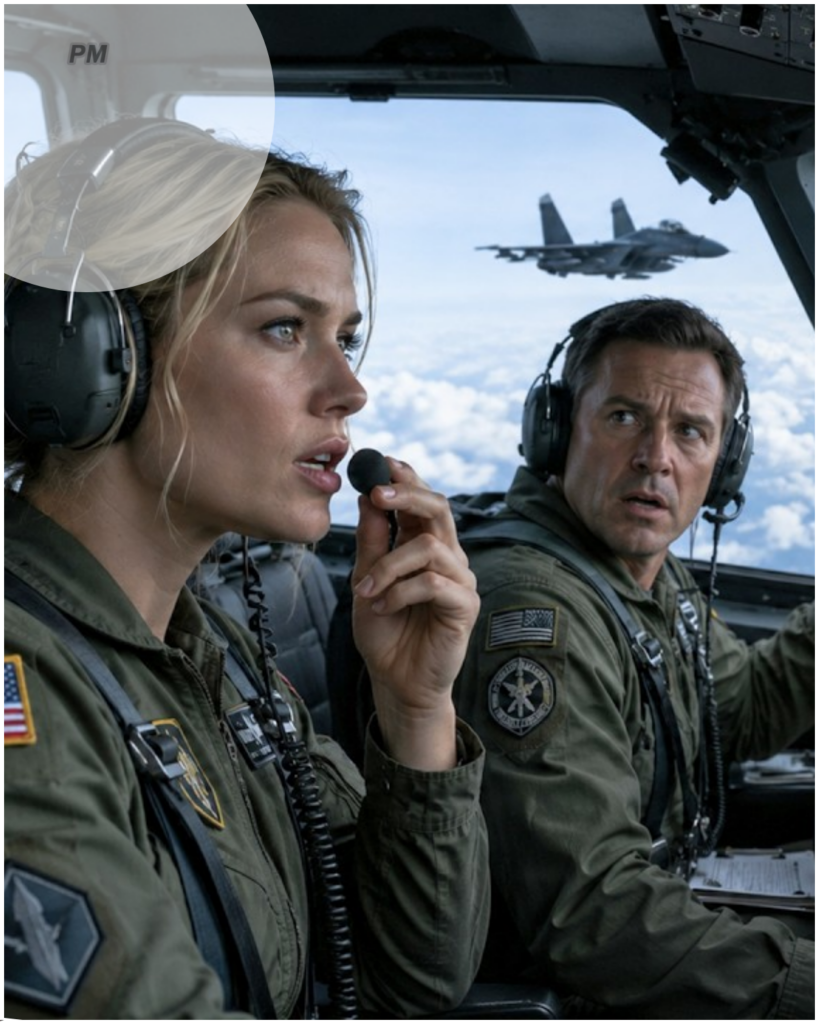
Valerie adjusted her headset, her eyes narrowing as she studied the digital horizon. The static on the radar wasn’t random.
It had a rhythm. It was a localized blinding technique. A way to create a hole in a transport plane’s situational awareness.
She had used the exact same tactic during offensive counterair missions. Major, Valerie said, her voice dropping an octave devoid of any conversational warmth.
I recommend we bank 5° south. Put some distance between us and the territorial limit.
Negative cross, Donovan side. If we deviate south, we burn more fuel. Fighting the jet stream.
We’re holding course. Standard operating procedure. Standard operating procedure applies to standard flights, sir. Valerie pushed back gently but firmly.
This interference is targeted. We are flying completely blind on our left flank. Captain, I am the aircraft commander, Donovan said, his tone sharpening.
Uh, you are here to assist, not to play tactical mastermind. Relax. That is an order.
Valerie’s jaw tightened. She took her hand off the instrument panel and rested it on her lap.
Copy that, Major. Holding course. For 20 excruciating minutes, the C-17 lumbered forward through the dark.
The steady, hypnotic hum of the four massive turbofan engines vibrated through the floorboards. To Donovan, it was a lullaby.
To Valerie, it was a countdown. Then the radar warning receiver, RWR, shrieked to life.
It wasn’t a gentle ping. It was a blaring, earpiercing siren that flooded the headsets of every crew member in the cockpit.
On the ground, twelve hundred miles to the east, the operation had begun three hours before Flight 818 ever entered the corridor, in a briefing room where the air smelled of cigarette smoke and old coffee.
The commander of the 14th Guards Fighter Aviation Regiment was a veteran of dozens of intercept missions, a man with gray at his temples and a reputation for patience, and he had studied the flight the way a hunter studies a trail.
The transport would fly alone, unarmed, through the one stretch of sky where the radar coverage went thin, carrying cargo that his superiors wanted very badly and understood very little.
The plan was simple, and simple plans were the ones that worked: jam the outbound frequencies, blind the left flank with a high-output pod operating just over the horizon, wait until the lumbering transport was deep inside the corridor, and then come up from below the cloud deck, four fighters, one on each side, one behind, so close the crew could see the pilots’ visors.
The commander had done this before, to other airplanes, in other corridors, and it had always ended the same way.
The transport would slow. The transport would turn. The transport would follow his fighters down to the designated airstrip, and by morning the cargo would be in a hangar and the crew would be in a cell, and no one would ever know.
He had chosen his best pilots for the box: a wingman who had flown with him for six years, a young lieutenant with fast hands and a steady nerve, and Ivan 2 on the right flank, a pilot who had never once broken formation in his life.
They had launched in darkness, without transponders, their jets painted in matte black radar absorbent coating, their tail numbers taped over, their radios silent until the moment came.
The climb to thirty-two thousand feet had been uneventful, and the wait had been the hardest part, holding formation in the dark while the transport lumbered toward them at four hundred knots, its navigation lights winking like a slow star.
When the order came, the commander had rolled in from the left, sliding up alongside the transport’s cockpit with the ease of long practice, and he had looked across fifty feet of empty night at the American pilot in the left seat, and he had seen the man’s face go pale.
That was the moment he liked best, the moment when the other pilot understood. He had keyed his microphone and delivered the ultimatum in the voice he used for such occasions, slow and confident, the voice of a man who had never lost.
He had expected panic. He had expected the transport to wallow and shudder as the pilot fought the yoke, and then the slow turn toward zero-four-zero, and the long descent to the airstrip, and the end of another night’s work.
What he had not expected was the silence that followed his ultimatum, or the way the transport held its course, steady as a rock, while the woman in the right seat looked straight at him through the reinforced glass of the canopy, her face utterly calm, her eyes locked on his.
He had fired the warning burst across the nose, the tracers stitching red light across the dark, and he had waited for the flinch, for the climb, for the surrender.
The transport had not flinched. The woman in the right seat had not looked away.
And for the first time in a long career of nights like this one, the commander of the 14th Guards felt something he had not felt since he was a young lieutenant: a cold thread of doubt, running down his spine, telling him that the airplane in front of him was not what it seemed, and that the woman looking back at him knew something he did not.
The threat display illuminated in angry red geometry. “Beep beep beep beep. Missile lock!” Gregory shouted from the engineering panel, his voice cracking with sudden terror.
“We’re being painted. Radar lock on our 6:00.” Donovan slammed his coffee thermos into the cup holder, his complacency vanishing in a millisecond.
Where did they come from? Evasive maneuvers, dropping flares. Donovan hold the heavy yoke to the left, attempting to bank the massive aircraft, but a fully loaded C-17 maneuvers with the grace of a flying school bus.
The aircraft groaned under the sudden G forces, metal stressing as automated countermeasure dispensers spat magnesium flares into the night sky, creating a brilliant, blinding cascade of fireworks behind them.
“It’s not a missile,” Valerie said. Her voice was terrifyingly calm. While Donovan and Gregory were caught in the panic of a sudden ambush, Valerie had instantly shifted into a state of hyperfocused combat flow.
Her eyes darted across the threat display, analyzing the bandwidth of the radar, painting them.
It’s an acquisition lock. They’re pacing us, trying to force our hand. Suddenly, shadows detached from the darkness outside the cockpit windows.
Sleek Delta-winged silhouettes sliced through the clouds, moving with terrifying, effortless agility. They were painted in a matte black radar absorbent coating, devoid of any national insignia or tail numbers.
Bogey’s visual, Valerie called out, her head on a swivel. Two on the left, one on the right, one in the slot directly behind us.
Su-35 flankers, heavy loadout. They’ve got air-to-air missiles on the pylons. Donovan stared out his window, his face going pale as a multi-million dollar war machine coasted just 50 ft off his left wing tip.
The hostile pilot was so close, Donovan could see the green glow of the man’s helmet visor.
Flight 818 was well and truly trapped. The emergency guard frequency 121.5 megahertz crackled in their headsets, cutting through the panicked breathing of the crew.
Unidentified heavy transport, a voice hissed. The accent was thick, distinctly eastern, and dripping with malicious confidence.
You are violating restricted sovereign airspace. You are to immediately drop your air speed to 200 knots.
Alter your heading to 040 and prepare to land at a designated air strip. Comply or you will be shot down.
Donovan grabbed his microphone, his hand trembling slightly. Unknown fighters, this is United States Air Force Flight 818.
We are flying in international airspace. We are an unarmed logistics flight. Check your navigational charts.
We have the right of transit. There was a 3-second pause. Then the Su-35 on their left wing dipped its nose and squeezed the trigger of its 30 mm autocannon.
A terrifying stream of glowing red tracer rounds ripped through the dark, crossing mere inches in front of the C-17’s nose.
The supersonic crack of the rounds firing was audible even through the transport’s thick hull.
Donovan flinched hard, instinctively pulling back on the yoke and sending the transport into a steep, agonizing climb.