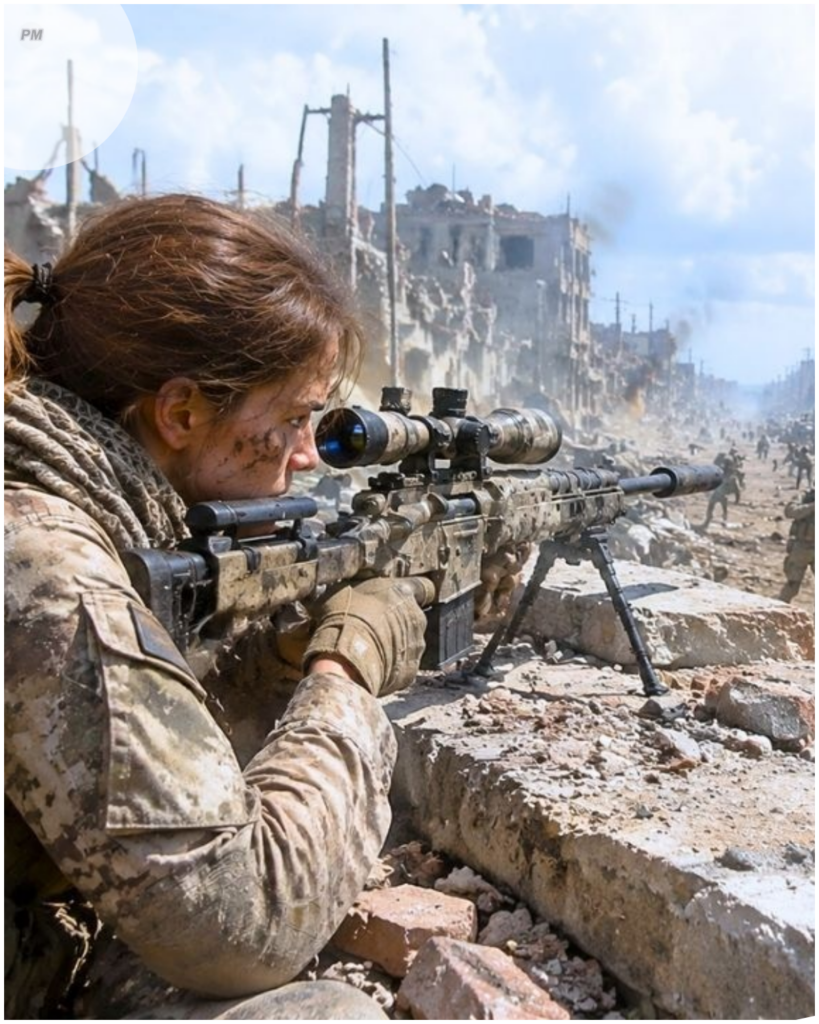
Megan had watched the team enter the trap
Megan had watched the team enter the trap. She had watched the canyon swallow them.
She had listened to the gunfire erupt and seen the team scramble for cover and seen one of them go down hard with a leg wound that even at 300 yd looked serious.
She had watched the enemy tighten the circle with professional patience. She had watched the enemy commander step into the clearing and deliver his speech with the calm confidence of a man who had never lost.
She had her rifle in her hands the entire time. She had not fired because her orders were clear.
Because Diane’s voice was in her head, very quiet and very firm under any circumstances.
Because four years of intelligence work and the safety of people she had never met depended on this operation remaining invisible, she had held right up until the moment the commander gave the order to shoot Foster in the legs and let him scream.
And something inside Megan Carter, something that had nothing to do with training or protocol or the careful architecture of a classified intelligence program, made its own decision.
She fired. The shot covered 320 yards in less time than it takes to blink.
The executioner, who had raised his weapon toward Foster, dropped clean, immediate. The commander spun toward the sound, but there was no muzzle flash to find no visible position.
Nothing to locate the shooter by. Megan was already moving her scope. Second shot. Machine gun operator on the eastern ridge.
Gone. Third shot. The fighter advancing fast on the left flank. The one who had been about to close off the team’s last viable movement option.
Gone. The enemy broke. Not in panic. These were professionals, but they broke. The pressure on the canyon floor dropped.
The team below began to move. Megan tracked their movement as she worked, keeping her scope on the threats rather than the friendlies trusting the team below to be competent and use the opening she had created.
She could see the big one, the broad shouldered operator she would later learn was Reed carrying the wounded man.
She could see the team leader directing movement with sharp, efficient gestures. They were good.
They were going to make it if she kept the pressure off them. She kept the pressure off them.
Shot after shot, each one placed with the deliberate care of someone who understood exactly how limited her ammunition was and exactly how much each round needed to accomplish.
She was not trying to win a gunfight. She was trying to shift the mathematics of the situation to take a battle where 60 men were winning and make them feel like they were losing or at least like they could not afford to stop paying attention to the ridge.
It worked for 11 minutes. It worked. Then the enemy commander, not the one she had shot in the first exchange, but his second in command, a lean and precise man who moved with the controlled economy of someone who had been in this kind of situation before, reorganized his force and made the decision that Megan had known was coming from the moment she fired her first shot.
He pointed at the ridge. He spoke to a group of his men 2025. She counted them as they assembled and he pointed at the ridge and he spoke for about 30 seconds and then the group began moving uphill.
Not toward the canyon, not toward the team she had been protecting. Toward her. Okay, Megan said quietly.
Not to anyone, to herself. The way she always talked to herself in tight situations, a habit she had developed in training and never broken.
Because it turned out that hearing a calm voice, even your own, did something useful to the part of your brain that wanted to make catastrophically bad decisions when the pressure hit.
Okay, so that’s happening. She did a rapid inventory, 31 rounds remaining in her primary supply, sidearm with two full magazines, a combat knife, field medical kit, no radio that could cut through the jamming, no backup, no extraction.
The team below had reached the northern slope. She could see them climbing. Good. That was good.
That was the right move. Higher ground. Better chance of getting above the jamming range.
Better chance of reestablishing communications. The problem was that the 25 men moving toward her were going to reach her position in approximately 6 minutes.
And between now and then, if she stopped shooting the enemy, soldiers in the valley were going to redirect their attention toward the climbing team.
So, she could not stop shooting, which meant she could not run. Think, she told herself.
Think she was not afraid. Or rather, she was afraid in the technical sense that her heart was running fast and there was a sharpness behind her eyes that she recognized as the physical signature of extreme stress.
But the fear was not in charge. She had worked very hard for a very long time to make sure the fear was never in charge.
Uh repositioned, moved 40 yards north along the ridge to a secondary position she had identified on day one of the operation, a natural formation of rock and route that offered cover from the eastern approach in a clear line of sight down the valley.
She settled into it, got her breathing back under control, picked up her scope, and went back to work.
The men climbing toward her were good. She could see that immediately. They moved in a dispersed pattern that minimized the damage any single shot could do to the group.
They used available cover consistently. They communicated with hand signals rather than voice. They were not contractors or hired security.
Former military, she said, Eastern European based on the movement doctrine. Probably Spettznaz or something derivative.
She shot the point man. He was the one determining the pace and direction of the group’s advance.
Without him, they stopped, regrouped, and lost 40 seconds to reorganization. 40 seconds was a lot.
She used them. Down in the valley, the remaining enemy soldiers were adjusting to the situation.
Two of them trying to establish a new firing position that could reach the northern slope where the team was climbing.
Megan shifted her scope, placed two shots in rapid succession, and the firing position was abandoned before it could be used.
The climbing team did not look back. Good. They were trusting her or trusting whoever was doing this.
They did not know her name. They did not know her face. They just knew that something was watching over them.
And they were using that fact with exactly the kind of discipline confidence she would have hoped for.
Walker, she would think later. That was Walker’s doing. Whatever he had said to his team when the shooting started, whatever decision he had made about how to respond to an unknown actor intervening on their behalf, it had been the right decision.
He had trusted and moved. That was the correct call. She took another shot. 19 rounds left.
The group climbing toward her had reorganized. They were moving again faster now, splitting into two elements.
One that she could see and one that had moved into dead ground to her left and was probably flanking.
Smart, she acknowledged. No bitterness, just recognition. They were doing what she would have done.
She shifted position again. 15 yd to the right, lower on the slope, sacrificing elevation for a better angle on the flanking element.
She found them four men moving fast through a gully that they thought was concealed, and she fired once to disrupt them and once more when the first shot caused them to bunch together instinctively, [snorts] which was the wrong response, but a human one.
The main element above used her shift to close the distance. They were 200 yd below her now.
Close enough that as she could see faces when they moved from cover to cover.
Close enough that the situation had changed from sniper operation to something considerably more personal.
Okay, she said again. New problem. She ran the numbers. 13 rounds, 20something men split into at least three elements.
A flanking force she had disrupted but not stopped. A direct assault element that was going to reach her position in approximately three minutes regardless of what she did and the valley below still needing attention if the climbing team was going to make it to the ridge without getting shot.
There was no version of the mathematics that came out cleanly. She had known that when she fired the first shot.
She had known at some level that choosing to enter this fight meant choosing to accept whatever the fight brought back to her.
You did not get to make that kind of choice and then escape its consequences.
That was not how it worked. She was not angry about it. She was not afraid in the way that produced paralysis.
She was simply very focused and very clear and working the problem with everything she had.
She fired three more times into the valley. All three shots disrupting enemy elements that were positioning to fire on the slope and then shifted her entire attention to the men coming up the hill.
The next four minutes were the most intense of her professional life. She moved constantly, never staying in any position for more than two shots, using the terrain the way she had taught herself to use it over years of training in landscapes exactly like this one.
She made herself harder to find than she should have been. She made every round count in a way that forced the advancing group to slow, to hesitate, to keep choosing cover over forward movement.
She bought time, seconds at a time. She bought time and she spent every second she bought on the problem of keeping the team below alive.
But she was alone and there were a lot of them. The flanking element reached her left side at the same moment.
The direct assault element crested the last rise below her position. She had three rounds left and no clean exit.
A rock ledge to her right was a dead end. The trees above her were too open.
The gully to her left was where the flanking element had come from. She had been in bad spots before.
She had never been in a spot quite this bad. “Carter,” she said to herself very quietly.
“You’ve had worse.” She paused. “No, you haven’t.” She almost smiled. “Figure it out anyway.”
She fired her last three rounds, two at the nearest members of the flanking element, one at the lead man of the direct assault, and then she was out of rifle ammunition, and the men were close enough that she could hear their breathing and the sound of their boots on the ground and the rustle of their equipment as they moved.
She dropped the rifle and drew her sidearm. This was the part where being a scout sniper stopped being an advantage.
At close range in confined terrain with multiple opponents converging, the calculus shifted entirely. She was fighting on the wrong terms now.
She knew it. She worked with it anyway. She shot the first man who came around the rock.
She put the second man on the ground with a technique that had nothing to do with firearms and everything to do with the close quarters training she had done until it became reflex.
She kept moving. She kept making them pay for every yard they closed. She kept refusing to become a target that stayed still long enough to hit cleanly, but there were too many of them.
A blow she did not see coming caught her on the left side and took her off her feet.
She hit the ground and was up again before they expected it, but the momentum had shifted.
She was injured now. Not badly, not yet, but enough that the edge she had been maintaining through superior positioning and constant movement was starting to erode.
Two of them came at her simultaneously from opposite sides, and she dealt with one and took a hit from the other that put her back against the rock ledge with no room left to maneuver.
The man who had hit her stepped back and looked at her. He was breathing hard.
So was she. The eyes were doing what eyes always did in that moment. Reassessing, recalculating, adjusting to the fact that the situation was not matching the expectation.
He had expected based on everything his training and experience told him to find a different kind of person up here.
An older man, a larger man, a man. What he found was Megan Carter bleeding from a cut above her eyesight arm, raised back against the rock and completely unbroken.
You’ve been making our morning very difficult, he said. His English was excellent. Military trained, she noted automatically.
