The enemy radio
The enemy radio. One of the enemy fighters, a large man with close cropped hair, who moved with the authority of someone in command, stepped into a partial clearing and brought a long range radio to his mouth.
He spoke in English, clearly, deliberately, as though he wanted to be heard. You are surrounded.
Nobody is coming for you. Your communications are dead. Your backup team has been redirected by false orders.
There is no rescue. He paused. You are four men. You are wounded. You are running out of ammunition.
I respect what you are. I have worked with men like you. This is not about pride.
This is about mathematics. Another pause. Put down your weapons. Stand up with your hands visible.
I give you my word that you will be treated as prisoners, not as corpses.
You have 60 seconds to decide. Silence. The four seals looked at each other across the fallen timber.
Foster spoke first, his voice calm despite everything. I’m not surrendering. Nobody’s surrendering, Walker said.
I just wanted to be clear, Foster said. In case anyone was considering it, I’m not.
Reed Walker looked at his second. I’ve got 12 rounds in this magazine and two in reserve, Reed said.
Tell me where you want them. Collins. Collins had not taken his eye from his scope since the commander’s speech ended.
Walker, look at the ridge. Walker lifted his own scope. The enemy commander was still standing in the clearing, waiting for an answer.
His men had formed up around him, disciplined and ready, waiting for the order to finish what they had started.
And then the enemy commander’s head snapped back. The sound reached them fraction of a second later.
A single suppressed rifle shot its crack, muffled, but distinct, coming from somewhere high and far.
The enemy commander dropped to the ground. For one full second, nobody moved. Not the enemy soldiers, not Walker’s team.
The entire forest froze in a collective moment of stunned disbelief. Then a second shot.
The man with the machine gun on the eastern ridge, a position that had been making Reed’s life extremely difficult for the past 15 minutes convulsed and went still.
Third shot. A fighter who had been advancing low and fast through the underbrush on the left flank dropped without a sound.
The enemy broke. Not in the panicked, disorganized way of undisiplined men. They broke in the controlled professional way of soldiers who recognized a tactical problem and responded to it.
Pulling back, seeking cover, changing their orientation to face a threat they could not yet locate.
But they broke nonetheless. The pressure on Walker’s position dropped from crushing to manageable in the span of perhaps 40 seconds.
“Someone shooting at them,” Colin said. The observation delivered with a slight note of wonder that he could not quite suppress.
From the high ground northeast. How far? 300 yd minimum. Maybe more. Collins paused. That’s an exceptional shot.
Multiple shots. Reed corrected. Every one of them placed. Walker stared at the ridge. The shooter had not revealed themselves.
No muzzle flash visible. No movement in the trees. Whoever was up there had chosen their position with the kind of care that came from experience and was maintaining that position with the kind of discipline that came from training.
Who is it? Reed asked. Does it matter right now? Walker replied. I suppose not.
Then let’s use this Collins with me. Reed, you’ve got Foster. We move in 30 seconds.
Move where? Walker pointed toward the northern slope. The route Reed had suggested earlier. The route Walker had dismissed as too predictable.
“You said the ridge was steep, but not impossible,” Walker said. “Yeah, I said that.”
“Then let’s go find out.” They went over the top of the fallen timber at a dead run.
Walker and Collins went first firing as they moved, covering angles and suppressing enemy positions that had been weakened by whoever was shooting from above.
Reed came behind them with Foster leaning heavily against his shoulder, moving with a grimacing, grinding determination that said everything about the kind of man Foster was.
The enemy turned back toward them. Guns swiveled. Voices shouted orders in that mix of languages.
And then another shot came from the ridge and another and another. Every time an enemy soldier tried to establish a stable firing position on Walker’s team, the shot came.
Not always lethal, sometimes just enough to disrupt to make a man flinch to interrupt the moment of aim, but always precise, always deliberate.
They’re protecting us, Colin said between breaths as they climbed. Whoever is up there, they’re covering our movement.
Keep climbing, Walker said. Behind them, the enemy made a decision. A group broke away from the main force.
Walker counted eight, then 12, then more, and began moving toward the ridge, not toward Walker’s team, toward the shooter.
Walker saw it and felt something cold move through him. He did not know who was up there.
He did not know their name or their unit or how they had come to be in this forest on this particular morning.
But he knew what was about to happen if 20 armed men reached their position.
Collins of Walker said, “I see it. We keep moving, Walker. We keep moving, Walker repeated.
Right now, that shooter is the only reason we’re still alive. The best thing we can do for them is get to higher ground, reestablish it communications, and get help in here.
That’s the mission. Collins did not argue, but his eyes stayed on the ridge for a moment longer than they needed to.
They kept climbing and somewhere above them, hidden among the pines and the silence in the deep patient shadow of the redwood forest, the shooter adjusted their position, checked the wind, and kept working one shot at a time, one life at a time, making a decision that no one had asked them to make in a situation no one could have predicted for people they had never met, because that was who they were.
And the forest for a moment went very quiet between shots. A silence full of hell breath and the knowledge that something extraordinary was happening in this valley.
Something that would be spoken about in low voices for a long time after this day was finished.
Walker reached the slope and did not look back. He trusted. He climbed. And he prayed in the way soldiers pray not with words but with the simple desperate need for there to be something watching over the people who watch over others.
Foster stumbled. Reed caught him. Collins fired twice to the south to discourage pursuit, and the shooter on the ridge fired once more, and the forest swallowed the sound, and the circle of protection held.
For now, the shot that killed the commander’s executioner came from a direction nobody in that valley had been watching.
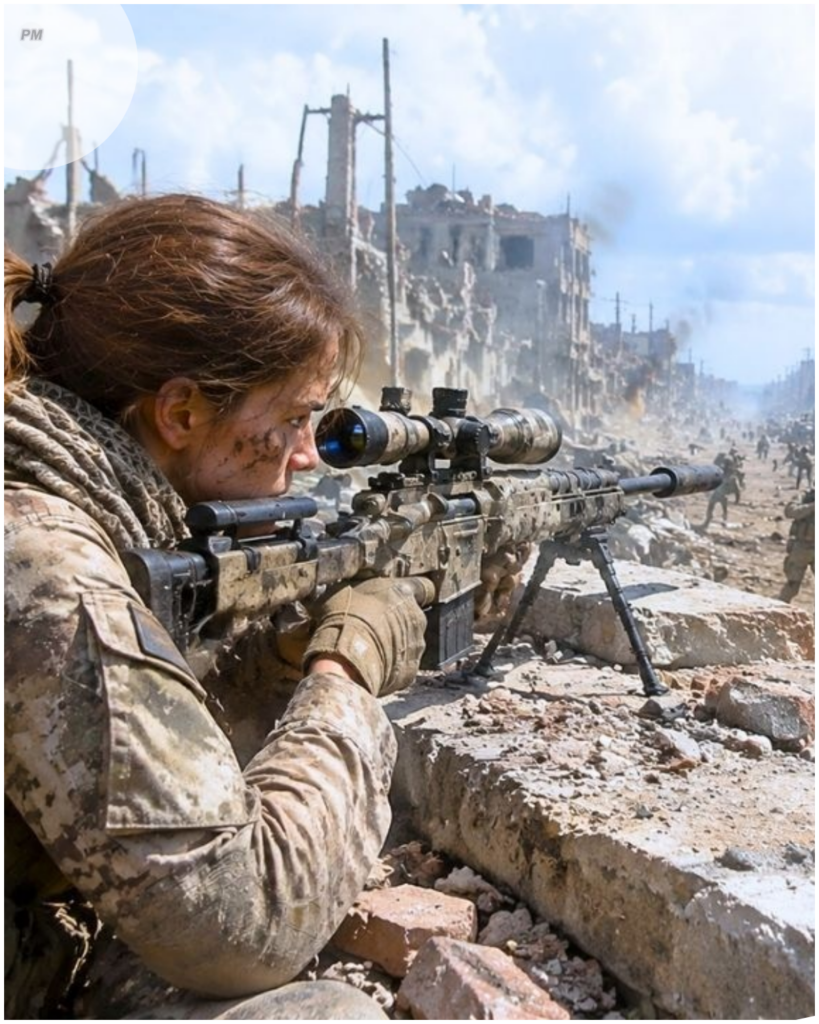
That was the point. 320 yd to the northeast, above the canyon floor, above the tree line where the pines grew thick enough to swallow a person whole, Megan Carter pressed her cheek against the stock of her rifle and did not breathe.
Not for the 3 seconds after the shot. Not while she tracked the next target.
Not while her mind ran the calculation she had run a 100 times in training and a handful of times in actual field conditions.
Windsp speeded elevation, drop, target, movement, distance correction with the cold mechanical efficiency of someone whose body had learned to separate the act of shooting from the emotional weight of what shooting meant.
She breathed again only when she had confirmed the second target and was already moving her scope to the third.
Megan Carter was 31 years old. She had grown up in Bosezeman, Montana, the daughter of a wildlife biologist and a high school football coach, which meant she had spent her childhood outdoors in her teenage years, learning that most problems could be solved with patience, preparation, and the willingness to do the uncomfortable thing when the comfortable thing wasn’t working.
[clears throat] She had joined the Marine Corps at 19, not because anyone pushed her toward it, but because she had looked at her options and decided that the most honest version of herself was the version that did something real in the world.
The core had taught her to shoot. Her instructors had given her the foundation. But the instinct, the ability to read a battlefield, the way other people read a room to know where the danger was coming from before it announced itself, that had always been there.
You could not teach that. You either had it or you spent your career pretending you did.
Megan had it. She had earned her scout sniper qualification in a class that questioned her presence every single day for 11 weeks.
Not loudly, not always directly, but in the small, persistent ways that people communicate doubt when they have decided someone does not belong.
The slightly longer pauses before her input was acknowledged, the jokes that stopped when she entered the room, the evaluations that seemed to hold her to a standard that shifted whenever she met it.
She had responded to all of it the same way. She shot better. She performed better.
She outlasted every person who expected her to quit. By the time the qualification was finished, there was nothing left to argue about.
The numbers did not leave room for argument. She had been selected for the classified reconnaissance program 8 months ago.
The program did not have a public name. It operated in the space between agencies collecting intelligence on threats that were too sensitive for conventional units and too complex for standard law enforcement.
Her handler, a compact gay-haired woman named Diane, who spoke in short sentences and never used more words than a situation required, had briefed her on the criminal network 3 weeks earlier.
“These people move weapons,” Diane had said, “not for ideology, for money, which makes them more dangerous in some ways because money does not care about principles, and it does not get tired.”
“She had slit a folder across the table. We need eyes inside that operation. We need to know who the buyers are, what they’re purchasing, and when the next exchange is scheduled.
We do not need a firefight. We need information. Understood. Megan had said, “You go in alone.
You come out alone. You do not engage under any circumstances.” Understood. Diane had looked at her for a moment with eyes that had seen a great deal and had stopped being surprised by most of it.
I mean that, Carter. This network has reach. They have people in places that would make you uncomfortable if I told you where.
If this operation goes loud, it does not just compromise you. It compromises everything we’ve been building for 4 years.
I understand the stakes. Megan had said, “I won’t engage.” She had meant it when she said it.
She had believed it completely when she inserted into the forest 6 days ago, and began her careful patient work, moving by night, lying still for hours at a time by day, eating cold rations, and recording everything she observed through her scope with the disciplined thoroughesses of someone who understood that the details that seem small were usually the ones that mattered most.
She had documented the layout of the weapons exchange site. [snorts] She had counted personnel photographed faces through her long lens, recorded license plates on the vehicles that moved in and out of the abandoned logging infrastructure.
She had identified three men she recognized from intelligence files and two she did not.
She had recorded everything. She had engaged nothing. She had been exactly as Diane required, invisible.
And then on the morning of the sixth day, four men in American military equipment had entered the forest on the eastern approach.
Megan had seen them through her scope before they were 100 yards into the treeine.
She had recognized their equipment, their movement pattern, their tactical formation. She had also in the same moment recognized what was waiting for them.
No, she had said out loud to nobody. To the empty forest around her, to whatever part of her mind was still hoping she was misreading the situation.
She was not misreading it. The criminal network had known the team was coming. The ambush was already in position.
60 plus fighters spread across the valley floor and the lower slopes. Each one placed with the kind of care that spoke to a military mind rather than a criminal one.
They [clears throat] had done this before. They had done this to American operators before and they were very good at it.
