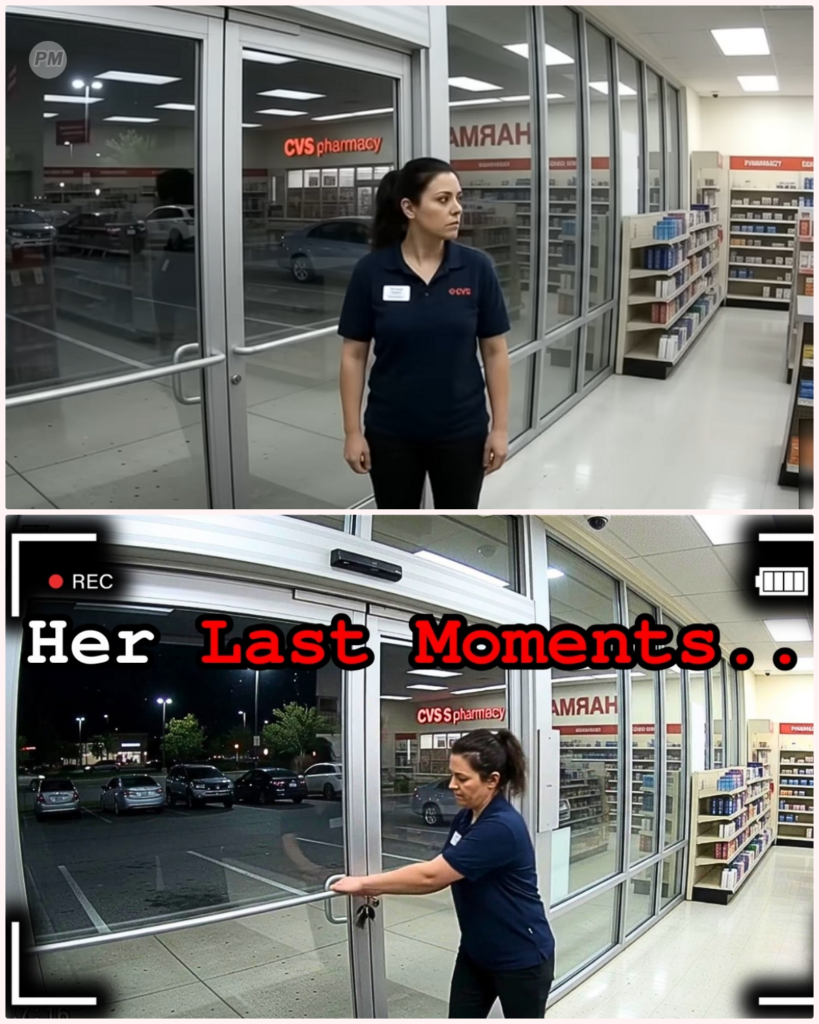
Nobody had a bad feeling about him
Nobody had a bad feeling about him. Nobody flagged anything to management. This is not because anyone was careless.
It’s because the entire design of what he was doing depended on being forgettable. A man who buys gum three times a week is not a red flag.
A man who watches the same employees closing routine for 3 weeks while never once making eye contact for longer than a transaction requires does not register as a threat to anyone because threat isn’t usually loud.
It’s usually patient and quiet and wearing a completely unremarkable jacket. There’s a term investigators use for this kind of behavior pattern, though it wouldn’t be applied to Marcus Webb’s case until much later after the full timeline was reconstructed.
Target selection through routine exploitation. It means exactly what it sounds like. Not a crime of opportunity, a crime of study.
Back to 10:12 p.m. Sarah walks toward the back office. This is confirmed by internal footage, the kind not usually released publicly, but referenced in later reporting on the case.
She has no reason to suspect anything. The alarm system hasn’t triggered because the service door, once re-locked from the inside by someone standing in the dark, doesn’t register as a breach.
No forced entry, no broken glass, nothing for the system to flag. At 10:14 p.m., the internal camera nearest the pharmacy’s back hallway captures the last clear image investigators would later be able to identify as Sarah Martinez alive walking toward the office.
It’s an unremarkable few seconds of footage. She’s not looking over her shoulder. She has no reason to.
What happened in the minutes after that has been reconstructed through forensic evidence, not footage, because there was no camera covering the back office or the stockroom beyond it.
This is deliberate on our part. We are not going to narrate an assault that wasn’t captured on any surveillance system.
What we can tell you, because it’s part of the public record established during the investigation, is that Sarah Martinez did not leave the store that night.
Her car remained in the parking lot until the following afternoon when a co-worker arriving for the opening shift noticed it and called the store manager confused because Sarah never left her car overnight, not once in 6 years.
The store was found unlocked from the inside. The alarm, still armed, still showing no recorded breach, sat blinking uselessly on a wall a few feet from where investigators would spend the next several hours processing a scene that told a very different story than the one the front door camera had shown the night before.
Here’s the twist this story has been building toward and it isn’t a twist about identity.
You already know who Marcus Webb is. It’s a twist about time, about when the actual danger occurred versus when everyone, including Sarah, believed it did.
Every instinct in us wants danger to announce itself in the moment it happens. We want the locked door to mean the story is safe.
We want I checked twice to be enough because if thoroughness isn’t enough, what is?
But the incident didn’t happen at 10:11 p.m. When Sarah tested that front deadbolt and the story looked for a moment like nothing was wrong.
It happened 3 weeks earlier in a 19-second gap that no one at the time would have had any reason to flag.
The front door was never actually the vulnerability. It was the misdirection. The thing everyone’s eyes were trained on while the real threat had already found its way in through a door nobody was watching at all.
That’s the part investigators kept returning to during the case review. Not the lock, the key.
Where it came from, how ordinary, how forgettable the moment of its theft had been.
The investigation didn’t move in a straight line and it’s worth being honest about that because the early hours of a case like this rarely do.
When the store was first discovered unlocked from the inside with no sign of forced entry anywhere on the building’s exterior, the initial working theory among responding officers leaned toward an inside job.
Someone with legitimate key access, a disgruntled former employee, maybe even a current one. It’s a reasonable theory.
It’s also, in this case, completely wrong and detectives spent the better part of a day running down employee alibis and personnel records before that theory quietly ran out of road.
Every current employee had a verifiable location that night. The alarm logs showed no unusual access patterns tied to any staff credential.
That dead end turned out to be useful in a grim way. It forced investigators to stop assuming the door had to have been opened by someone who was supposed to have a key and start asking a harder question.
What if someone who was never supposed to have one got one anyway? Marcus Webb was identified within 72 hours once that question reframed the investigation.
Store surveillance from the weeks prior, the same footage that had seemed unremarkable in real time, became the backbone of the case once detectives started pulling every clip from the preceding month, looking not for a break-in, but for a pattern.
They found him in 11 separate visits over 18 days. They found the exact frame where he photographed Sarah’s keys.
They matched the timestamp on that image to a hardware store’s kiosk transaction log two towns over.