October 14th, a Saturday, though the date on the s…
October 14th, a Saturday, though the date on the surveillance timestamp is really the only thing that matters here, because nothing about the day itself was unusual.
No holiday, no special event, no reason for anyone’s guard to be up or down more than any other closing shift.
Sarah’s last customer left at 9:52 p.m. The store’s exterior camera, mounted above the entrance, shows the parking lot mostly empty by then.
A scattering of cars belonging to employees at the sandwich shop next door, already closed, waiting for their own shifts to end.
At 9:58, Sarah begins her closing routine. This part of the footage has been slowed down, studied, replayed by people whose job it is to understand exactly what a text and a keychain and a 19-second gap can add up to.
She checks the register. She walks the main aisles, the way she always does, scanning for anything out of place.
She heads toward the pharmacy counter to secure the medication storage, standard end-of-night protocol at any pharmacy handling controlled substances.
Here’s where we need to pause and go back. Because while Sarah is finishing her walk-through inside a brightly lit, seemingly secure building, something else is happening about 40 ft away, in a part of the parking lot the front camera barely catches the edge of.
A vehicle has been parked there since 9:40. Not close enough to the entrance to draw attention.
Not so far that it loses sight of the door. It’s the kind of positioning you’d only notice if you were specifically looking for it.
Which, on an ordinary Saturday night, no one was. Marcus Webb has been sitting in that car for 18 minutes.
18 minutes is a strange amount of time to hold in your head. It’s long enough that if you were watching that parking lot live on a bank of monitors in some back office nobody was staffing that night, you might start to wonder about the car.
It’s short enough that nothing about it would ever be flagged after the fact in the ordinary run of a Saturday night by a system built to notice broken glass and triggered alarms, not stillness.
18 minutes of a man doing absolutely nothing is, to a security system, indistinguishable from 18 minutes of nothing happening at all.
We won’t dramatize what was in his head during those 18 minutes. We don’t know, and this isn’t a story that benefits from inventing what can’t be confirmed.
What we do know, from the timeline investigators later assembled through phone records and surveillance, is what he did next.
At 10:09, as Sarah approaches the front doors to begin locking up, Marcus exits his vehicle.
He does not walk toward the front entrance. He walks around the side of the building toward a service door that pharmacy staff use for deliveries.
A door with a working lock, but no exterior camera coverage at all. A blind spot that had likely existed since the building’s original construction and simply never got addressed.
This is the moment the story asks something uncomfortable of you. Because right now, in this exact 60 seconds, two completely different scenes are happening in the same building, and only one of the two people involved knows there are two scenes at all.
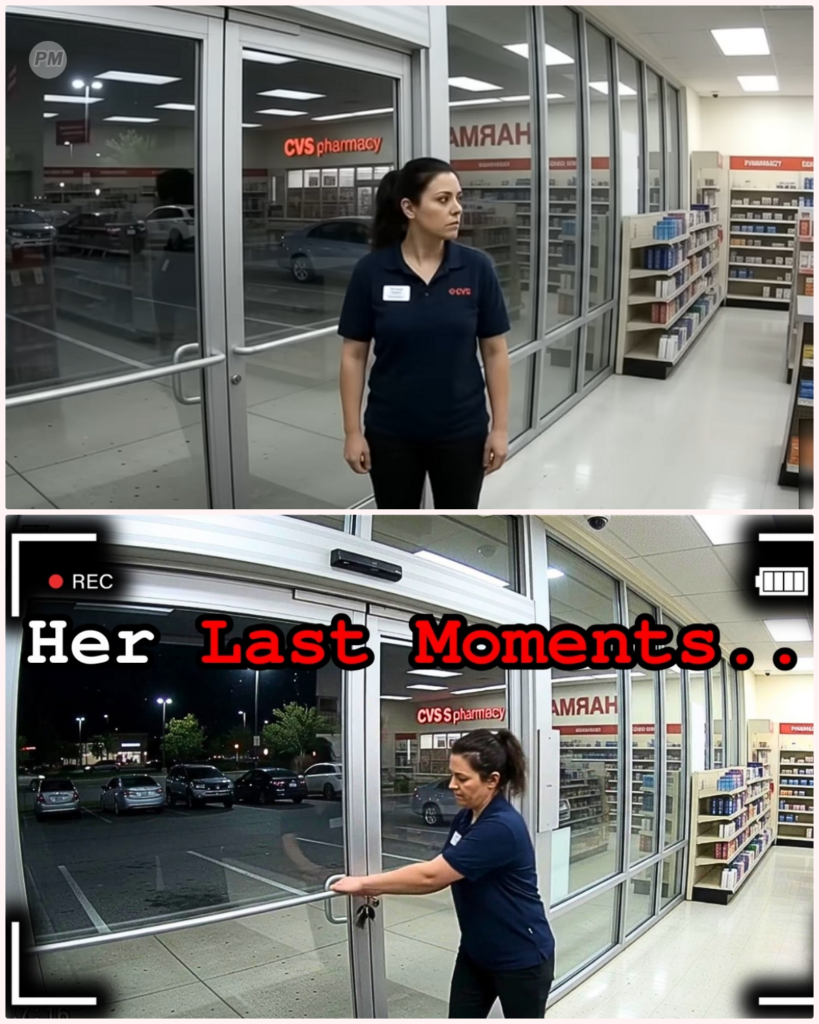
Inside, at the front of the store, Sarah, alone, checking the deadbolt on the main entrance, testing the handle, confirming it’s locked the way she’s confirmed it hundreds of times before.
This is the footage most people who followed this case have seen. Grainy, overhead, timestamped 10:11 p.m.
A woman doing her job correctly, thoroughly, exactly as trained. At the back of the building, at the same time, a man with a copied key, sliding it into a lock that has no reason to resist him, because it doesn’t know the key is wrong.
Locks don’t check intentions. They check shapes, and the shape was right. The front door footage, the footage that would later circulate, the clip most people associate with this case, ends around 10:12, when Sarah walks away from the entrance, satisfied, and heads toward the back office to grab her bag before setting the alarm and leaving through the employee exit, as she’d done a thousand times before.
What that clip doesn’t show, because no camera was positioned to show it, is what was waiting in the back of the store by the time she got there.
There’s a detail in this specific window of footage that deserves its own moment, because it’s the kind of thing that only becomes visible once you already know how the story ends.
At 10:11, in the exact same minute Sarah is confirming the front deadbolt is secure, believing the building is now sealed, the service door camera blind spot, the one Marcus is currently standing inside of, sits about 90 ft away from her, separated by a single interior wall and a stockroom full of shelving.
90 ft. If either of them had made a sound loud enough in an empty building at night, there’s a chance it might have carried that far.
Neither of them did. She was doing her job. He was being careful. This is the moment true crime storytelling usually wants to slow down and linger on for dramatic effect, and we’re going to resist that instinct because dwelling on proximity for its own sake doesn’t serve the story.
It just borrows tension from someone else’s tragedy. What matters here isn’t the 90 ft, it’s the wall.
The wall that made two people in the same building at the same moment completely invisible to each other right up until they weren’t.
Let’s go back further than that 30-second gap for a moment. Not to change what happens.
Nothing changes what happens. But to understand the full shape of the pattern because Marcus Webb’s plan didn’t begin and end at the hardware store kiosk.
Co-workers interviewed afterward described him, when asked directly, as that guy who comes in around closing sometimes.