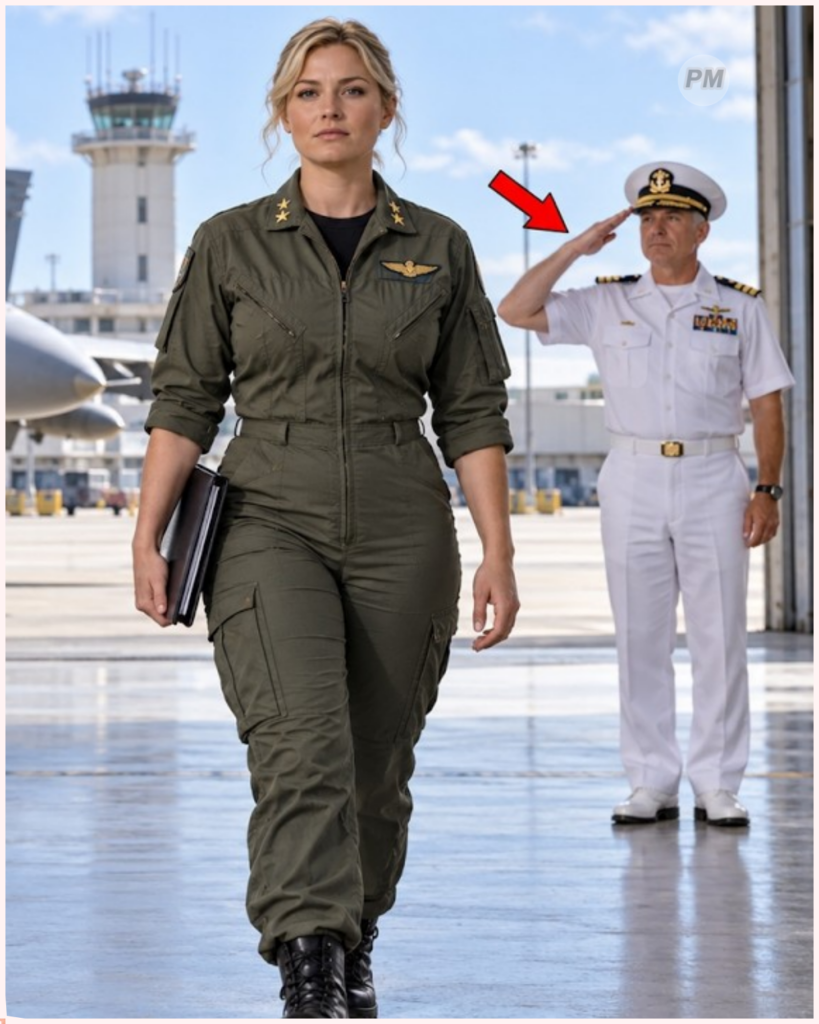
Then she looked at the chief
Then she looked at the chief. Chief, you saved a life. No, ma’am, you did.
I only read a letter, she said. You wrote it. Tom Alvarez looked away and his eyes were red.
I almost did not send it. I thought nobody would care. Someone cared. Elena said, “Next time, you do not have to mail it.
You can walk into any office on this base and say it out loud. That is the rule from now on.”
In the weeks that followed, Harlow Point began to change. It did not happen all at once because real change never does.
It started in small ways. Above the maintenance table in Hangar 3, a new sign went up.
Painted by the mechanics themselves in plain white letters. If you see something, say something.
No one will be punished for telling the truth. Elena signed herself. She made a new rule for the entire base.
Any mechanic of any rank could ground an aircraft by writing a single line in the log book.
No pilot and no commander could overrule it without a full inspection first. People started calling it the Alvarez rule.
Tom hated the name at first and secretly loved it. She began holding open meetings every Friday afternoon.
And in these meetings, a mechanic spoke first, then the junior pilots. Then everyone else.
At the first meeting, nobody said much. At the second, a young mechanic raised his hand and asked about a faulty fuel gauge.
At the third, five people had questions. Then 10. Within a month, the quiet corners of the base were not so quiet anymore.
Sarah Kim was promoted to flight leader. The first real test of the new rule came on a gray Tuesday three weeks later, and it came from the youngest mechanic on the line, a nineteen-year-old airman named Doyle who found a fuel gauge reading that drifted whenever the jet sat in the sun.
Under the old arithmetic he would have mentioned it to a senior man and let it travel upward until it disappeared.
Instead he walked to the log book, wrote one line, and signed his name, and the jet stayed on the ground.
For an hour the schedule bent around the empty slot and a flight lead grumbled within Elena’s hearing about paperwork grounding airplanes.
She let him grumble. By evening the gauge had been pulled and found genuinely faulty, and the same flight lead was standing in the maintenance bay asking the airman, a little stiffly, how he had caught it.
Elena, passing with her coffee, said nothing at all. Some lessons a base has to teach itself, out loud, in its own voice.
She was nervous at first. She had spent most of her career being told to wait her turn.
“Ma’am, I do not know if I am ready,” she told Elena. You are the person who wrote down the truth when it was hard.
Elena said that is exactly what a leader does. Sarah stood a little taller after that.
Cole Matthews spent his two weeks in the maintenance bay. The first days were rough.
The mechanics did not trust him and they gave him the dirtiest jobs, the coldest tasks, the long hours on the bellies of the aircraft.
He scrubbed fuel tanks. He carried tools. The first two days they gave him the fuel tanks, which are cleaned on your back, in the dark, with solvent that finds every cut on your hands.
The third day he held a flashlight for four hours while a petty officer worked a panel he was not qualified to touch, and his arm shook for an hour afterward.
Nobody mocked him. That was the part he had not expected and the part that worked on him hardest.
Mockery he could have answered. Instead the bay simply included him in its real economy: coffee appeared beside him without comment, a senior mechanic named Okafor corrected his grip on a torque wrench once, wordlessly, and moved on, and Alvarez checked his work the way he checked everyone’s, thoroughly and without theater.
Cole began, somewhere in the fourth day, to understand that the bay ran on a standard the ready room never mentioned.
Upstairs, a mistake could be laughed off by Friday. Down here, a mistake had a tail number, and it waited, patient as gravity, for altitude.
He held flashlights for hours. He never complained. On the sixth day, Chief Alvarez handed him a wrench and said, “Come here, Lieutenant.
I want to show you something.” He led Cole beneath a Super Hornet, pointed at a small valve, and explained how it worked.
Then he explained what happens when it fails. Then he explained quietly what that failure looks like from inside a cockpit at 400 knots.
Cole listened. For the first time in his career, he really listened. I never thought about it this way, he said when the chief finished.
I always thought maintenance was the people who get the jet ready for me. I never thought of them as the people who keep me alive.
We are both Alvarez said simply when the two weeks ended. Cole walked into Elena’s office and stood at attention.
Admiral, permission to speak? Granted. I owe you an apology and I owe one to Chief Alvarez and Lieutenant Kim and every mechanic in that hangar.
He swallowed. On the first day, I laughed at you. I made a joke. I decided who you were before I even knew your name.
Yes, you did. I was wrong about you. But more than that, I was wrong about what makes a good pilot.
I thought it was skill. It is not. It is listening. Elena studied him for a long moment.
That is the most important thing you will learn in your career, Lieutenant. Most people never learn it all.
She stood and held out her hand. Return to flight status. And Cole, I want you to mentor the new pilots.
Teach them what you learned, not how to fly faster, how to ask better questions.


