Autumn had come early that year, and by the end of…
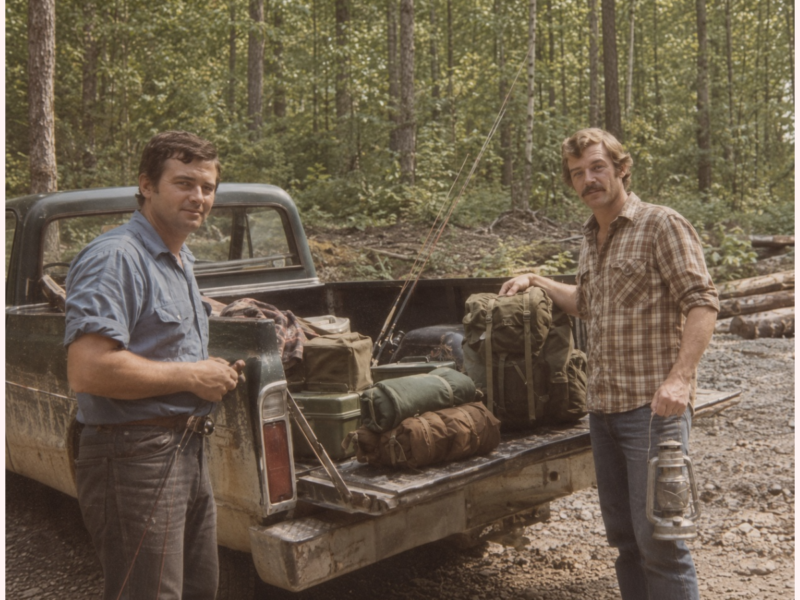
Autumn had come early that year, and by the end of their journey, they expected to see the golden crowns of birches and maples.
At 11:30 a.m., they reached a rocky foothill, where the trail climbed steeply to the right along screecovered granite ledges.
The brothers stopped for a rest on a small clearing surrounded by fallen fur trees.
Jonathan unfassened the straps of his backpack. The weight of the lenses and tripod was pressing down on his shoulders.
He crouched down, took off his backpack and began to adjust the straps. Marcus was distracted by preparing food.
He opened a can of tuna and laid out some bread. When he looked up a minute later, his brother was gone.
Marcus stood up and looked around. There was no rustling of branches, no shadow of a person, no movement among the trees.
Jonathan’s backpack lay in front of him, placed neatly on the ground as if he had simply stood up and walked away for a moment.
Only the backpack and scattered pine cones remained where Jonathan had been sitting. Marcus shouted his brother’s name several times, then rushed back and forth along the trail, peering into the undergrowth.
The area was softly lit by the midday sun. Not a drop of rain or sound of water nearby broke the silence except for the muffled sound of the wind in the treetops.
There was no sign of a struggle, no scrap of fabric, no scattered belongings. At 12:00, Marcus reached the trail head and reported what had happened to the park rangers.
That same day, two groups of rangers and volunteers began combing the area from the lower ravines to the rocky slopes.
Dogs trained to search for people picked up a faint scent from the backpack lying on the ground and followed the trail uphill.
But when they reached the rocky ridge, the trail disappeared. Rescuers searched the entire slope, checking every ledge, but by evening they had found no sign of the missing man.
On the second day, a helicopter joined the search. The crew surveyed the plateau from the air.
Visibility was up to 2 mi, but the flat surface looked like a uniform carpet of pine needles.
No backpack, no human silhouette. As the clouds lowered, the flights were cancelled, and ground teams continued to search the forest.
By the third day, the search covered a radius of 2 mi from the point of disappearance.
They searched every ravine, stream, and overhanging ledge. The temperature at night dropped to plus 3° C, but the rescuers worked in their uniforms while Jonathan was probably dressed too lightly.
There were no signs of a fire, an emergency camp scattered food, or notes. A little over a week passed.
Cold days set in, and the first frosts appeared. The search slowly shifted to reconnaissance and monitoring mode.
Rescuers noticed that for some reason there were never any tents or traces of tourists in the highest parts of the ridge, even though climbers sometimes ascended to the glacial circs in the summer.
And then on the 14th day, when most of the teams were already preparing to end their active search due to the risk of frostbite and snowfall, one of the field teams headed for the climbing ledges of the eastern cliff.
The group members, experienced rock climbers, climbed ropes to a small ledge at the edge of a cliff approximately 520 ft high.
There, on a smooth granite slab, they found Jonathan’s flask. The flask lay at the very edge of the plateau, but there were no traces of dirt, blood, or damage.
All around was scattered dry granite dust and a few dried pine needles. The rescuers were puzzled.
How could Jonathan have gotten there without climbing equipment and left his flask by a fallen pine tree on the trail?
On their way up, the rescuers saw no traces of boots. The granite surface was immaculately clean, barely touched by the first snow.
There were no footprints or fragments of rock where someone could have placed a safety device.
The only thing they found were thin scratches resembling a carabiner worn down by a rope.
Investigators versions were an accident. It was assumed that Jonathan slipped off the trail, hit a rock, and lost consciousness.
Then his belongings were swept to the edge of the cliff, but he was nowhere to be found.
However, the body would have been discovered, and there would have been traces of injury and blood on the backpack.
Another version was animals. They considered that a bear could have dragged away his belongings, but large predators rarely carry their prey to such heights, and paw prints would have been left on the rock.
His brother was also thoroughly questioned, as he may have been hiding something, but the possibility of him being kidnapped by his own brother and other tourists seemed far-fetched and without any evidence.
The anomalous version was close in all respects. The man disappeared, leaving behind only his backpack in his canteen, which was found in a place he could not have physically reached.
But officially, no paranormal hypotheses are accepted. The National Park Service report states after 14 days of continuous searching, he is missing.
The only personal items found were Jonathan Hill’s backpack and canteen discovered on an alpine ledge that was impossible to reach without specialized equipment.
The investigation revealed no signs of foul play or an accident with standard consequences. No body or other evidence has been found.
The case has been closed. Jonathan’s family regularly visited Yellowstone, leaving flowers at the Granite Crest trail head and at the base of the cliff.
Marcus, a journalist by profession, published an essay about the incident, noting that sometimes the mountains give us back only a part of those who have left us, things without people.
The opinions of researchers of unexplained disappearances differ, but whenever they mention the story of Jonathan Hill, they emphasize when things end up in inaccessible places and a person disappears without a trace, nature prefers to keep its secrets.
In July 1999, Shannondoa National Park in Virginia was crowded with tourists seeking a short respit from the hustle and bustle of the city.
A popular clearing by a stream surrounded by centuries old oak and pine trees beckoned for picnics and leisurely walks.
It was to this very clearing that the Thompson family arrived. Father Michael, 35, mother Lisa, 33, and their 8-year-old son, Jacob.
According to the couple, the weather was perfect. Clear skies, a light breeze, and a temperature of around 80.6 degrees Fahrenheit.