Further examination did not turn them into a dated…
Further examination did not turn them into a dated object. The same distinction applied to the food.
Its presence supported his statement that he had obtained provisions somewhere, but it did not identify a household or a year.
By then, the case depended on several different sources. The rangers could describe the condition in which they found him and the objects he possessed.
Medical staff could describe the injury and the dressing. Alice could establish that the Bellamys had lived in the area and that an old letter described a similar visitor.
Michael supplied the account connecting those things. No independent witness saw the occupied cabin, met the family during the search, or observed the change he described after leaving the house.
A memory affected by illness remained one explanation for the cabin. It did not require Michael to be lying, and his consistency could not by itself exclude it.
Someone deliberately creating a story might also have used historical information, though no evidence established that Michael had obtained the private letter before Alice found it.
Another possibility was that he received help from an unidentified person, and later reconstructed the experience around the ruin.
That possibility still required a source for the shoes and an explanation for the similarities in the correspondence.
The following spring, Michael returned with a ranger involved in his rescue. They approached in dry weather using the route established during the search.
Michael recognized the final slope and pointed out where he remembered seeing the first light through the rain.
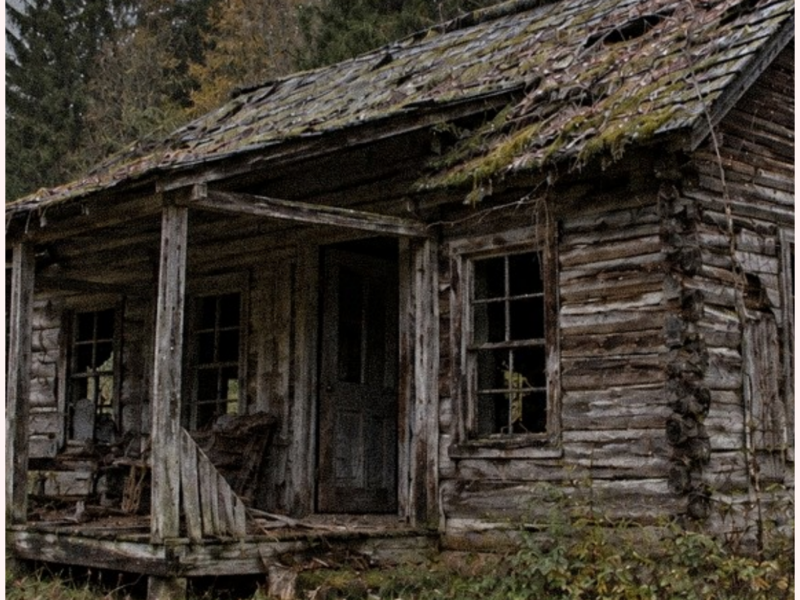
From there, they could see the remaining wall. They checked the surrounding ground for another foundation, an occupied shelter, or a path that might have taken him to a different building.
Nothing they found provided an alternative location matching his description. At the ruin, Michael identified the place where he said his bedding had been laid beside the hearth.
He showed where Caleb kept the damaged tool and pointed to the recess he associated with the water container.
The ranger compared those positions with the drawing made in the hospital and took additional photographs.
Michael’s account of the layout remained consistent. The examination did not establish details of the roof, furniture, [music] or other features he remembered that had left no surviving trace.
They also checked the route he described taking when he heard the whistle. It led around the side of the foundation and a short distance uphill.
From there, the ruin remained visible through the trees. There was no separate building he could have confused with it during the return.
The tree in the old doorway had substantial roots extending through the former floor area.
The site showed no sign of recent occupation, and the visit produced no new object that could be compared with the shoes, dressing, or letter.
Michael did not report hearing or seeing anything unusual during that visit. He returned with the ranger and provided no further account of encountering the family.
The examination of the site ended without locating the hiking boots or identifying anyone who had cared for him.
His leg continued to heal and he eventually returned to work. Questions about the missing days remained, but there was no additional location to search and [music] no person whom the rangers could contact to verify the cabin story.
The shoes and copies of the historical material stayed with Janet. The original letter remained in the family collection from which Alice obtained it.
Its wording was not changed to identify Michael and the footwear examination did not assign the shoes to 1800.
The medical account recorded an injury that had received some care before rescue. None of those findings established time travel, but they also did not identify a modern household responsible for the care Michael described.
When asked later whether he intended to prove that he had traveled into the past, Michael said he had no further evidence to offer.
He continued to maintain that he spent six nights with Caleb, Miriam, and Ruth. The part of the letter he asked Alice to clarify concerned his departure.
He wanted to know whether the family believed he had deliberately left without thanking them.
Alice could only confirm what the passage said. They looked for the injured stranger, did not find him, and still had the boots he left behind.
Which evidence would you examine first? The shoes, the medical findings, or the original letter?
Share your view in the comments and subscribe to UNK files to learn about more unexplained disappearances and the accounts of people who returned.