He estimated the girl's age at about six
He estimated the girl’s age at about six. He described where he slept and how the adults treated his injury.
He also insisted that the house had been standing until shortly before the rangers found him.
His account of the first day contained nothing unusual. He followed the trail on Friday and stayed overnight at a small clearing he had selected from his map.
On Saturday, rain began while he was making his way toward the return route. He continued because he expected to reach the car that afternoon.
At a damaged section of trail, he tried to pass around fallen timber on the downhill side.
His foot slipped and he slid into broken branches below the path. A sharp piece of wood cut through his trousers and opened his lower leg.
Michael used material from his first aid kit to cover the wound. He could stand, but climbing back toward the trail caused enough pain that he had to stop repeatedly.
By the time he reached more level ground, he was uncertain whether he had regained the correct path.
Visibility was poor and water running down the slope made several openings resemble trails. Rather than continue after dark, he found an overhang and spent the night beneath it.
His clothing remained wet and he slept badly because he could not find a position that kept pressure off the injury.
On Sunday morning, the leg was swollen and the dressing had soaked through. He tried to establish his position from the map, but could not confidently match the small drainage below him to anything marked.
He believed the access road lay beyond the next rise. Each attempt to gain higher ground ended at another obstruction, forcing him to change direction.
Late in the afternoon, he noticed a light below him through the rain. He first thought it belonged to another camper.
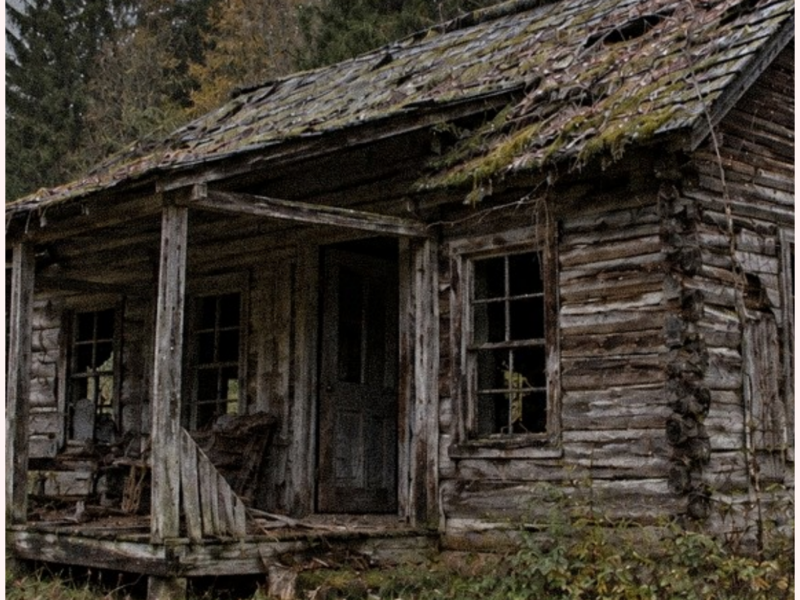
As he descended, he saw smoke and part of a roof. The cabin stood on a small bench above a creek.
Michael remembered a low doorway, a stone chimney, and a narrow opening through which he could see the fire.
He called before approaching the door. A man came out and looked at his injured leg, then helped him inside.
Michael later identified that man as Caleb. A woman moved a stool near the hearth, while a young girl watched from the other side of the room.
The adults seemed more concerned with getting his wet clothing off than with asking how he had reached them.
Caleb removed Michael’s boots. One was difficult to pull over the swollen foot, and Michael remembered gripping the stool while the man worked it loose.
Miriam heated water and cut away the material he had placed around the wound. She washed the leg and covered it with strips of cloth torn from a larger piece.
Michael could not identify everything she used. He remembered a small container and a cloth she kept dipping into warm water, but he was tired and in pain.
Afterward, they settled him near the hearth and put his boots on a shelf to dry.
The family’s clothing and belongings looked old-fashioned. Caleb wore a loose shirt and trousers Michael could not place in any familiar style.
Miriam wore a long skirt and an apron, with most of her hair covered. The room contained handmade furniture and household objects made from wood, pottery, and metal.
There were no visible electrical fittings. Michael assumed he had encountered people who deliberately lived without modern conveniences.
He had heard of isolated households that avoided electricity, and he did not consider the appearance of the cabin a reason to refuse help.
He slept for much of the first night. When he woke, Miriam brought food and examined the dressing.
Michael asked whether they had a telephone or knew where he could find one. Neither adult appeared to understand the question.
He tried describing a device used to speak with someone in another town. Caleb asked questions that made Michael think he had explained it badly.
Eventually, Michael stopped discussing the telephone and asked whether someone could carry a message or guide him to the nearest road.
Caleb described a route involving a creek crossing and a settlement Michael did not recognize.
The directions depended on landmarks rather than road names. He warned that the water would be difficult after the rain and that Michael could not manage the walk in his current condition.