He did not see much point in a formal review of th…
He did not see much point in a formal review of the original investigation. The detectives were retired.
Nothing could change what had happened to Sherry. But he said the case had a lesson in it about keeping an open mind and not fixing on one theory too early.
He said, “I’ve seen too many cases where that tunnel vision did not serve the department well.”
Tunnel vision is the right name for it. Not necessarily a conspiracy and not necessarily malice.
A theory formed in the first days that the case was a burglary and that every new fact for 23 years was fitted into the bite that was more likely a woman’s.
The jewelry left behind the marriage license taken the stack of equipment that had not been knocked over.
A father saying the same name over and over. There is one more chapter and it belongs to the Rasmisson family.
After the arrest, Nells and Loretta Rasmusen asked the city of Los Angeles to answer for two things.
That a police officer had murdered their daughter and that the department had over two decades helped to cover it up.
The department’s internal affairs division took up the claim. It waited until after the criminal trial.
The officer assigned to it, according to the record of that investigation, never spoke to the Rasmusins.
Of the seven hours recorded as spent on the case, four were spent writing the report.
Two weeks after the conviction, the matter was closed. The first allegation was sustained automatically because of the conviction, though no discipline could follow because Stephanie Lazarus no longer worked for the department.
The second allegation of a cover up, was ruled unfounded with a note that read, “We do not condone murder.”
Matthew McGoff, the author of the Lazarus Files, would later call that internal investigation a sham.
He said that the department quietly closed it. He said, “It’s police culture. It’s a sense of this could look bad and we’re not going to go there.”
And about the evidence that might once have been in the file, he made a point that applies to every cold case.
It’s really hard, he said, to know what could be missing if it’s already gone.
The family also sued the city. The case went through state court, then federal court, then state court again, and in the end it was dismissed.
The courts ruled that the family had waited too long to bring it, that the time to sue had begun to run once they broke off contact with the police department in the late 1990s.
The family’s argument had been that they could not have known what the department had done or failed to do until the arrest.
The courts did not agree. So after years of telling the department who had killed their daughter, the Rasmusins were told in effect that they had stopped asking too soon.
In the separate part of their lawsuit against Stephanie Lazarus herself, the outcome was different.
Because she had been convicted of the murder, the court held her liable for Sherry’s death.
Her lawyers argued that the family had sued her too early before the criminal case was finished.
The court rejected that, too. Nells Rasm died in 2020. He had lived to see the arrest.
He had lived to see the conviction. He did not live to hear the confession.
But he had made sure in the only way left to him that his voice would still be heard when it mattered.
Now step back and look at how the answer came. It came through Sherry herself who was 6t tall and strong and who did not stop fighting so that whoever killed her left her own saliva in a bite mark on Sherry’s arm.
It came through the criminalist who on the first day took a swab of that bite mark when no one alive could have said what it would one day reveal.
And it came through the fact that he or someone kept it. It was not logged in any computer, but it was in the freezer.
It came through the people who set up a cold case evidence unit in the Los Angeles Police Department in the late 1990s on the idea that old evidence might have new things to say.
It came through Jennifer Francis who did not just run the test she was given but read the file, found the woman in it and asked the question.
She was given an answer and then told the case was a burglary. She did not stop the case from stalling but the result she produced in 2004 was sitting in the file when the right people opened it.
It came through Jim Nuttle, who picked up a box from the floor near his desk and read what was in it and believed it, and through Pete Barbara, who agreed with him that a jewelry box in plain view and a neat stack of stereo equipment do not make a burglary.
And through Rob Bub, who took a case against one of the department’s own detectives all the way to the chief.
And it came above all through Nell’s Rasmusen. In the first week after his daughter’s death, he told the detectives what he knew.
When they told him there was nothing there, he kept telling them. When [clears throat] they told him he watched too much television, he wrote to the chief.
When the true crime writer Anne Rule said that a retired lap detective had told her the case was too hot to handle and she would not write about it, he kept going.
When the science arrived, he offered to pay for it out of his own pocket.
When he was told the police needed a suspect, he reminded them that he had given them one.
He did it for years until by 1998, the detectives had worn him down. And when finally a detective called him, he told that detective the same thing he had told the first one in 1986.
This time someone wrote it down. That is what persistence looks like in this case.
Not a single dramatic moment, but a father saying the same true thing over and over to an institution that would not hear it until one person inside it did.
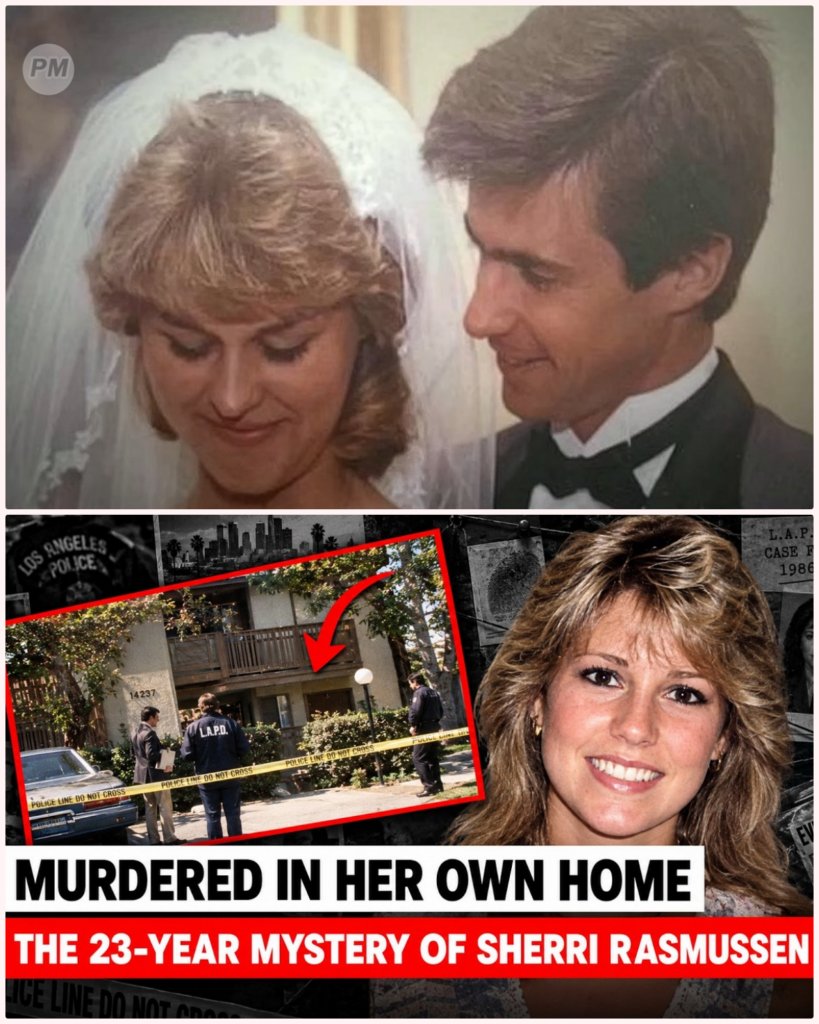
On the morning of Monday the 24th of February 1986 in Van NY, Sher Rasmusen, who was 29 years old and the director of nursing at Glendale Adventist Medical Center, was at home with a sore back deciding whether to call in sick 3 months after her wedding.
Her alarm code was the date she was married.
