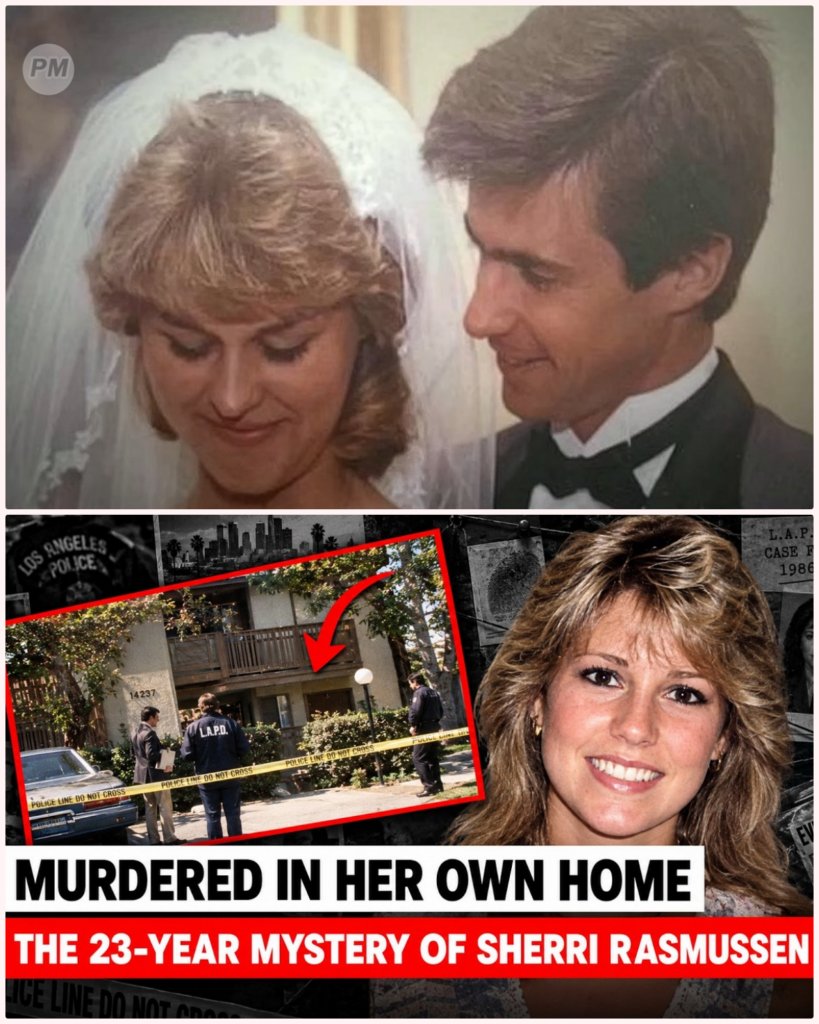
The typed record of the investigation, the chronol…
The typed record of the investigation, the chronological log that homicide detectives keep, does not mention Stephanie Lazarus at all until November of 1987, more than a year and a half after the murder.
In that typed record, John Ruettin’s surname is misspelled throughout. Nells Rasmusen’s repeated pleas by telephone and in person about the police officer who had been harassing his daughter are not recorded.
A journalist named Matthew McGgov, who spent years researching the case for a book called The Lazarus Files, would later argue that the file appeared to have been altered.
He also cataloged what he saw as basic failures in the original investigation. A mark on Sherry’s face, noted and photographed at the autopsy, was not matched to the muzzle of a 38 caliber revolver until 2009.
A bloody fingerprint visible on a disc player at the top of the stack of electronics and most likely left by the attacker rather than by Sherry was never collected or photographed in usable detail and the disc player itself was never taken into evidence.
The detective’s follow-up report was written about 3 months after the murder later than procedure required and it stated as fact things that were at best guesses from the physical evidence.
The Los Angeles Police Department’s own internal investigation much later found the allegation of a cover up unfounded.
The record is the record. Each person who has told this story has had to decide what to make of the gaps in it.
But one thing nobody disputes is what happened next. The burglary theory became the case.
In April of 1986, a man was arrested after a burglary in a similar condominium in Van NY in which a stereo had been taken.
For a while, he looked like the prime suspect. His fingerprints did not match. He was ruled out.
8 months after the murder, there was a follow-up story in the newspaper, and the Rasmusen family offered a reward.
Nothing came of it, and the case went cold. What the family did with the waiting is the spine of this story.
In November of 1987, nearly 21 months after the murder, Nells and Loretta Rasmusen held a news conference in Los Angeles.
They repeated their reward. They called for more to be done. Nells Rasmusen wrote to the chief of the Los Angeles Police Department, Daryl Gates.
He laid out what he knew about Stephanie Lazarus. He asked the department to look at her.
According to the family, the response from the detectives was that he watched too much television.
[clears throat] In 1988, one of Sherry’s sisters suggested that they approach a well-known true crime writer, Anne Rule, and ask her to write about the case.
Perhaps they thought public attention would force the department to look again. The Rasmusens met her.
Nells told her about Stephanie Lazarus. Rule told him that a retired detective she knew from the Los Angeles Police Department would ask around.
A few days later, according to the family, she told Nells the case was too hot to handle and that she would not be writing about it.
In 1991, Lyall Mayor retired. A few years later, Steve Hooks was moved to another division.
A new detective took over and told Nells Rasmusen that he could not follow up on Mayor’s notes and did not think there would be new leads.
By 1993, the science had changed. DNA testing had come into its own. Courts across the country were accepting it.
Nells Rasmmanson offered to pay for DNA testing on the evidence from his daughter’s murder himself.
He was told the police had to have a suspect first. He had given them a suspect in the first week.
That same year, the records show detectives in Vanise took a renewed look at the case.
They ordered new tests on fingerprints. They checked records of paroleies. They were looking still for a burglar.
At some point in that review, a detective checked trace evidence out of the coroner’s office.
The bite swab was not among the things anyone looked at. In 1997, a former c-orker of Sherry’s secretary contacted the police about the day at the hospital when Stephanie Lazarus had come to confront Sherry.
Nobody followed up. 3 years later, the secretary died. And while all of this happened, Stephanie Lazarus’s career went on.
In 1994, she was promoted to detective. She worked in background investigations of new recruits and taught in the department’s drug education program for schools.
In 1997, she married a fellow officer she had met while teaching. They adopted a daughter.
They lived in Simei Valley. She became an instructor at the police academy. Twice during the 1990s she was assigned to the Van NY division where the murder book on Sherry Rasmusen was kept.
In between she spent a year in internal affairs. Matthew McGaw in his book reported that colleagues remembered her often volunteering for overnight shifts at Van NY when the division was quiet and lightly supervised.
He also reported that a colleague from the early 1990s recalled her mentioning that she had once been interviewed in a homicide investigation, one involving a former boyfriend’s wife.
Whether anyone in the department ever formally interviewed her about Sher’s death in those years has never been established.
Lyall Mayor denied that he did. Investigators would later find that on several occasions in the late 1990s, she had searched the internet for John Rutin’s name.
She also kept in touch with Jon. In 1989, 3 years after Sherry’s death, the two of them reconnected briefly on a trip to Hawaii, and for a couple of years after that, they saw each other occasionally.
At one point, Jon contacted Lyall Mayor and asked whether there was any evidence linking Stephanie to his wife’s death.
And there, for a long time, the story stopped. What did not exist in 1986 is the reason this case could be solved at all.
So it is worth setting it out carefully. In 1986, the use of DNA to identify a person from biological evidence was brand new.
A British geneticist named Alec Jeff had developed DNA fingerprinting in 1984. And the first criminal investigation to rely on it was in England in 1986 and 1987.
The English case, the murders of two teenage girls in the villages of Leershshire, ended with the first conviction for murder based on DNA in 1988.
And along the way, the new technique also cleared an innocent young man who had confessed.
In the United States, the first conviction based on DNA came in Florida in late 1987.
