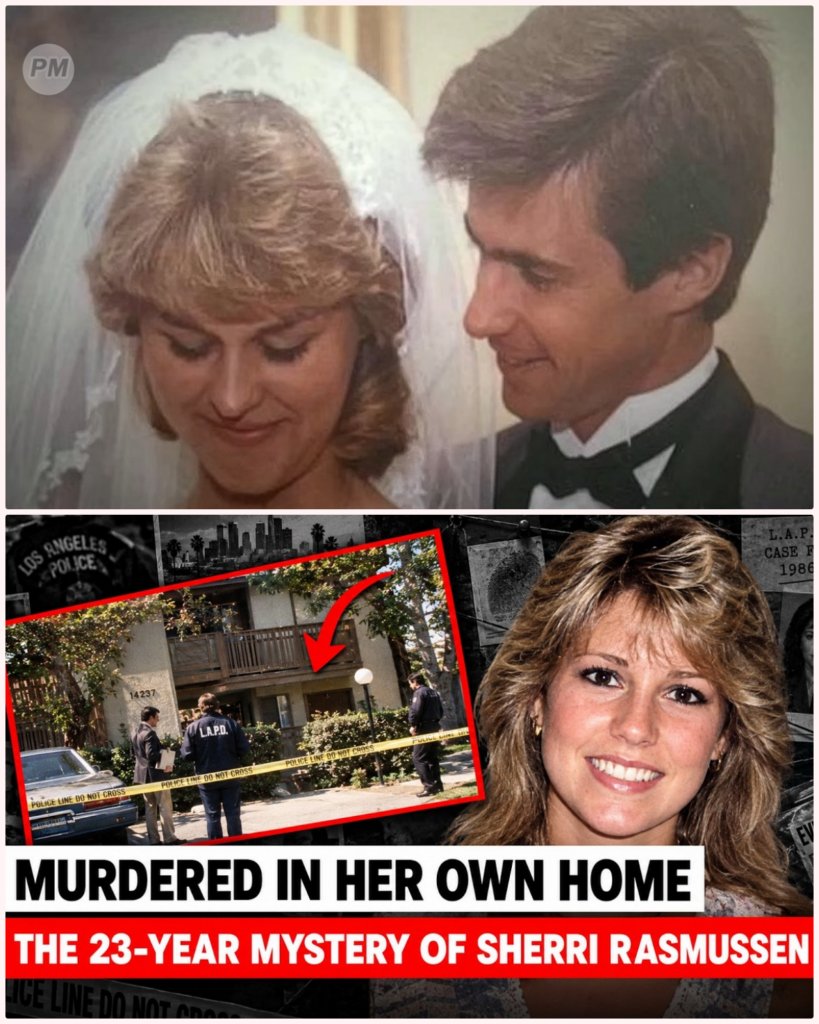
During the struggle, Sherry's attacker bit her on…
During the struggle, Sherry’s attacker bit her on the arm. Then the scene was arranged.
Stereo and video equipment was stacked at the bottom of the stairs as if a burglar had been gathering it to carry out.
Sherry’s jewelry was left behind. So was a jewelry box sitting in plain view on a dresser.
And one thing was missing that no burglar would have had any reason to want.
The couple’s marriage license. Her car, the BMW, was taken. A neighbor later said that during the day, she had noticed the couple’s garage door standing open with no car inside.
Someone working in a nearby unit later said she had heard what sounded like two people fighting and then something falling.
Later that day, two men believed to be gardeners in the complex handed Sher’s purse to a neighbor.
None of it at the time added up to anything. That evening, John Ruettin came home and found the glass and the open garage and his wife.
The investigation was assigned to two homicide detectives in the van NY’s division. Lyall Mayor and his partner Steve Hooks.
Within a short time, they had a theory. Sherry, they believed, had surprised a burglar or burglars in the act.
There had been other break-ins in the area. One report around that time involved a burglary suspect who might have been carrying a 38 caliber revolver.
And the bullets that killed Sherry were 38 caliber rounds of a type made by the company Federal called a plus P.
The stack of electronics at the foot of the stairs fitted the theory. The stolen car fitted the theory, too, the detectives thought.
Though Mayor noted that it was unusual for burglars to take a car, he concluded there had probably been two of them.
11 days after the murder, an officer spotted Sher’s BMW parked near the corner of Zomar Avenue and Cohasset Street, roughly 2 mi east of the condo.
It was unlocked with the keys in the ignition. Crime scene technicians found what might be blood stains, fibers, and four fingerprints, none of them sheries or John’s.
The detectives knew that burglars lived in that neighborhood. And to Mayor, the location of the car made the burglary theory stronger.
There was one piece of evidence that did not fit as neatly. Steve Hooks noticed it.
It was the bite. In a struggle, he knew. Biting was more often done by women than by men, and most burglars were men.
He noted it. But men do bite sometimes in fights, and the burglary theory stood.
A criminalist at the scene or at the coroner’s office took a swab of the bite mark on Sherry’s arm.
In 1986, the main thing that could be learned from a swab like that was a blood type.
DNA testing for criminal cases barely existed. The first American conviction based on DNA evidence was still more than a year away.
The swab was taken, tested as far as it could be, and put away. Remember that swab?
It is the most important object in this story. Now we come to the family.
Nells and Loretta Rasmmanson came to Los Angeles after their daughter’s death and they talked to the detectives.
They told Lyall Mayer about Stephanie Lazarus. They told him about the visit to the hospital.
They told him about the skis and the uniform and the woman standing in the living room.
They told him their daughter had been afraid. They told him that the woman their daughter had been afraid of was a police officer.
John Rutin, for his part, told the detectives that Stephanie Lazarus was a former girlfriend.
He would later testify that he told them about her during his second interview, the morning after the murder.
He did not tell them about the last time he had slept with her, or about the confrontation at the hospital, which by his own account, he did not know about at the time.
Like nearly every husband in a case like this, John Ruitin was looked at first.
He later recalled that early on, the detectives asked him to take off his shirt so they could look for scratches and photographed him without it.
About 2 weeks after the murder, he was given a polygraph examination. He was very emotional during it, and the result was recorded as inconclusive.
His employer confirmed where he had been that day at work in Chadzsworth, and the detectives were satisfied that he had not killed his wife.
For Jon, the months that followed were their own kind of collapse. He took a leave of absence from his job.
He left the condominium and moved back in with his parents in San Diego. In the years to come, he would return to the Los Angeles area.
And in 1991, he would meet the woman who became his second wife, but the case would never leave him.
Nearly four decades later, he would still be speaking at hearings about the pain of it.
Lyall Mayor made a note. And then, according to Nells Rasmusen, he told the father that there was nothing there.
It is worth being careful here because this is the point on which everything turns and because the people involved remember it differently.
Years later after the arrest, Lyall Mayor would say that he and the other detectives in Van Ny had been fooled.
He called the idea that he had steered the investigation away from Stephanie Lazarus absurd and unreal.
He said he did not know her. He said that if he had ever suspected a police officer of being involved, he would have reported it to his superiors and to internal affairs.
He also said that if Stephanie Lazarus had been treated as a suspect at the time, she would almost certainly have used her right to remain silent and to have a lawyer, and the case, as he put it, would have been dead in the water.
What the record does show is this. In the case file that survived, the detectives early handwritten notes from the first months of the investigation are missing.
