He was 62 years old
He was 62 years old. Patricia was certain the grief had killed him. She was alone.
Robert Kimball lived a normal life. He went to work every day. He came home.
He mowed the lawn. He fixed things around the house. He and Margaret had dinner together every night.
They watched television. They went to church on Sundays. No one suspected him. He attended family gatherings.
He sat across from Patricia Thanksgiving dinner. He helped Thomas carry furniture when they remodeled the kitchen in 1998.
He was quiet, polite. He never brought up Emily unless someone else did. And when they did, he would shake his head.
He would say it was a tragedy. He would say he hoped they would find her someday.
He knew they never would. The VHS tapes were hidden in his attic behind a false wall he had built in 1996, sealed in a cardboard box, wrapped in duct tape.
He had watched them once, the day after he buried Emily. Then he hid them.
He never watched them again. He did not need to. He remembered. This is the part of cases like this that the public struggles to understand.
How does someone commit a violent crime and then return to normal life? How do they sit across from the victim’s family and show no emotion?
The answer lies in what forensic psychologists call compartmentalization. Individuals who commit premeditated violent crimes often possess an extraordinary ability to separate their actions from their daily lives.
They do not experience guilt the way most people do. They do not ruminate. They do not break down.
They simply move forward. Robert Kimball was able to attend family dinners with Patricia because in his mind, what he had done to Emily existed in a completely separate mental space.
He had filed it away. And he never opened that file again. This is what makes certain offenders so dangerous.
They do not fit the profile the public expects. They are not visibly disturbed. They are not erratic.
They are calm, controlled, ordinary. Robert and Margaret had a quiet marriage. They rarely fought.
They had settled into a comfortable routine. Margaret never suspected anything. She trusted her husband completely.
In 2015, Robert was diagnosed with early stage lung cancer. He had smoked for 30 years.
The doctors caught it early. He underwent chemotherapy. The cancer went into remission. In 2019, it came back, aggressive, stage four.
The doctors gave him 2 years. He made it to 2021. He died on March 18th at home in his sleep.
Margaret was beside him. He never confessed. He never showed remorse. He took his secret to the grave.
Margaret was devastated. She had loved him for 34 years. She stayed in the house for 2 more years, but it was too much.
Too many memories. Too much space for one person. In January 2023, she put the house on the market.
Michael and Lisa Carter bought the house in February 2023 for $340,000. They were in their early 30s.
Michael worked remotely as a software engineer for a company in Seattle. Lisa was a freelance graphic designer.
They had moved to Spokane from the west side of the state. They wanted more space, lower cost of living, a quieter life.
The house needed work. The roof was old. The kitchen was outdated. The bathroom fixtures were from the 1980s.
But it had good bones. They planned to renovate. In April, they started on the attic.
The insulation was old, possibly asbestos. They hired a contractor to inspect it. The contractor said the attic would need to be gutted.
Michael went up to take measurements. The attic was unfinished, exposed beams, old drywall, dust, and cobwebs.
He noticed something odd. A section of drywall near the back corner did not match the rest.
The seams were newer. The texture was different. It looked like someone had installed it recently, or at least more recently than the rest of the attic.
Michael called Lisa up. They pulled at the edge of the drywall. It came away easily.
It had never been properly secured. Behind it, tucked into the insulation, was a cardboard box sealed with duct tape.
Old duct tape, yellow, cracked. Michael carried it downstairs. They set it on the kitchen table.
Lisa cut the tape. She opened the box. Inside, two VHS tapes. Both had labels, handwritten in black Sharpie.
Same handwriting. Same date. September 23rd, 1995. Michael and Lisa looked at each other. They had no idea what the tapes were.
But the fact that someone had hidden them behind a wall felt wrong. Lisa said they should watch them.
Michael said they should call the police. Lisa said they needed to know what they were first.
Michael and Lisa were vintage collectors. They had an old VCR they had bought at an estate sale the year before.
They had bought it as a joke. They used it to watch old movies on VHS.
Nostalgia. A conversation piece. Lisa hooked it up. She put in the first tape. The screen flickered.
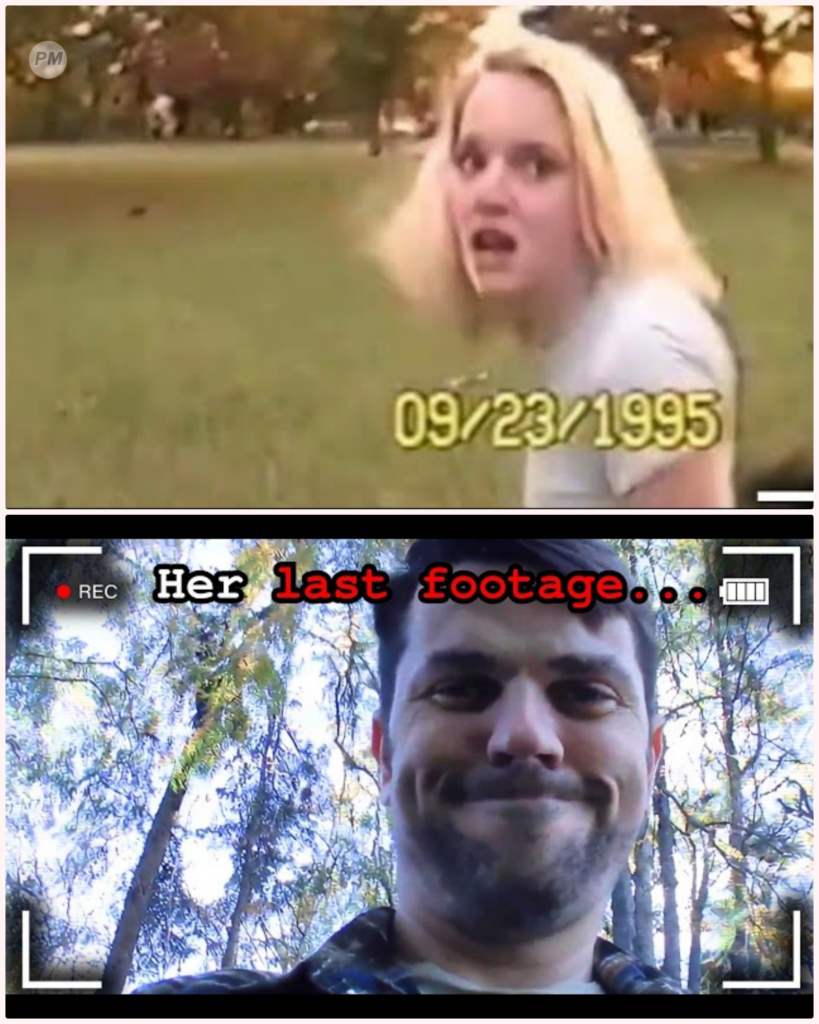
Static. Scan lines. Then the image appeared. Handheld footage. Shaky. The camera bouncing violently. Someone running.
Trees, grass. The frame jerking up and down. And ahead of the camera, a young woman.