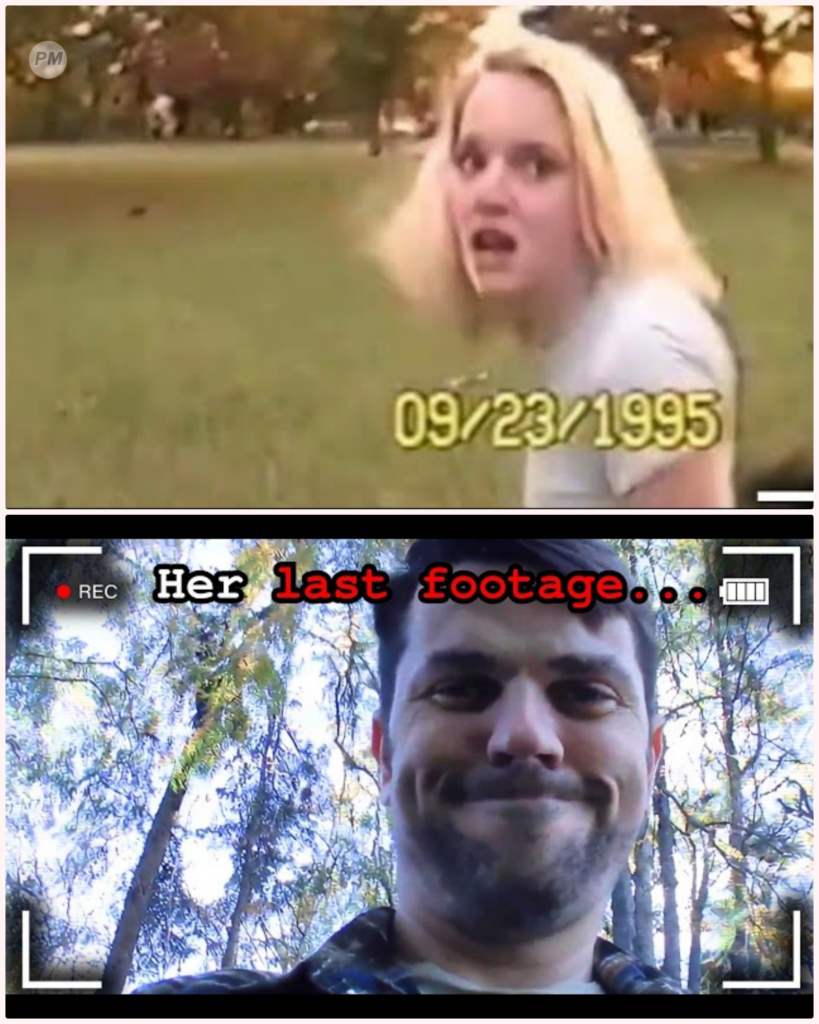
Blond hair, jeans, a white t-shirt, running
Blond hair, jeans, a white t-shirt, running. She looked back over her shoulder. Her face filled the frame for a split second.
Blue eyes, wide with terror. Her mouth open, screaming. Then she turned forward and kept running.
The footage lasted 8 seconds. Then it cut to static. Lisa stopped the tape. Her hands were shaking.
Michael said they needed to call the police now. Lisa said they should watch the second tape first.
She put it in. This one started differently. The camera was pointed down at the ground.
Grass, dirt, and a wooden door built into the earth. Weathered planks, rusted hinges. The camera stayed on the door for several seconds, documenting it.
Then the camera moved. It lifted, slowly. The image blurred as the camera rotated. Trees, sky, sunlight.
Then a face. A man. White, mid-30s, dark hair. He was looking directly into the lens.
He was filming himself. His expression was neutral at first. Then he smiled. Not a friendly smile.
Not an awkward smile caught on camera. A deliberate smile. Cold. Satisfied. His eyes were empty.
He nodded once, slowly, as if confirming something to himself. Then, the tape ended. Lisa ejected the tape.
She turned off the VCR. Michael called 911. Detective Sarah Ortiz arrived at the Carter residence at 3:15 p.m.
She was with the Spokane Police Department’s Criminal Investigations Division. 38 years old, 12 years on the force.
She specialized in cold cases. She watched both tapes. She asked the Carters where they had found them.
Michael showed her the attic, the false wall, the box. Ortiz asked who had owned the house before them.
Michael said a woman named Margaret Kimball. She had lived there with her husband. He had died in 2021.
She sold the house in 2023. Ortiz asked if they knew the husband’s name. Michael checked the closing documents.
Robert Kimball. Ortiz went back to her car. She called the department. She requested a search of the missing persons database.
Date range, September 1995. The database returned one result, Emily Garrison, 18 years old, reported missing from her home on Spokane’s North Side on September 23rd, 1995.
Case went cold in 1996. Never solved. Ortiz pulled the original case file. She read through Detective Bowman’s notes.
She saw the address where Emily had lived, 4782 North Maple Street. She checked the address where the tapes had been found, 4790 North Maple Street.
Two houses apart. Ortiz cross-referenced the names. Robert Kimball married to Margaret Kimball. Margaret’s maiden name, Margaret Garrison, sister of Patricia Garrison, Emily’s mother.
Robert Kimball was Emily’s uncle. Ortiz contacted Frank Bowman. He was retired, 76 years old, living in Coeur d’Alene.
She told him about the tapes. He said he remembered interviewing Robert in 1995. Robert had an alibi.
His wife confirmed it. There was no evidence to suggest otherwise. Ortiz asked if Bowman had suspected him.
Bowman said no. Robert was calm, cooperative. He showed no signs of deception. Ortiz hung up.
She watched the second tape again. She focused on the background, the trees, the clearing, the grass.
She called the department’s forensic video analyst. She asked him to enhance the footage, isolate the background, identify landmarks.
The analyst worked for 6 hours. He extracted stills from the video. He compared them to satellite imagery of parks and wooded areas around Spokane.
He cross-referenced vegetation patterns, tree density, terrain elevation. He found a match. Riverside State Park, northwest section, a clearing near the forest edge.
The terrain matched, the tree formations matched, the distance from the tree line to the clearing matched.
Ortiz assembled a search team. What’s critical to understand here is that video evidence from nearly 30 years ago presented challenges modern investigators rarely face.
VHS tapes degrade over time. The image quality is poor. Color bleeding, scan lines, distortion.
But advancements in digital forensic analysis allow investigators to extract details that would have been impossible to identify in 1995.
The angle of sunlight can indicate time of day and season. Vegetation patterns can pinpoint geographic locations.
Even the specific species of trees visible in the background can narrow down a search area to within a few hundred meters.
This is how cold cases are solved in the digital age. Technology catches up to crimes committed in an analog world.
May 15th, 2023. Detective Ortiz and a forensic team arrived at Riverside State Park at 7:00 a.m.
They brought ground penetrating radar, two cadaver dogs, a full excavation crew. They focused on the northwest clearing, the area identified by the video analyst.
The dogs hit on a spot near the tree line, both of them, independently. The radar showed an anomaly, a hollow space, approximately 6 ft underground, rectangular, man-made.
The excavation team began digging. 2 ft down, they found the wooden door, rotted, covered in nearly 30 years of dirt and overgrowth, the same door from the video.
They pried it open. Inside, skeletal remains, human, female, clothing still partially intact, jeans, a white T-shirt, deteriorated, but recognizable.
The forensic team secured the site. They photographed everything. They carefully removed the remains. They documented the underground space.
It was roughly 6 ft long, 4 ft wide, 3 ft deep, lined with plywood, a crude cellar, built to hold something or someone.
The remains were transported to the Spokane County Medical Examiner’s Office. Dr. Helen Cross performed the examination.