For the first time, something flickered across Van…
For the first time, something flickered across Vance’s face, not doubt. Doubt would have been too much to hope for.
It was something closer to satisfaction, the look of a man who thinks he has finally cornered the thing he came to corner.
“Then I guess,” he said, “you’d better be as good as your file says you are.”
And he grabbed her vest. Now, most people hearing this story would assume that this was the moment Emily Carter screamed or begged or froze.
That’s what the men in that helicopter assumed, too. That’s what they had counted on.
Because in their minds, the story had already been written. And in that story, the young woman panics, and the panic proves everything they wanted to believe.
But here is what none of them knew. Emily Carter had spent two years of her career flying search and rescue in the mountains of Alaska.
She had pulled climbers off ledges in whiteout conditions. She had recovered down pilots from terrain so hostile that other crews had refused the tasking.
And in all that time, she had learned the one thing that separates the people who survive these mountains who from the people who don’t.
She had learned the land. She knew, better than any man in that helicopter, exactly what was below them.
She knew the ridgelines. She knew the snow shelves. She knew the way the storms funneled through the passes and where the drifts piled deep enough to catch a falling body and where the rock waited underneath like a set of teeth.
And in the four seconds it took Vance to drag her toward that door, Emily Carter did the thing she always did.
The thing that made her dangerous in a way none of them had bothered to understand.
She calculated. Wind speed, direction, the angle of the aircraft, the pattern of the drifts she’d memorized from 100 rescue flights over this exact valley.
The soft accumulation on the leeward slope of the eastern ridge, 300 m to the north, where the storm had been dumping snow for six straight hours.
“Sir,” she said, and her voice was so level that Vance actually paused. “You’re making a mistake.”
“Am I?” “Not the one you think.” He shoved her, and Emily Carter went out the door of that helicopter into the screaming Alaskan night, and every man inside believed they had just killed her.
They watched the dark swallow her. Kowalski pulled the door shut. Briggs was pale, his hands shaking, and he looked at Vance with something that wasn’t loyalty anymore.
“Sir,” Briggs said, “we just we just threw a captain out of a moving aircraft.
We just That’s Sir, that’s a court-martial. That’s murder.” “That’s a training decision that went wrong in bad weather,” Vance said flatly.
“Aircraft got caught in a downdraft. Captain Carter was not properly secured. Tragic accident.” He sat back down and picked up her file, and he did not open it.
“Write it however you want, Lieutenant, but you’ll write it the way I tell you.”
Kowalski said nothing. He was staring at the closed door. And below them in the dark, Emily Carter was not dying.
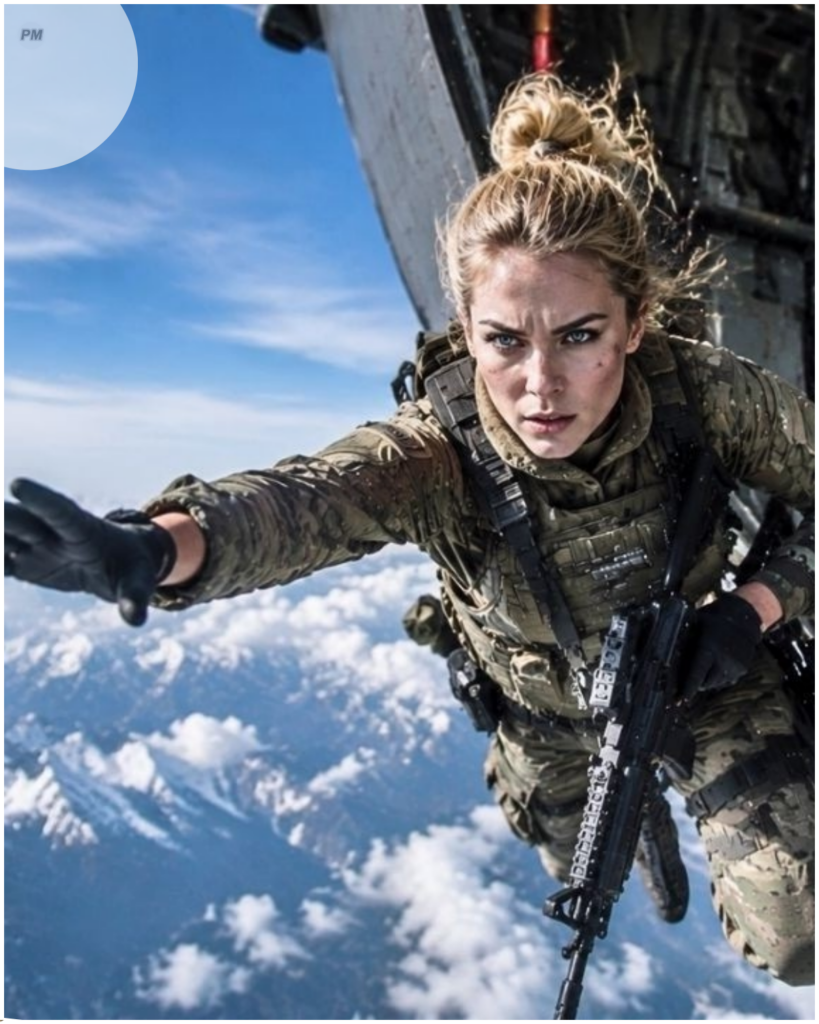
She was working. The fall was the loudest thing she had ever experienced. The wind tore at her, spun her, tried to take away her sense of up and down, and she let it for exactly 1 second while she oriented herself against the only fixed point in the world, the black wall of the eastern ridge she had memorized years ago.
She found it. She found north. And then she did the thing that no panicking person can do, and every trained one must.
She stopped fighting the fall and started steering it. She spread her body flat, arms out, legs wide, turning herself into a surface the wind could push.
She angled her shoulders. She dropped one arm and lifted the other, and the wind caught her like a sail and pushed her meter by meter toward the leeward slope, toward the deep soft snow she had counted on, the snow that had been piling up for 6 hours in the exact place her memory told her it would be.
She was not going to survive this fall because she was lucky. She was going to survive it because she had spent years learning a mountain that a colonel in a warm helicopter had never bothered to study.
The slope came up out of the dark faster than any human body is built to accept, and Emily Carter tucked and turned and hit the snow at an angle, and the world became white and violent and roaring, and then it became still.
She lay there for a moment, buried to her chest in powder, her heart hammering, her whole body screaming with the shock of impact, she took inventory the way she had been trained.
Fingers, toes, spine, ribs, nothing broken. Nothing that would stop her. And then Captain Emily Carter began to laugh.
Not because it was funny, because it was the only sound big enough to hold what she was feeling.
Which was not fear, and was not relief, but something harder and colder and far more dangerous than either.
It was clarity. She pulled herself up out of the snow and she stood and she looked up into the storm where the helicopter had already vanished and she said out aloud to men who could not hear her, “You just made the worst mistake of your lives.”
Because Colonel Marcus Vance thought he had ended her story. He hadn’t. He had started the part of it he was going to regret for the rest of his life.
Now, to understand what happened next, you have to understand who Emily Carter was before that helicopter door ever opened.
And to understand that, we have to go back. Not far, just 6 months. To a briefing room at Fort Wainwright where the whole thing began.
6 months earlier, Captain Emily Carter had walked into that briefing room and felt every conversation stop.
She was 28 years old. She was a decorated Army Aviation officer. She had a rescue record that veteran pilots spoke about with respect when they didn’t know she was in the room.
And she walked into that briefing room and watched a dozen senior officers look up at her and see none of it.
They saw a young woman. That was all. And Emily had learned over years of walking into rooms exactly like this one that the first 90 seconds were the ones that mattered.
It was in the first 90 seconds that men decided what box to put her in and once they’d chosen the box, everything she did afterward got read through it.