She walked the ground
She walked the ground. She got permission for a series of low-altitude familiarization flights and on every one of them she memorized the terrain like a person memorizing a face they love.
The ridgelines, the snow shelves, the leeward slopes where the drifts piled deep, the dead ground where a radio couldn’t reach and the high ground where it could.
She built a map of that valley inside her own head, a map more detailed and more true than anything in the mission folder and she carried it everywhere she went.
Nobody knew she was doing it. That was the point and through all of it the doubt never stopped.
It followed her through the mess hall where conversations dropped when she walked past. It followed her into the hangar where a mechanic once asked her, not unkindly, if she was sure she wanted a mission this size.
It followed her into the officers meetings where her assessments were heard politely and then quietly set aside in favor of the opinions of men who had never flown the valley she knew by heart.
There was one night about a month before the mission when it almost got to her.
She was alone in the ready room at 2:00 in the morning going over the terrain map for the hundredth time and a voice behind her said, “You know they’re taking bets, right?”
She didn’t turn around. “On what?” “On how long you last.” It was Kowalski. He came around and leaned against the table arms folded.
“Nothing personal, guys just talk.” “What’s the line?” Kowalski actually looked a little uncomfortable. “You don’t want to know.”
“I asked.” He hesitated. “Most of them think you don’t come back at all.” Emily nodded slowly and she kept her eyes on the map and for a moment the doubt was a physical weight pressing down on her chest whispering the oldest question she carried.
The question every underestimated person carries in the dark hours. “What if they’re right? What if I’m exactly what they think I am?”
And then she did what she always did. She let the question in, looked at it clearly and answered it with the only thing that had ever silenced it.
Not confidence, not anger, work. “Sergeant,” she said quietly, still looking at the map, “do me a favor.
Put a little money on me.” Kowalski laughed, surprised. “Yeah? Why’s that?” Emily finally looked up at him, and there was something in her face that made his laugh die in his throat.
“Because I’m going to walk out of that valley,” she said, “and every single one of them is going to have to look at me and know they were wrong.
And when that happens, you’re going to want to be the one man who believed.”
Kowalski held her gaze for a long moment. Then he pushed off from the table, and as he walked out, he said over his shoulder, “You’re either the most arrogant pilot I’ve ever met, Carter, or the most dangerous.”
“Why not both?” Emily said, and turned back to her map. She didn’t know that night that Kowalski would be on the helicopter 6 months later.
She didn’t know that he would be the one to open the door. She didn’t know that his face, in that moment, would be the last human face she saw before the wind took her.
But she remembered the conversation. She remembered all of them. Every doubt, every drop conversation, every bet against her name.
She didn’t collect them out of bitterness. She collected them the way she collected everything, wind speed and ridgelines and enemy tactics and the voices of men who thought she couldn’t hear them.
Because Emily Carter had learned the most important lesson of her whole life a long time ago, long before Fort Wainwright, long before the army, and it was this.
The people who underestimate you will always give you their weakness for free. They hand it to you wrapped up in their own arrogance, believing you’re too small to use it.
And a smart person doesn’t waste that gift on hurt feelings. A smart person saves it, studies it, waits.
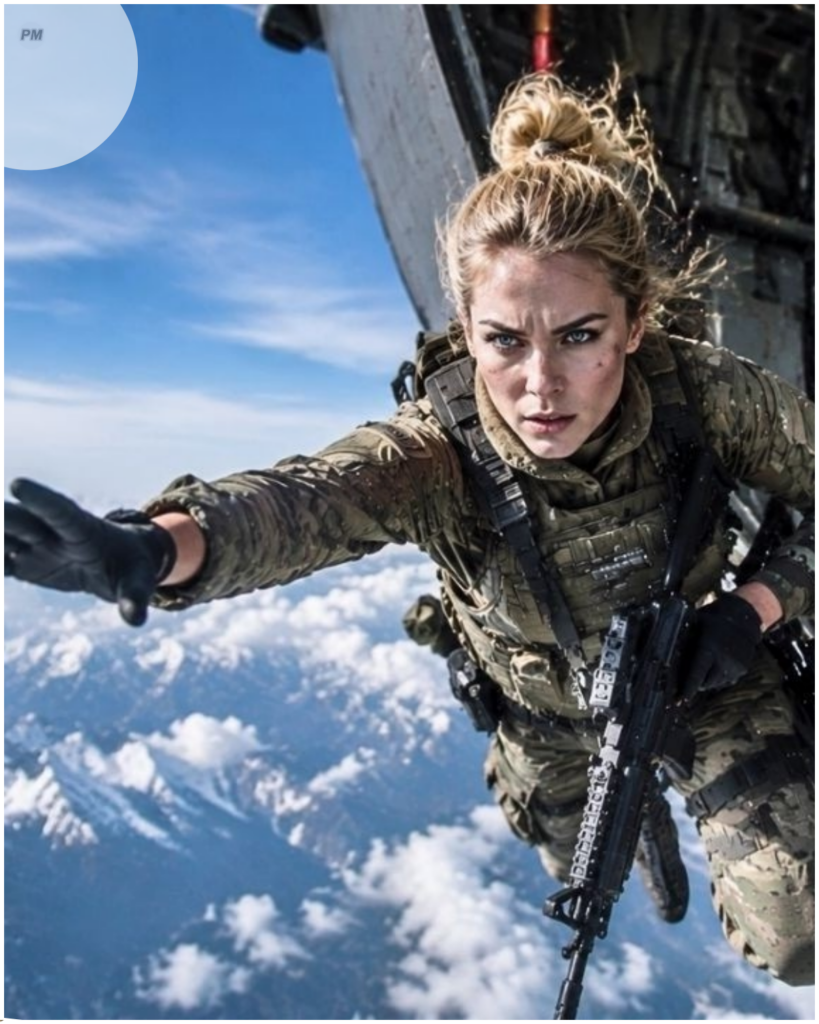
And so when Colonel Marcus Vance grabbed her vest in that shaking helicopter 6 months later and screamed, “Fly or die,” and threw her out into the storm, he wasn’t doing what he thought he was doing.
He thought he was ending her. He thought he was proving his point. He thought he was writing the last line of a story he’d already decided the ending to.
He wasn’t. He was handing Emily Carter the one thing she had spent her entire life learning how to use.
He was handing her his weakness. And down in that valley, buried to her chest in the exact snowdrift her memory had promised her, Captain Emily Carter dug herself free, and stood, and looked up into the storm, and began to think.
Not about survival. She had already survived. The fall was over. That part was easy.
She thought about the valley she knew by heart. She thought about the enemy unit somewhere out there in the dark, the one command had sent her to observe, the one that didn’t know a United States Army captain had just fallen out of the sky into their backyard.
She thought about the forward observation team still out there, still waiting, still counting on a delivery that Vance’s arrogance had just thrown into the snow.
And she thought about the men in that helicopter flying back to a warm base to write a lie about a tragic accident, believing they had gotten away with it, believing the story was over.
A slow, cold certainty settled over her, steadier than the storm, steadier than her own hammering heart.
They had made three mistakes, and they didn’t even know it. The first mistake was thinking the fall would kill her.
The second mistake was thinking that being alone behind enemy lines made her helpless. When the truth was the exact opposite, because a person nobody knows is out there is the most dangerous person on any battlefield.
And the third mistake, the one Vance would understand last and regret most, was the simplest of all.
They had spent years teaching Emily Carter how to survive. They had trained her, sharpened her, drilled every skill of endurance and observation and patience into her until it was part of who she was.
And then, they had taken all of that, everything they had made her, and they had dropped it into a battlefield and walked away, believing they were throwing away something weak.
They weren’t. They were arming it. Emily Carter checked her body one more time. She oriented herself against the eastern ridge.
She found north. She took a slow breath of the freezing air, and she felt something inside her go very quiet and very clear, the way it always did right before she did something no one thought she could do.
“Okay,” she said softly to the storm, to the mountains, to the men who had thrown her away.