When the investigators came for their statements,…
When the investigators came for their statements, Emily gave hers first, and she told the truth, all of it, exactly as it happened.
Because the truth was the only thing that had ever served her. But she told it whole.
She [snorts] told them that Vance had built the trap. She told them that Briggs had frozen and signed a lie under threat, and that it had eaten him alive until he broke it himself.
She told them that Kowalski had opened that door. Yes. And that Kowalski had also spent every hour after it torturing himself into becoming the man who blew the whole thing open, who stood up in a room full of his superiors and confessed his own part to save her when staying silent would have kept him clean.
“I’m not going to tell you they’re innocent,” Emily said to the investigating officer. “They were there.
They were part of it, but I’ll tell you this, when it mattered, when it actually counted, when there was a choice between protecting themselves and saving me, they chose me.”
Kowalski flew into that valley. Briggs burned his own cover to get the mission launched.
“Whatever they were 3 days ago, that’s who they are now, and I’d want both of them in my crew tomorrow.”
She paused. “Weigh that however you weigh it, but weigh it.” The investigation would run its course.
Vance would face the full weight of what he’d done, and it would be heavy, and it would be right.
Briggs and Kowalski would face consequences, too. Lighter ones, tempered by their choices and by the testimony of the one person who had the most right to condemn them, and instead chose to speak for them.
That was justice, and Emily let it [clears throat] work because she believed in it the way she believed in the mission, the way she believed in the map inside her own head.
But the story that spread through the army in the weeks and months that followed was not the story of the investigation.
It was the story of the captain who fell. It traveled the way the best true stories travel, from base to base, mouth to mouth uh mouth, growing more accurate rather than less because the truth of what Emily Carter had done needed no exaggeration.
Pilots told it in ready rooms. Sergeants told it to new recruits. It reached places Emily had never been and people she would never meet.
And everywhere it went, it carried the same lesson, the one that mattered most, the one Emily had been trying to teach a briefing room full of daughters 6 months before any of them ever knew her name, that you cannot measure a soldier by how they look sitting in a chair, that the person everyone underestimates is often the most dangerous person in the room precisely because everyone underestimates them, that the ones who get thrown away sometimes turn out to be the ones you should have feared.
Ray Delgado recovered, and he did exactly what he’d promised on that stretcher. He told the story to anyone who’d listen for the rest of his career, and he never once told it without saying the same thing at the end.
“She came into an enemy camp with a knife and pulled me out of a chair, and then she carried me for 3 days, and she never once, not for a single second, considered leaving me behind.”
Kowalski found Emily a few days after they got back when the medical checks were done and the debriefs were finished and the base had settled into the strange quiet that follows a story too big for it.
He found her outside the hangar alone, and he came up beside her, and for a while neither of them said anything.
“I keep trying to figure out how to say it,” Kowalski finally said, “and there’s no way that’s big enough.”
“Then don’t,” Emily said. “You already said it. You said it when you came out of that aircraft before the skids were even down.”
She looked at him. “You made a bet against me once in the ready room.
You [clears throat] remember?” Kowalski winced. “I remember.” “You should have taken my advice and bet the other way.”
And there was, for the first time since the valley, the faintest ghost of a smile at the corner of her mouth.
“You’d be a rich man.” Kowalski let out a breath that was half a laugh and half something that hurt too much to be a laugh.
“Carter, Emily, for what it’s worth, and I know it’s not worth much.” He turned to face her fully.
“You’re the best soldier I’ve ever served with, and I helped throw you out of a helicopter.
I’m going to carry that till the day I die.” “Good,” Emily said, not unkindly.
“Carry it. Not because I want you to suffer, because the day the army stops having men who’d carry that is the day it stops being worth serving in.”
She put a hand on his shoulder briefly, and it was the closest thing to forgiveness a man like Kowalski would ever be able to accept without falling apart.
Learn it. Teach it. The next time there’s a young officer walking into a room full of people who’ve already decided she can’t do the job, you be the one who bets on her.
That’s how you pay me back. Not to me. Forward. And Kowalski nodded and could not speak.
And Emily let him keep his dignity by turning her eyes back to the mountains, the one she’d fallen into and fought across and walked out of.
And they stood there together in a silence that had finally completely changed its shape.
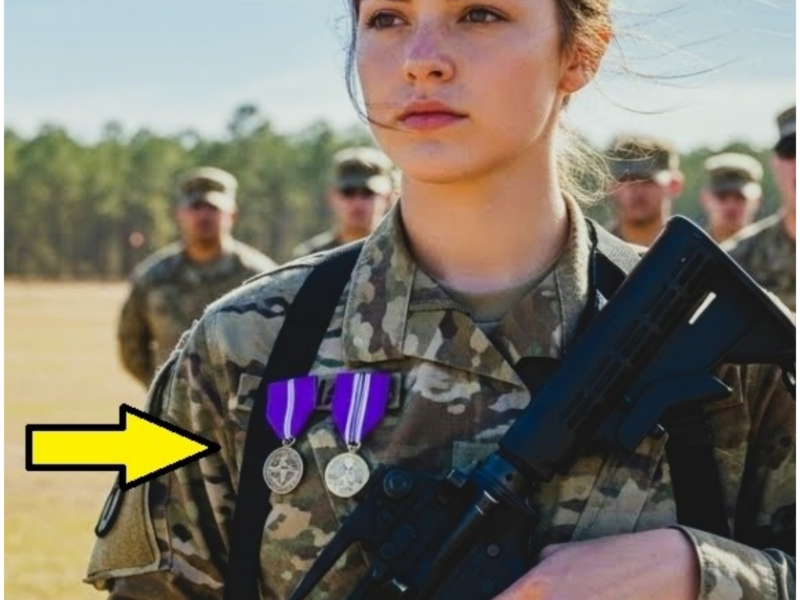
Months later they gave her a medal. There was a ceremony and the same briefing room that had once gone silent with doubt when she walked in now stood at attention when she entered.
The officers who had questioned whether she could handle a mission meant for veterans stood in their dress uniforms and watched a captain they’d underestimated receive the recognition she’d never asked for and had earned a hundred times over.
And when they pinned it on her and the room applauded, Emily Carter stood there and felt more than pride, a kind of quiet completeness.
Because she had not come back for this. She wanted to be sure of that standing there and she searched herself for it the way she searched for everything honestly all the way down and she found that it was true.
The medal was fine, the recognition was fine, but it was not why she had done any of it.
And if they had given her nothing at all, if she had walked out of that valley to no ceremony and no applause and no medal, she would not have felt cheated.