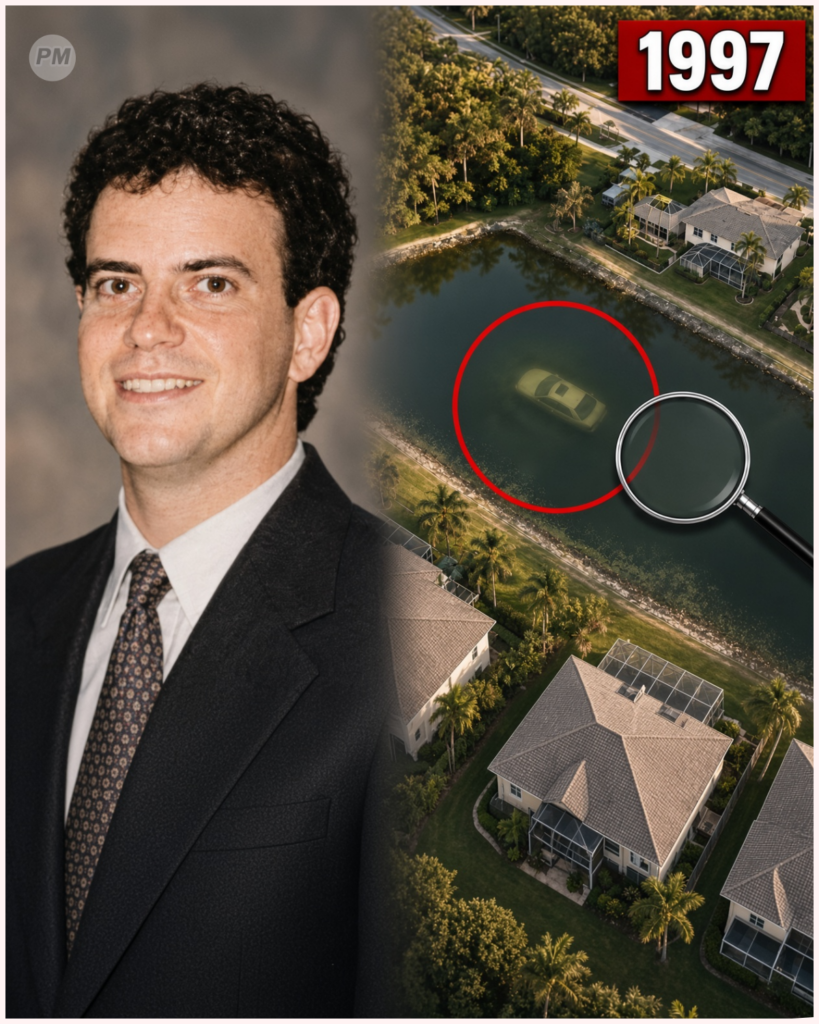
The skeletal remains recovered from the white 1994…
The skeletal remains recovered from the white 1994 Saturn SL pulled from the retention pond on Moon Bay Circle in Wellington, Florida, belonged to William Earl Molt.
His family was notified by the Palm Beach County Sheriff’s Office. After 22 years and 10 months, they had an answer.
There was no courtroom drama, no arrest, no sentencing hearing, no detective standing at a podium announcing a breakthrough in a major investigation.
The resolution of William Moltz’s disappearance was as quiet as the man himself had been.
A phone call, a confirmed identification, a case file updated from open to resolved. The neighbors of Grand Isles processed the news the way people always do when something unthinkable turns out to have been happening in their own backyard.
Brian Martin, a resident of the community, told reporters that if there was any upside to the situation, it was that the family finally knew what had happened to their loved one.
He offered his condolences. His wife, Lorie Martin, described the discovery as deeply shocking to everyone who lived there.
And it was shocking not because of the nature of what happened to William Molt, which was tragically simple and accidental, but because of the sheer duration of the concealment, 22 years in a pond surrounded by occupied homes.
In a place where children played and adults relaxed, and families built their daily lives within yards of where a man’s remains had been sitting since before the homes were even built.
The Charlie Project, the missing person’s database run by researcher Miyagen Good, updated its file on William Earl Molt and marked his case as resolved.
Good noted that the vehicle had been visible on Google Earth satellite imagery since at least 2007.
Another name moved from the missing column to the found column. Another file closed. Closure is a word that gets used often in cases like this, but it’s a complicated word and it doesn’t always mean what people want it to mean.
William Molt’s family no longer had to live with the question of what happened to him.
That particular torment, the not knowing, the wondering, [music] the imagining every possible scenario was over.
But the answer they received was not one that offered much comfort. Their loved one had died in a quiet accident on a dark night less than 20 m from where they were searching for him.
In a body of water that nobody ever thought to check. He had been visible from satellite imagery for over a decade.
A stranger browsing the internet on an idle afternoon found him before any organized effort ever did.
There is no way to make that feel like justice. There is no framework that turns 22 years of unanswered suffering into a satisfying resolution.
It’s simply an answer. A terrible, simple, accidental answer. A man drove into a pond on a dark night and nobody knew for more than two decades.
But within that answer, there is something else. Something that extends beyond the Mold family and beyond the Grand Isles community.
William Mold’s case demonstrated in a way that no theoretical argument could that the tools to resolve cold disappearances already exist.
They are available. They are free. They are sitting on every laptop and every smartphone in the [music] world.
The satellite imagery is there. The aerial photography is there. The sonar technology is there.
What has been missing in case after case after case is not the technology. It’s the human act of looking.
One man looked. One man on one ordinary afternoon opened Google Earth and zoomed in on a retention pond in his old neighborhood.
And a 22-year-old cold case was solved. Not by a detective, not by a forensic lab, not by a tipline or a reward or a deathbed confession, by a former neighbor with nothing better to do on a weekday afternoon than look at where he used to live.
That is both the tragedy and the promise of William Molt’s story. The tragedy is that it took so long.
The promise is that it happened at all. Because if a stranger’s idle curiosity could solve this case, it could solve others.
And somewhere right now, in a retention pond in Florida, in a canal in Texas, in a lake in Michigan, there may be another car sitting just beneath the surface.
Another family waiting for a phone call. Another answer hiding in plain sight, waiting for someone to open Google Earth and look.
William Earl Molt, [music] born March 26th, 1957. A mortgage broker in Palm Beach County, Florida.
A quiet man who kept to himself. A man who went to a nightclub on a Friday night, called his girlfriend to say he was coming home, and meant every word.
He wasn’t a famous case. He wasn’t a headline. He was a person who loved someone and was loved back.
And who spent [music] 22 years in the dark water behind someone’s house, waiting for anyone to look down.
The satellite saw him. A stranger found him. And finally, after all those years, William Molt came home.
If this story stayed with you, share it with someone. These cases get forgotten far too easily, and every share keeps them visible.
If you want to keep following Cold Case Redemption as we tell the stories of the ones who were finally found, subscribe and turn on notifications.
Every case here went cold. Every case here found its way back. We’ll see you in the next one.