And a stranger with a laptop in a few idle minutes…
And a stranger with a laptop in a few idle minutes who saw what no one standing on the ground ever could.
So, what actually happened on the night of November 7th, 1997? The complete truth will never be known.
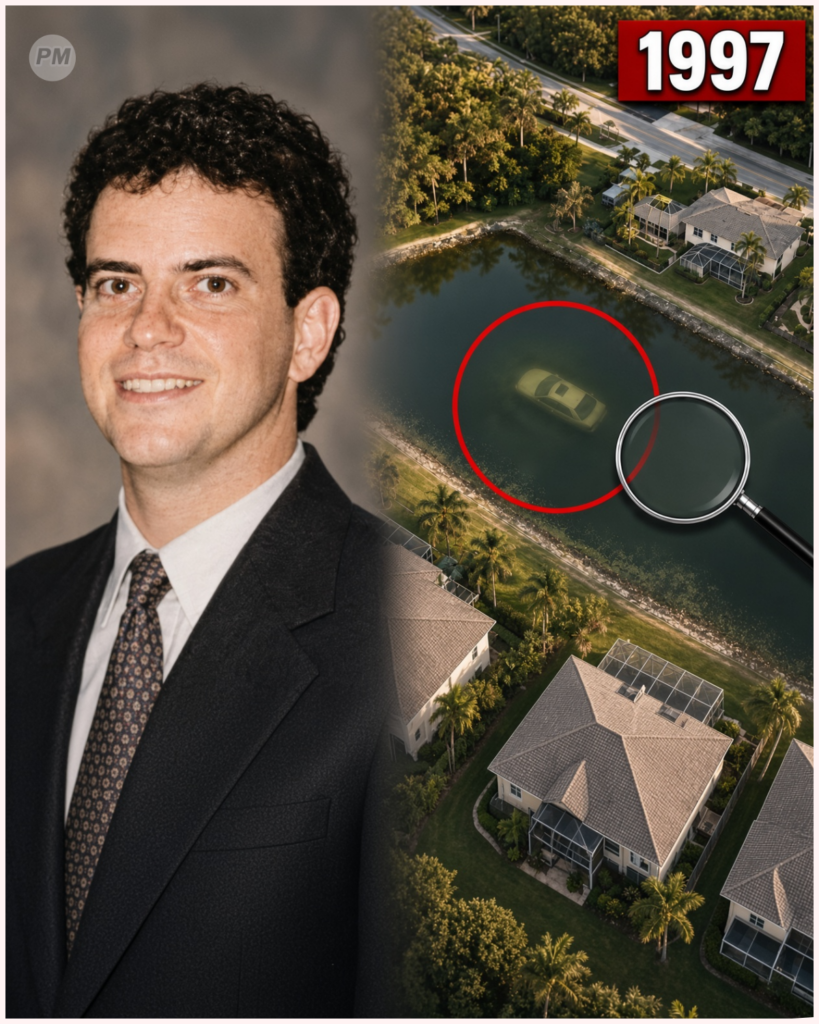
22 years of submersion in a Florida retention pond destroyed whatever physical evidence might have told the full story.
[music] There were no skid marks preserved from that night, no surviving security camera footage from the area, no witnesses who heard or saw anything, and no forensic evidence that could be recovered from the vehicle or the remains after more than two decades underwater.
In 1997, security cameras in an active construction [music] zone would have been rare anyway, but investigators were able to construct a plausible account of what most likely happened based on the circumstances they did know.
William Molt left the nightclub in Lantana sometime around 11 p.m. He’d consumed several drinks during the evening, though witnesses said he did not appear obviously intoxicated.
He got into his white 1994 Saturn SL and began the drive toward home. The route from Lantana toward the Wellington area would have taken him west through Palm Beach County.
In 1997, stretches of this drive passed through areas that were considerably less developed than they are today.
The Grand Isles development, where his car was ultimately found, was in the earliest phase of construction.
The landscape surrounding the retention pond was not yet a residential neighborhood. It was a construction zone.
Cleared land, graded lots, partially built roads, [music] and open bodies of water with no barriers, no guard rails, no curbing, no fencing, and no lighting.
The retention pond had nothing around it to keep a vehicle from entering the water.
No concrete barrier, no metal railing, no reflective markers or warning signs, just open ground leading to the water’s edge.
In daylight, the pond would have been visible. At night, on an unlit stretch of road or cleared lot adjacent to a construction zone, it would have been almost impossible to see.
At some point during that drive, Molt’s car left the paved road and entered the retention pond.
Perhaps the drinks affected him more than the witnesses at the club had noticed. Perhaps he drifted off an unfamiliar road in the dark.
Perhaps the Saturn’s headlights didn’t illuminate the water until it was too late to stop.
Perhaps the ground sloped so gradually toward the pond that there was no jolt, no warning, no moment of alarm before the front tires went from dirt to water.
The car went in. The water rose over the hood, the windshield, the roof. The Saturn settled onto a ledge near the narrowest point of the pond between what would eventually become two rows of residential homes.
And by morning, the surface of the retention pond was still again. No debris floating, no oil slick, no tire tracks in the mud that anyone noticed.
Nothing at all to indicate that anything had happened. There was no crime, no villain, no conspiracy, and no foul [music] play.
Just a man driving home at night through a part of Palm Beach County that was being transformed from empty land into a suburban community who veered off the road into a body of water that swallowed his car silently and completely.
That quiet accidental simplicity is the hardest part of this story. There was no malice, no intent, no chain of events that could have been broken by someone making a different choice.
There was just a dark night, a construction zone without barriers and a body of water that didn’t care about the difference between a piece of debris and a man trying to get home to his girlfriend.
She waited [music] for him. She checked the clock. She looked out the window. She picked up the phone and put it down again, not wanting to seem like she was checking up on him, then picked it up again because the worry had outgrown any concern about appearances.
She called the nightclub. She called the hospitals. She called the people who might have seen him.
And when morning came without an answer, she called the police. For 22 years, she and everyone who loved William Mold had no way of knowing that he was already gone.
That by the time she started worrying, by the time midnight passed and the first real fear set in, it was already over.
He was sitting at the bottom of a retention pond 20 m from where they’d last heard his voice in a construction zone that would eventually become a quiet suburban neighborhood where other people’s families would live and laugh and eat dinner and look out at the water without knowing.
He told her at 9:30 p.m. That he was coming home. And he had been trying to do exactly that.
The road just didn’t let him finish the trip. The discovery of William mold in August 2019 did not happen in a vacuum.
It was one data point in a growing pattern that has been emerging over the past decade as satellite imagery, aerial photography, drone technology, and volunteer search teams have started finding the people that traditional investigations could not.
The closest parallel to Mold’s case occurred in Michigan. In October of 2006, a 72-year-old man named Davy Lee Niles left a bar in Byron Center, a small community south of Grand Rapids.
He never arrived home. His family reported him missing. Police searched, found no leads, and the case went cold.
9 years later, in November of 2015, a man named Brian Houseman was decorating a Christmas tree on a bucket lift at the Cook Funeral Home in Byron Center.
From his elevated vantage point, roughly 20 ft above the ground, he happened to look toward a nearby retention pond, and he saw the outline of a vehicle beneath the surface.
Divers from the Kent County Sheriff’s Office recovered a Chevy Corsica from the pond. Inside, they found Davy Lee Niles’s wallet and his skeletal remains.
DNA testing confirmed his identity. He had been sitting in that pond for 9 years, less than a block from where he was last seen in a car that had been faintly visible on Google Maps satellite imagery for years.