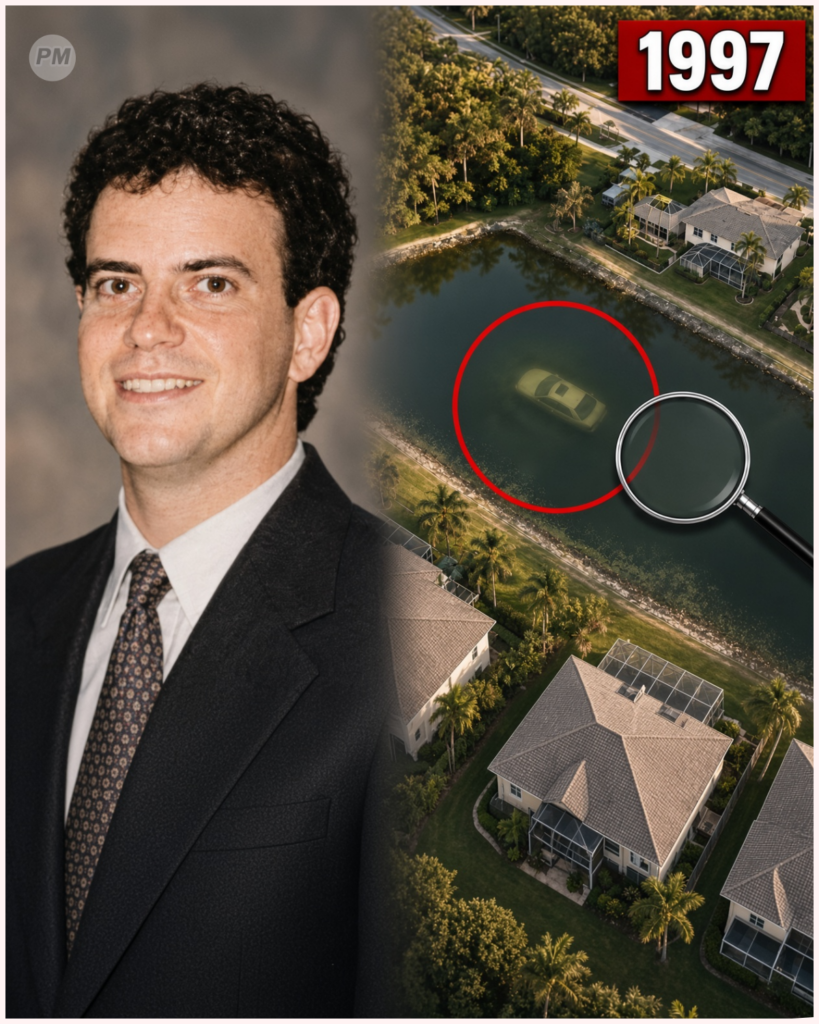
For 22 years, that was William Molt status
For 22 years, that was William Molt status. A name in a database, a line in a spreadsheet, a file in a cabinet.
That was all he was to anyone outside the circle of people who missed him.
To understand how a man in his car could disappear so completely in a populated part of South Florida, you have to understand what Florida actually looks like at ground level.
Not the tourism brochure version, the real thing. Florida is the flattest state in the country.
Its highest natural point sits only 345 ft above sea level. Beneath the surface, the water table hovers just below the ground across most of the state.
Mishbanthan Bay, which means that any hole dug more than a few feet deep fills with water.
The entire state is essentially a thin layer of land floating on a reservoir. This means water is everywhere.
Florida has approximately 30,000 lakes. It has more than 1,700 rivers and streams. It has over 700 natural springs.
And layered on top of all that natural water is a vast man-made infrastructure of canals, drainage ditches, and retention [music] ponds built to manage the rainfall that hammers the state from late spring through early fall.
Every housing development, every commercial park, every stretch of highway has water collection features built alongside it.
Retention ponds are the most ubiquitous. They are the engineered catch basins designed to collect storm water runoff and prevent neighborhoods from flooding during heavy rain.
They exist in virtually every residential development in the state and in most cases they sit right behind people’s houses.
A body of water, sometimes 50 ft wide, sometimes several hundred feet across, separated from someone’s patio by a strip of mowed grass.
Some have small fountains, some have banks planted with ornamental shrubs. Many have nothing, no fence, no guardrail, no barrier of any kind between the land and the water.
The consequences of this geography are severe and measurable. Florida leads the entire nation in vehicle submersion deaths.
Between 2013 and 2017, nearly,00 people in the United States died when their vehicles entered water.
One out of every six of those deaths happened in Florida. [music] The state recorded 185 fatalities during that period, 2 and a half times the number in California, a state with nearly double the population.
A separate analysis of Florida Department of Transportation data found 168 water related deaths from car accidents in the state between 2011 and 2016.
Bad roads and alcohol were contributing factors in roughly a quarter of those cases. Palm Beach County, where William Mold lived and disappeared, recorded the highest number of vehicle submersion fatalities in all of South Florida during that period [music] with 29 deaths.
The numbers tell a story, but the individual cases make it real. In 2017, when water managers lowered the level of the Boca Rio Canal in Boca Raton to prepare for Hurricane Irma, they found six vehicles on the bottom.
One of them was a Toyota containing the remains of a woman named Lorraine Pinto who had disappeared approximately 9 months earlier.
Six cars in one canal, one of them with a person inside. And nobody had known any of them were there until the water level dropped.
That’s the reality beneath the surface of Florida’s suburban landscape. The ponds and canals that residents walk past and drive past every single day are in some cases hiding people.
Right now under the dark opaque water that nobody thinks to look into because it’s just part of the scenery.
The retention pond where William Molt spent 22 years sits in the Grand Isles neighborhood of Wellington, Florida.
Grand Isles is a guardgated community of roughly 611 homes spread across five subdevelopments with names like Carmel, Harbor Cove, Emerald Bay, Emerald Point, and Salelo.
The homes were built between 1997 and 2000 by Sentex Homes and LAR. Today, it’s an established suburban neighborhood on the north side of Lakew Worth Road, just west of State Road [music] 7.
Neat houses, manicured lawns, families with children who ride their bikes on the wide, quiet streets.
The kind of community that markets itself on safety and tranquility. But in November of 1997, Grand Isles didn’t look anything like it does today.
The development was in its earliest stages of construction. [music] Foundations were being poured. Roads were being graded.
The area around the retention pond was an open, unlit construction [music] site. There were no completed homes around it, no street lights, no curbing, no guard rails, no barriers of any kind between the surrounding terrain and the open water of the pond.
It was just a body of water sitting in the middle of a half-built subdivision surrounded by dirt and construction equipment.
Lantana, where Molt was last seen alive, is roughly [music] 20 m from Wellington, a drive-thru Palm Beach County that someone could make in 30 minutes on a quiet night.
20 m of Florida roads. Some of them passing through areas that in 1997 were far less developed than they are today.
Some of them running alongside canals and ponds and open water with nothing to keep a drifting car on the pavement.
In the late 1990s, Palm Beach County was in the middle of a massive suburban expansion.
New developments were going up everywhere. Construction zones dotted the landscape, and those zones were often the most dangerous stretches of road at night.
Unfinished grading, temporary detours, missing signage, and newly dug retention ponds with nothing around them except raw earth and standing water.
