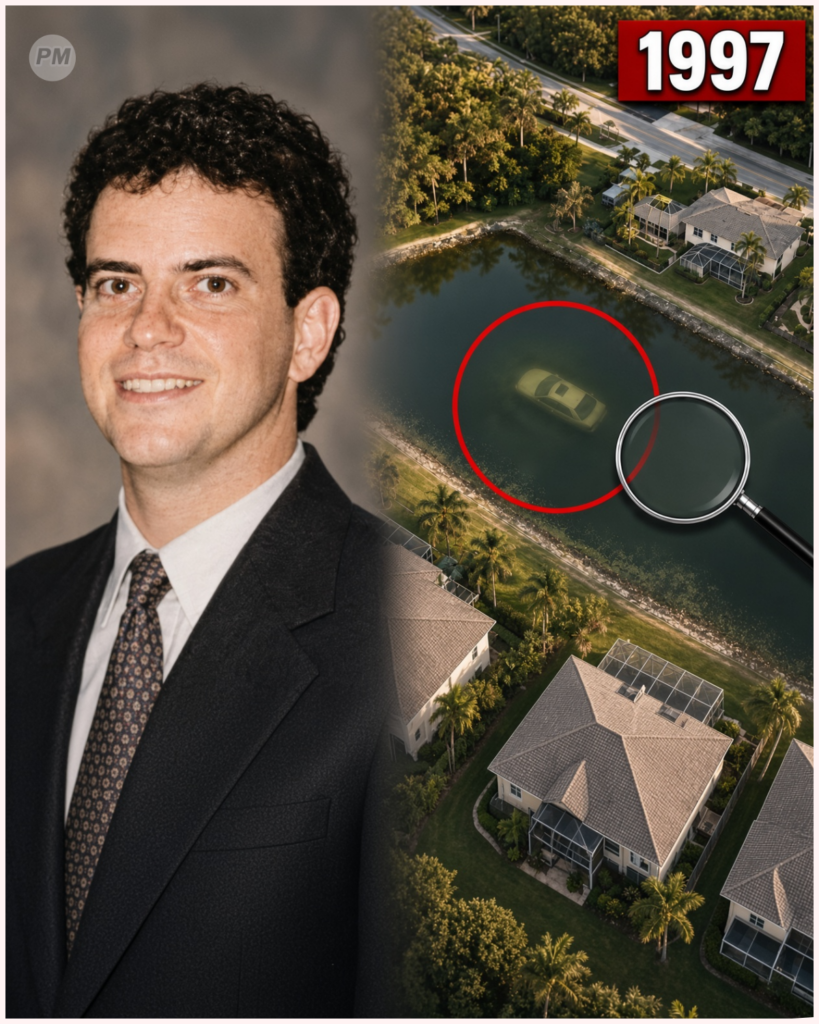
Nobody had noticed until a man standing on a bucke…
Nobody had noticed until a man standing on a bucket lift happened to look in the right direction at the right time.
The community responded by renaming the adjacent park the David Lee Niles Memorial Park. These cases are not coincidences.
They are symptoms of a problem that is far more widespread than most people realize.
Across the United States, vehicles sit submerged in ponds, canals, rivers, and lakes. And some of them contain people who have been listed as missing persons for years or even decades.
And increasingly, it is not detectives or organized search teams who are finding them. It is ordinary citizens, amateur investigators, and volunteer organizations using tools that either didn’t exist or weren’t widely available when these people first vanished.
Adventures with Purpose is one of the most prominent of these volunteer groups. Based in Bend, Oregon, and founded by Jared Leek, the organization has used Sidescan sonar equipment and professional diving gear to locate vehicles submerged in waterways across the country since December of 2019.
They have recovered dozens of missing people from underwater vehicles, many in cases that have been cold for years.
Their operations are documented on a YouTube channel with well over a million subscribers and they’ve become one of the most visible civilian forces in the modern cold case resolution landscape.
In Florida, where the problem is most concentrated, a team called Sunshine State Sonar has [music] focused specifically on the state’s waterways.
Co-founded by Mike Sullivan, the organization has located hundreds of submerged vehicles in Florida’s ponds, canals, and lakes, and has helped recover the remains of multiple missing persons.
One case involved Sandra Lamir, a woman who vanished in May of 2012 and whose car was found submerged near the Walt Disney World Resort area in December of 2023, more than 11 years after she disappeared.
Another conducted in partnership with the group Depths of History recovered Karen Moore, who had been missing since 2001 from a waterway in Davy, Florida.
Sullivan has estimated that roughly a thousand submerged cars may be sitting in Miami Dade County waters alone.
Many of those vehicles were stolen or illegally dumped, but some of them contain people.
People with names, people with families still searching for them. People who went missing 5 years ago, 10 years ago, 20 years ago, and have been lying under the surface of a body of water that someone drives past on their way to work every morning.
The tools available to find these people are improving rapidly. Google Earth’s satellite imagery archive now stretches back decades, with some locations having historical imagery from the 1980s and beyond.
The platform’s [music] time-lapse feature allows anyone to scrub through years of satellite photographs and watch a single location evolve over time.
Highresolution drone cameras can cover large areas of water quickly and cheaply. Sidescan sonar can map the bottom of a lake or canal and identify anomalies that would be invisible from the surface.
And yet, the scope of the problem is staggering. Over 600,000 people go missing in the United States every year.
The majority are found quickly, but thousands become long-term cases that may never be resolved through traditional methods.
An estimated 4,400 unidentified bodies are recovered across the country annually, and roughly a thousand of them remain unidentified after a full year.
The Department of Justice has estimated that as many as 40,000 sets of unidentified human remains may exist across the nation at any given time.
They have called this the nation’s silent mass disaster. How many of those people are in the water?
[music] How many are sitting in retention ponds behind someone’s house, in canals beside a highway, in lakes at the edge of a park?
The honest answer is that nobody knows. And that uncertainty is the most disturbing part of the entire equation.
William Mold’s case was cracked because one person on one afternoon for no particular reason opened Google Earth and looked at his old neighborhood.
That single act of idle curiosity accomplished what 22 years of official investigation could not.
It wasn’t technology that failed to find mold. The technology was there for over a decade.
It was attention that failed. Nobody thought to look. And these are just the cases involving water.
They don’t account for the people lost in forests, in abandoned buildings, in remote terrain, [music] in the countless other places where a person can disappear from view and stay hidden for years.
Water is simply the most common concealer because it is the most opaque. A car that goes off the road into a ditch will be found within hours.
A car that goes off the road into a Florida retention pond might not be found for decades.
The Mold case, the Niles case, and the growing list of recoveries by volunteer sonar teams all point to the same conclusion.
The infrastructure to find missing people in waterways exists right now. Satellite imagery covers virtually every square mile of the United States.
Drone technology has made aerial surveys affordable for anyone. Sidescan sonar can be mounted on a small boat and towed across a lake in an afternoon.
The question facing investigators, volunteer teams, and the families of the missing is not whether the tools exist to find these people.
They clearly do. The question is whether enough people are looking and whether law enforcement agencies strapped for funding and manpower can integrate these tools into their standard protocols for long-term missing person’s cases.
On September 10th, 2019, the Palm Beach County Medical Examiner’s Office confirmed what the vehicle identification number and the circumstantial evidence had already made almost certain.
