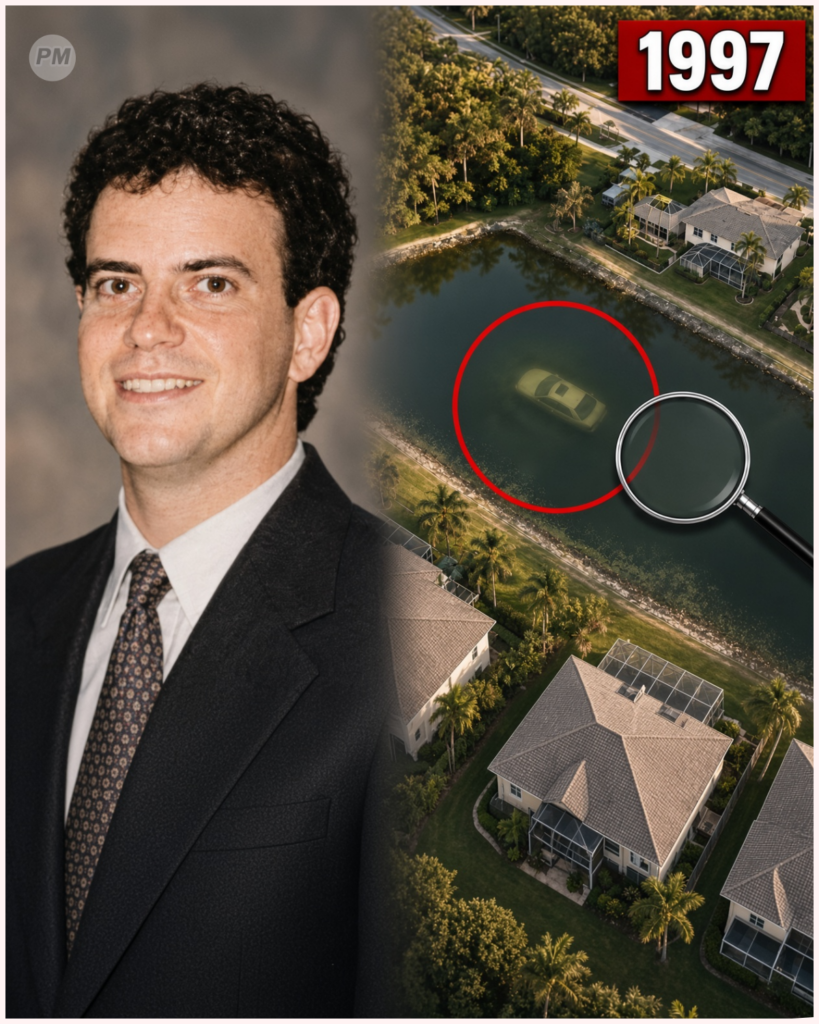
Last known location, a nightclub in Lantana, Flori…
Last known location, a nightclub in Lantana, Florida. Last known contact, a phone call to his girlfriend at approximately 9:30 p.m.
On November 7th, 1997. That was the totality of the information investigators had to work with.
And it wasn’t enough. There was no crime scene. Nobody found Mold’s car abandoned on a roadside or parked at a location where he might have gone.
Nobody reported seeing the Saturn in any unusual place. Nobody reported hearing a crash, a splash, a cry for help, or any sound at all that might have been connected to a vehicle leaving the road.
There was no evidence that Mold had met with anyone after leaving the club. There was no evidence of foul play.
There was no evidence of anything at all. The challenge facing the investigators was fundamental.
A missing person’s case with no starting point is one of the hardest things in law enforcement to work.
When someone is found dead, you process the scene. When someone’s car is found abandoned, you search the area.
When there’s a witness, you follow their account. But when a person leaves a known location in a functioning vehicle and simply ceases to exist somewhere along the road between there and home, there’s no scene to process, no area to prioritize, no [music] thread to follow.
Deputies searched, they canvased, they interviewed the people at the nightclub again, looking for anything that might have been missed the first time [music] around.
They checked hospital records across Palm Beach County and beyond. They checked with the medical examiner’s office.
[music] They ran his name through every database they could access, looking for any trace of the man or his vehicle.
Every avenue came back empty, and the geography of Palm Beach County didn’t help. The county stretches from the Atlantic coast deep into Florida’s interior, a landscape laced with roads, [music] highways, canals, lakes, drainage ditches, and man-made retention ponds.
The water is everywhere. [music] It runs alongside the roads. It sits behind strip malls and housing developments.
It fills the gaps between neighborhoods. A vehicle could leave the road in hundreds of places across the county and end up in water within seconds.
Swallowed by a canal or a pond with no trace left on the surface. Without an accident report.
Without a witness, without a single piece of physical evidence, the investigation reached a dead end.
The case went cold. Mold’s file joined the stacks [music] of long-term missing person’s cases that sit in every law enforcement office in the country, waiting for a break that may never come.
The cruelty of a cold missing person’s case is particular and unrelenting. When someone is murdered and the [music] case goes cold, the family lives with the injustice of no arrest, no [music] trial, no accountability.
But they know. They know their person is gone. They can [music] grieve. They can bury them.
They can begin however painfully the process of living without them. [music] When someone vanishes without a trace, there is no such beginning.
There is only the waiting. The family of a missing person exists in a permanent state of suspension.
They cannot grieve fully because there is no confirmed death. They cannot move on because moving on feels like giving up.
They cannot stop hoping because hope is the only thing left and they cannot escape the questions.
Is he alive somewhere? Did he choose this? Is he hurt? Is he dead? Where is he?
For more than two decades, the people who loved William Mold lived with those questions.
Every holiday, every [music] birthday, every November 7th that came and went. Over 600,000 people go missing in the United States every year.
The vast majority are found within hours or days, but thousands fall through the cracks and become cold cases, entries in databases, names on lists that grow longer with each passing year.
The Department of Justice estimates that approximately 4,400 unidentified human remains are recovered across the country each year, and about a thousand of those bodies are still unidentified after a full year.
At any given moment, as many as 40,000 sets of unidentified human remains may exist across the nation.
The DOJ has called this the nation’s silent mass disaster. 40,000 people who have been found but not named and an unknown number more who haven’t been found at all.
William Molt was one of them. Case number M074124414 in the NCIC database. A man who left a nightclub on a Friday night in November and became a line of data in a government system.
There’s a particular kind of purgatory that comes with being a cold missing person’s case.
The file doesn’t get destroyed. It doesn’t get officially closed. It [music] just sits there in a cabinet or a database.
Technically active but practically dormant. If new information comes in, someone will look at it.
But new information almost never comes in because there was nothing to build on in the first place.
The case exists in a state of bureaucratic limbo, not solved, not abandoned, just waiting.
And the family exists in the same limbo, not mourning, not hoping, just suspended in the space between the [music] two year after year with nothing to move them in either [music] direction.