You couldn't make out any words, but it rose and f…
You couldn’t make out any words, but it rose and fell like human speech. The first experiments were with dogs.
They’d fit a dog with a harness and a long rope and lower it down into the opening, or encourage it to walk in on its own.
Some of the dogs refused outright. They’d dig in their paws at the rim, whining, and nothing would get them closer.
The ones that did go in were given a set amount of time, an hour, sometimes a few hours, >> [music] >> and then pulled back out.
Some came back and some didn’t. With the ones that didn’t, the rope came back empty.
The dogs that did come back were examined by the camp doctor, and there was nothing wrong with them.
No injuries, no infections, no signs of poisoning. They were perfectly healthy, but every single one of them, within an hour of coming out, would lie down and fall asleep.
And they’d sleep for 3 days straight, waking only to drink water before going straight back to sleep.
On the fourth day, they’d get up as if nothing had happened. The old man said there was one more detail he’d never forgotten.
One of the dogs came back with something tangled in its fur, a few seeds and burrs from a plant.
The camp’s chemist was something of an amateur botanist, and he spent weeks going through reference books trying to identify them.
He never could. Whatever plant they came from, it didn’t grow anywhere in Chukotka. As far as he could tell, it didn’t grow anywhere at all.
The scientists wrote their reports and sent them up the chain, and after a while, a decision came back down.
The dogs weren’t enough. They needed to send people. At this point in the conversation, the reporter said, “The old man stopped for a long time.
He looked out the cafe window at the harbor for maybe a minute without saying anything.
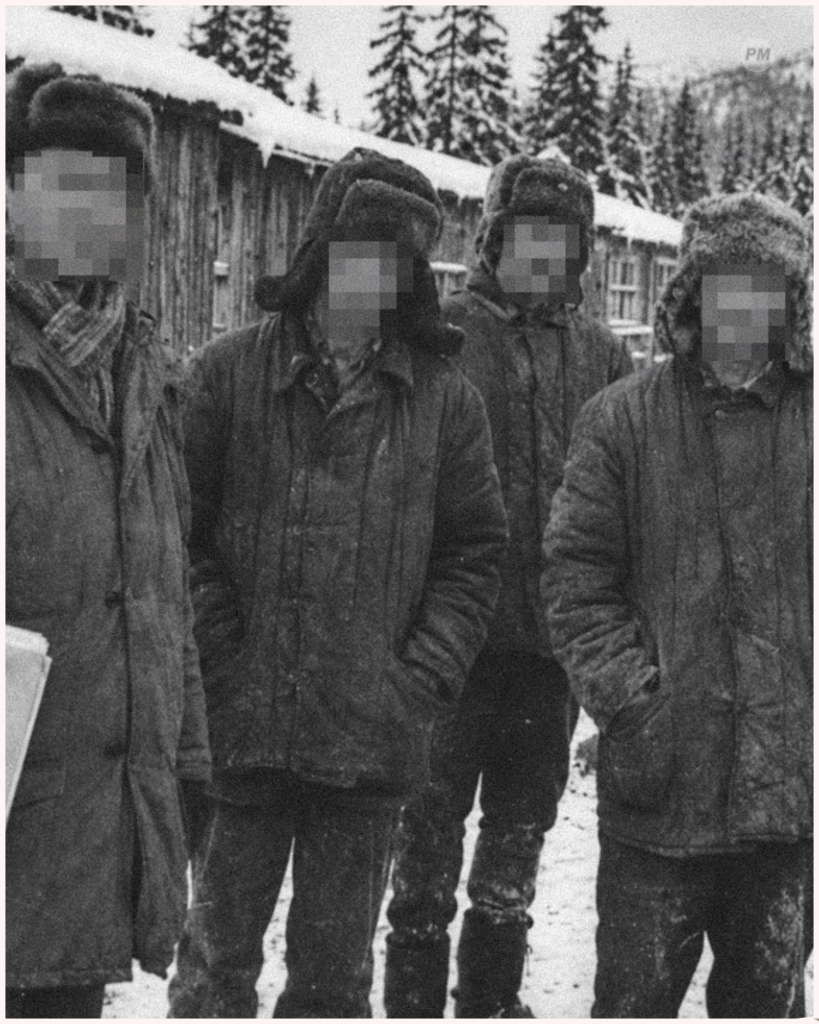
And then he went on. He said the people they sent were prisoners. They were brought in from the labor colonies further north.
The camps that still existed in those days across Siberia and the Far East. He didn’t know exactly how they were chosen.
He believed most of them were serving long sentences and that they’d been offered a deal.
Volunteer for a dangerous scientific task and if you came back, your sentence would be canceled.
You’d be a free man. Over about 2 years, he said, roughly 40 men went into the hollow.
They went in one at a time or sometimes in pairs. Each of them was fitted with a harness and a long strong rope tied off to a winch at the rim.
Each carried a portable radio and a small hand-cranked film camera and was told to walk in, keep talking on the radio, film everything he saw and come back when the rope was pulled three times.
Not one of them came back. The old man described the procedure. The man would climb down into the opening and the rope would pay out slowly behind him.
Then, at some point, it would stop moving. When the time was up, the men at the winch would start pulling it in and it would come back easily.
Much too easily. When the end came up out of the hole, the rope had been cut.
Not torn, not frayed or chewed, cut perfectly cleanly as if by a very sharp blade every single time.
And then there were the radios. For the first hour or two after a man went in, the radio would give nothing but static, a constant hiss.
The scientists would sit in the hut by the receiver listening. And then, sometimes, out of the static, they’d hear voices.
The old man said it sounded like Russian. The rhythm was Russian, the intonation was Russian.
>> [music] >> And every now and then you’d catch a word you recognized. But most of the words they didn’t understand.