And that was why why was breaking it now
And that was why why was breaking it now. And then he did something that the reporter said he would never forget.
He reached into his coat and took out an old photograph and put it on the table.
It was a black and white print, slightly faded, the edges worn soft from handling.
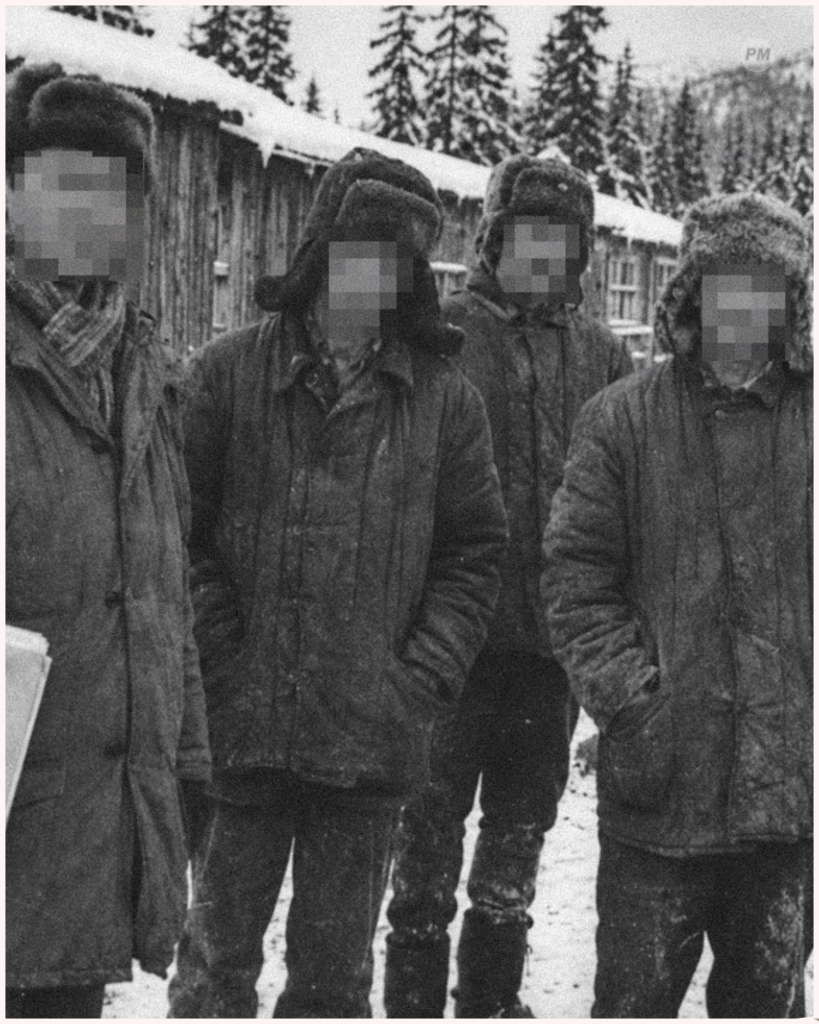
It showed a group of men standing in rows on the tundra with prefabricated huts behind them.
They were all wearing padded quilted jackets, the kind Soviet prisoners wore. Some were young, some were middle-aged.
Some of them were looking at the camera and some were looking away. The old man said this was the photograph taken of the prisoners when they arrived at the camp, before any of them went into the hollow.
He said it was all of them, about 40 men. Then he told the reporter what had happened a few years earlier, after he’d already moved to Alaska.
One day, he said, he found an envelope in his mailbox. There was no return address.
The stamp was Soviet and the postmark was Soviet, too, but it was smudged and impossible to read.
You couldn’t make out the city or the date. And remember, by then the Soviet Union had been gone for years.
Nobody was printing those stamps anymore. Nobody was postmarking letters in a country that didn’t exist.
Inside was a photograph. The same photograph. The same tundra, the same huts, the same rows of men in quilted jackets.
Except one of them was missing. The old man pointed to the place on his own copy, in the second row, where a young man was standing.
On the copy that had come in the envelope, he said, that spot was empty.
Not cut out, not painted over, not retouched in any way he could see. There was just a gap in the line where that man should have been, with the tundra visible behind it.
And on the back of that photograph, written by hand in Russian, there was one line.
The reporter had him translate it twice to be sure. It said, “We found the way.
We’re coming soon.” The reporter asked if he could see the second photograph, the one that had come in the mail.
The old man said no. He said he’d burned it. That was the end of the interview.
The old man drank his tea, which by then must have been stone cold, stood up, thanked the reporter, and walked out.
The reporter went back to the office and typed up his notes. He did some digging, but he couldn’t get anywhere.
He contacted a couple of academics who specialized in Soviet history and asked whether they’d ever heard of a classified research site on the Chukotka coast.
Nobody had. He tried to work out who the old man actually was, but the old man had been very careful.
He’d paid in cash, and he hadn’t left a phone number. So, the reporter decided to sit on the story for a while.
He wanted to meet the old man again, push him on details, see if he could get anything solid.
He never got the chance. About a month after that meeting, an old man was reported missing in that town.
The reporter recognized the description immediately. A couple of days later, his car was found.
It was parked on a gravel track on the shoreline, a few miles outside of town, at the very edge of the beach.
The doors were closed, but unlocked. The keys were in the ignition. The headlights had been left switched on, and the battery had run completely flat.
>> [music] >> And the car was facing out over the water, facing west across the Bering Strait towards Russia.