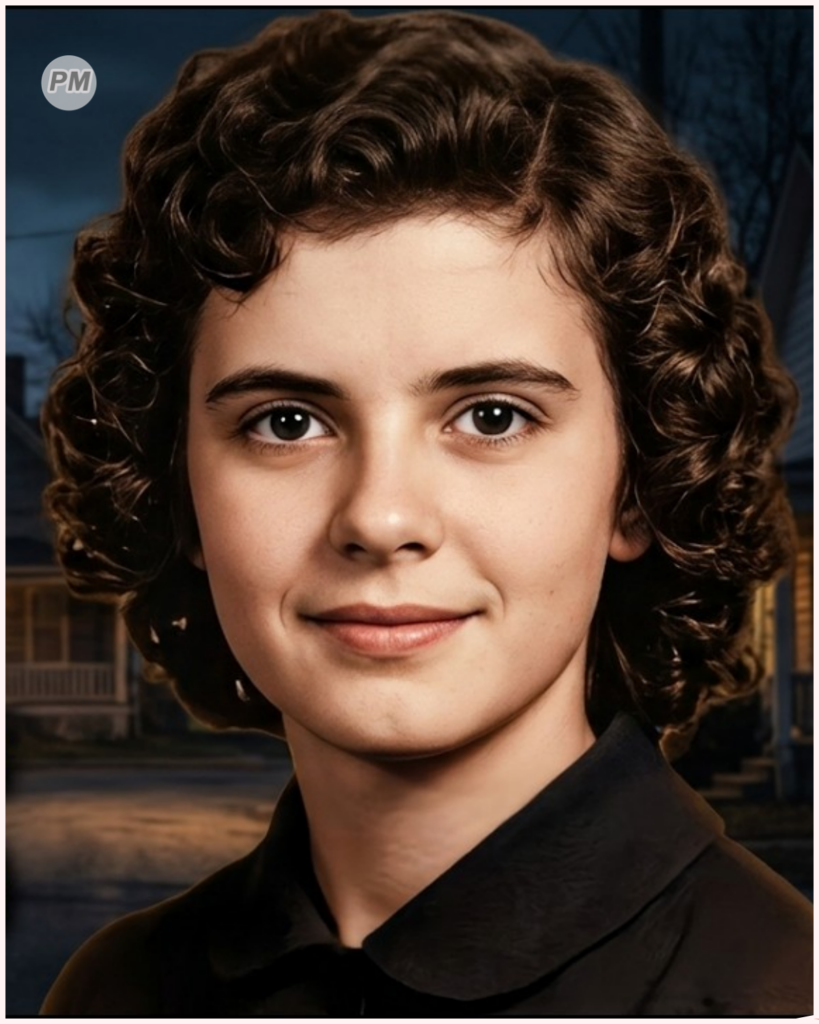
She hired an investigative genealogist to help her…
She hired an investigative genealogist to help her focus on matches from her mother’s side of the family.
Vera’s DNA went into the system, too, through Ancestry and 23andMe. And on Ancestry, Vera came back as a close match to a 20-year-old woman in the Toronto area.
Based on how much DNA they shared and on the young woman’s age, Christa worked out that only a handful of relationships were possible.
One of them was grandniece. In other words, [music] the young woman in Toronto could be the granddaughter of one of Vera’s siblings.
When Christa reached out, the young woman said she did not know anyone named Rosemary.
And as far as anyone can tell, she was telling the truth. She had no idea that her grandmother had ever gone missing in Montreal in 1954.
So they built the whole family tree. Because the family came from Germany, they brought in a German genealogist experienced with DNA testing there and Caroline Becker.
Becker entered the surname of Vera’s grandmother into a database she had built, and her software produced nine generations of ancestors.
Krista described the printout as a whopping 34 pages of tiny text. Becker then went through the DNA matches and ruled out anyone who was not related to Vera on both her mother’s side and her father’s side.
Relatives began adding their own DNA. In the end, more than 900 people filled out a family tree reaching back to the 1600s.
Using a website called DNA Painter, which maps the segments of DNA that relatives share, Krista confirmed it.
The 20-year-old woman in Toronto was Rosemary’s granddaughter. With the help of investigative genetic genealogists, professional DNA tools, and assistance from the German government, Krista said the probability was 100%.
Then the police came in. Detective Constable Michael Kelly worked in the Toronto Police Service’s Homicide and Missing Persons Unit, and he had used genetic genealogy before to put a name to an unidentified woman found in a Toronto park in 2020.
Now he went to digitized records from the 1950s and searched old Toronto area directories.
That search led him to people who confirmed they were Rosemary’s descendants, and it led him to the marriage certificate from June 1957.
There was one more test to run. Kelly compared the handwriting on that marriage certificate with the handwriting in the prayer book Rosemary had left behind in Montreal, the one she used to carry in her red purse.
They matched. Detective Constable Kelly concluded his investigation at the end of September 2022. After 68 years, Rosemary Doterline had been found.
She had died in 2009. The family had been searching for her for 13 years after she was already gone.
The family finally knew what had happened. What they did not know was why. Krista reached out to the young woman in Toronto a second time.
This time with proof. Through her, Krista and Vera connected with Rosemary’s family, including several of her sons and some of her grandchildren.
They had never heard her speak of Montreal. They learned about the cooking, the embroidery, and the red purses.
They learned she had been loved. But the more they learned, the less the story resembled anything they had imagined.
Detective Constable Kelly said that they had answered the question of what happened, but that the why and the how only raised more questions.
So what really happened in the fall of 1954? There are two ways to read the evidence, and both of them deserve a fair hearing.
The first reading is that Rosemary chose to leave. She was a teenager in a strange country.
Within three years, she was married and expecting a child, building a life in another province.
She lived for decades as an independent adult. She raised five sons, divorced, remarried, moved across the country, and ran her own business.
Nothing in the reported record shows anyone holding her against her will or preventing her from contacting her family in all the years that followed.
The second reading is that she was taken. She was 14. She spoke neither English nor French, and she knew no one in Canada outside her own family.
She left behind the two things her sister says she treasured most. Vera told Kelly that if Rosemary had truly run away, she would never have left her prayer book and her red purse behind.
She lived under false names with a false birth date and false names for her parents.
She would not cross the border. Her grandchildren remembered her giving inaccurate answers whenever anyone asked about her past.
Krista came away convinced that there was something Rosemary must have been afraid of, and she has wondered aloud what stopped her from ever saying anything.
Detective Constable Kelly framed it as a choice between two possibilities. Either she left voluntarily, he said, or was she taken and convinced not to look for her family.
He was honest about the limits of what anyone [music] could know. With no surviving police report, he said, he was relying on Vera’s account of events 68 years after they happened.
He said he believed Rosemary’s parents had been genuinely heartbroken. And on the central question, he admitted that everyone involved was guessing.
Here is what is not in doubt. A 14-year-old girl who could not speak the language of the city she lived in left home on an errand and never came back.
About two and a half years later, she was a 16-year-old bride with a false identity.
If she ever told anyone what happened in between, it has never been made public.
For Vera, the answer brought something she had not expected. She says that why her sister never got in touch with her birth family remains [music] the great mystery.
But she also says she is thankful that her sister’s skeleton never turned up somewhere in the Laurentian Mountains.
And she says she finds joy in knowing that Rosemary was surrounded by the love of her five children, her grandchildren, and her great-grandchildren, all of whom loved her dearly.
