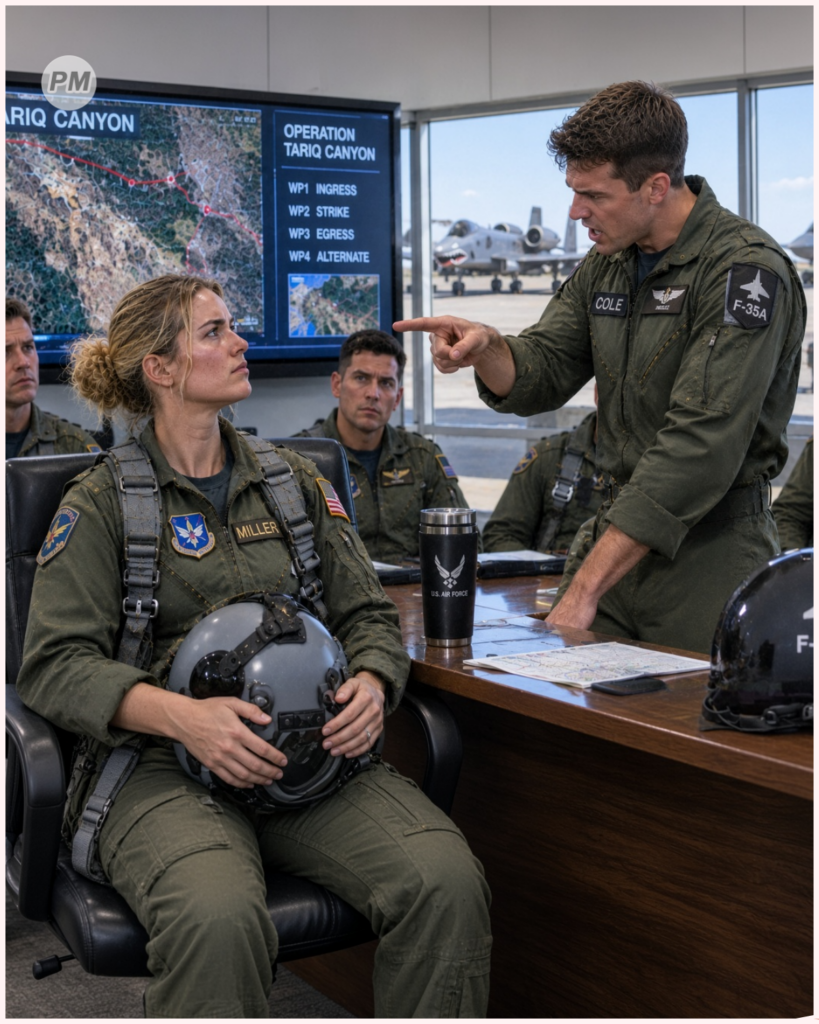
The hanger at Langley Air Force Base smelled like jet fuel and ambition. It was 0600 hours on a Tuesday and the base was already alive.
Engines warming, boots clicking on concrete, voices cutting through the cold morning air. A joint training exercise was scheduled for 0900 and every pilot on the roster was treating it like a performance because it was.
The evaluation team from the Pentagon was flying in specifically to assess readiness levels across the Eastern Commands fighter units and everyone knew that careers could move up or sideways based on what happened in the next 12 hours.
Captain Maya Reeves wasn’t on the pilot roster. She walked into hangar 4 with a clipboard under her arm and a coffee she hadn’t touched yet.
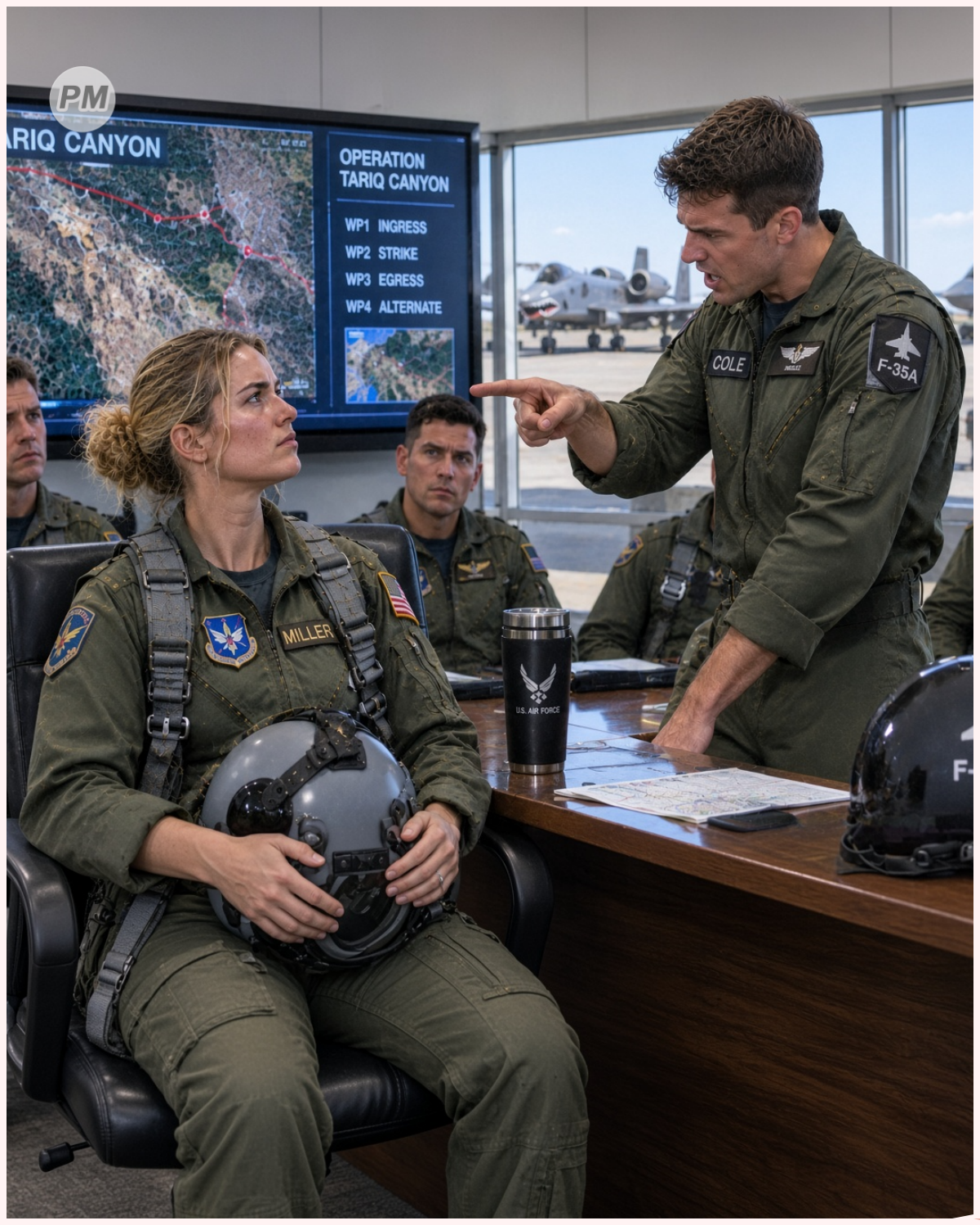
She was 34 years old, medium height, with the kind of quiet presence that people either respected immediately or completely overlooked.
Today, most people overlooked her. She was listed on the morning sheet as an aerospace system support specialist, a title that, in a hanger full of F35 pilots warming up their egos alongside their engines, essentially made her invisible.
She liked it that way. Maya moved along the row of aircraft with practiced efficiency, checking bleed air system readings, cross-referencing digital diagnostics with the physical gauges, noting fuel pressure levels that the automated systems sometimes failed to flag.
She wasn’t required to do this level of detail. Her assignment was administrative, confirm pre-flight checklists were signed, coordinate with the ground crew on support positioning.
But Maya had never been able to look at an aircraft and not read it.
It was the same way some people couldn’t walk past a crooked picture frame without straightening it.
She saw things others missed. She always had. She was crouching near the landing gear housing of the third aircraft in the row when she heard him.
Lieutenant Colonel Drake Harmon had a voice built for command. Loud, certain, the kind of voice that expected rooms to reorganize themselves around it.
He was 41 with a chest full of legitimate decorations and a reputation that preceded him through every base he’d ever walked into.
He was also the kind of man who had been told he was exceptional so many times that he’d stopped questioning whether it was true.
He stepped into the hanger with two of his fellow pilots flanking him like a formation, laughing at something he’d said.
And when he spotted Maya crouching near the wheel assembly of his assigned aircraft, he stopped walking.
Hey. His voice dropped into something that wasn’t quite a bark, but wasn’t far from it.
What are you doing near that bird? Maya stood. She looked at him without rushing.
Pre-flight systems check, sir. Bleed air gauge on this unit was showing a minor lag in the I didn’t ask for a systems check from support staff.
He said the words the way someone says them when they want everyone around to hear.
Get away from my aircraft. Last thing I need before an eval exercise is someone who doesn’t fly touching my equipment.
A few nearby crew members glanced over. Nobody said anything. Maya looked at him for exactly one second, not with anger, not with hurt, just with a kind of still measuring clarity, and then she nodded once, picked up her clipboard, and stepped back.
Drake turned to his pilots and said something low, and they laughed, and that was that.
Maya walked to the next aircraft and kept working. Master Sergeant Dileia Torres had watched the whole exchange from the operations bay doorway.
Dileia had been at Langley for 11 years. She had seen pilots come and go, had seen egos built and broken, and she had a gift for reading people that she’d never bothered to put on a resume because it couldn’t be quantified.
She watched Maya move to the next aircraft, steady, focused, completely unbothered, and something tugged at her.
She knew Maya had come from a previous posting under a classified assignment bracket. She knew the reassignment to support had been quiet and clean.
No scandal, no injury, no disciplinary record, just a transfer request approved without push back, which almost never happened unless someone very high up had decided to honor it without asking questions.
Dileia pulled out her access card and walked to the personnel records terminal. She typed in Maya’s name.
The file that came up required a secondary clearance confirmation, which almost never happened for a support specialist.
Dileia’s hand paused over the keyboard for a moment. Then she entered her credentials and kept reading.
She read for 4 minutes without moving. When she finally looked up, Drake Harmon was taxiing his F35 toward the runway, windows catching the early morning sun, looking every bit like a man at the top of the world.
Dileia looked back at the screen. Then she looked at the runway. Then she closed the file, walked to her desk, and quietly picked up her radio, not to call anyone yet, just to make sure it was charged.
Because if she’d read that file correctly, and she always read files correctly, the morning was not going to go the way Drake Harmon expected.
Not even close. Dileia Torres did not scare easily. She had worked through two hurricane evacuations, a base lockdown following a security breach, and a runway collision that had sent burning debris across 400 meters of tarmac while she calmly redirected foot traffic and kept communications running.
She was the kind of woman who, in a crisis, became quieter and more focused rather than louder and more frantic.
Her colleagues called it composure. Dileia called it math. When things go wrong, panic subtracts, calm multiplies.
But sitting at her desk with Maya Reeves personnel file open on the screen in front of her, Dileia felt something she rarely felt.
She felt like she had been missing something important for a long time, and she just found it.
Maya Reeves had enlisted at 19. Standard entry point, nothing unusual. She’d tested into avionics and systems engineering, scored in the 98th percentile on her technical aptitude evaluations, and been fast-tracked into flight school before her second year was complete.
What happened after that was where the file started reading differently from every other file Dileia had ever opened.
Maya had completed F/18 qualification ahead of her class. She’d been deployed at 23, unusually early, to a forward operating location in a region whose name in the file was replaced with a black rectangle.
She’d flown 112 combat sorties over two deployment rotations. 112. Dileia had worked alongside pilots her entire career and knew that number wasn’t just impressive.
It was the kind of number that turned people into legends or broke them entirely.
Maya had come back whole. She’d been awarded the Distinguished Flying Cross during her second deployment.
The citation was classified, but the award itself was confirmed, a small asterisk in the record that you’d miss if you weren’t looking for it.
Dileia had seen maybe three DFC recipients in her 11 years at Langley. She’d never met one who was currently doing pre-flight clipboard checks in a support role.
Then there was the incident from four years ago. The details were thin, deliberately thin.
The way files looked when someone had trimmed them on purpose, but what remained told enough of a story.
A carrier-based return flight, night conditions, partial hydraulic failure, radar system offline. Maya had brought an F/18 down on a moving carrier deck in the dark with instruments that were only partially functional using manual technique.
In what her commanding officers report. The one paragraph that hadn’t been redacted described as extraordinary situational awareness and aircraft intimacy that I have not observed in 22 years of naval aviation.
The aircraft had been saved. So had the carrier deck crew who would have been in the path of a catastrophic landing.
Maya had asked for a transfer to a support role 6 weeks later. Her request had been approved within 48 hours by a two-star admiral whose name Dileia recognized as someone who didn’t approve things quickly unless he considered them personally important.
Dileia sat back in her chair. There was one more entry near the bottom of the file, a certification code that she had to look up in the reference index because she’d never seen it used before in a personnel document.
When the reference page loaded, she read it twice. Maya Reeves held an emergency systems override certification for the F35B platform.
It was a qualification that existed in theory written into the program safety architecture as a contingency, but which required a training pipeline, so demanding that fewer than 20 people across all branches of the US military currently held it.
The certification meant that in the event of an F35 emergency where standard protocols had failed and the pilot needed real-time external guidance from someone who understood the aircraft’s failure architecture from the inside, Maya was one of the people authorized to provide that guidance.
She was in the plainest terms one of the most qualified people on this base to handle an F35 emergency.
She was currently walking between hangers with a clipboard. Dileia closed the file, stood up, and walked to the window that faced the runway.
Drake’s aircraft was already a shape in the distance, climbing cleanly into the pale morning sky, banking north toward the exercise corridor with the easy confidence of a man who had never once had to wonder whether he belonged in the air.
Dileia thought about what she’d read. She thought about the bleed air gauge Mia had been checking.
When Drake told her to step away, she picked up her radio again. This time, not just to confirm it was charged, but to find out exactly where Captain Reeves was right now and make sure she stayed within reach of the operation center just in case.
Because Dia Torres had been doing this long enough to know one thing above all else, the people who get dismissed in the morning are very often the ones the room is desperate for by afternoon.
The exercise launched at 0847, 13 minutes ahead of schedule, which was Drake Harmon’s doing.
He’d pushed the timeline forward during the final briefing, citing optimal weather window and ceiling conditions, and the evaluation team had approved it without argument.
That was the thing about Drake. He moved through institutional structures the way water moved through open channels, always finding the path that kept him in front.
It wasn’t manipulation exactly. It was confidence expressed as momentum, and most organizations rewarded it without noticing they were doing so.
His fourpilot formation climbed out of Langley in tight sequence and turned northeast over the Chesapeake, leveling off at 22,000 ft as the exercise corridor opened up ahead of them.
The sky was clean, a pale winter blue with almost no cloud cover, and the aircraft responded with the crisp precision that made the F35 the most capable fighter platform the country had ever fielded.
Drake felt it in his hands the way good pilots always felt their aircraft. Not as a machine they were operating, but as an extension of their own body, something that moved when they thought rather than when they commanded.
He loved this. He always loved this. Whatever else was complicated about his life, the politics, the paperwork, the endless evaluations and reports, this was not complicated.
Up here, everything made sense. In the ground operations center, Maya was at a workstation in the back row.
She wasn’t supposed to be in the operation center at all. But after finishing her morning checklist, she’d asked Dileia quietly without explanation if there was an available terminal in the op center with live telemetry access.
Dileia, who had read the file and needed no further convincing, had simply handed her a temporary access badge and pointed to the back row without a word.
Maya sat down, pulled up the telemetry feed for the four aircraft in Drake’s formation, and began reading the numbers.
For the first 20 minutes, everything looked normal. The evaluation team was clustered at the front of the room around the primary display, watching the simulated engagement scenarios unfold.
Drake’s formation was performing well. Crisp formations, clean communication, aggressive engagement geometry that the evaluators were noting with visible approval.
Drake was putting on exactly the kind of show he’d intended to put on. Maya wasn’t watching the display screen.
She was watching the data columns. And specifically, she was watching the bleed air system readings on Drake’s aircraft.
The same system she’d flagged that morning. The same reading Drake had waved her away from, the same gauge that had been showing what she described to him as a minor lag before he’d cut her off.
The lag was no longer minor. It was subtle enough that the automated alert threshold hadn’t been triggered.
It was subtle enough that a pilot focused on flying an exercise would almost certainly miss it.
But Maya had grown up reading aircraft the way other people read faces. And what she was seeing in those numbers was a system under stress, a small dysfunction compounding slowly, the way a hairline crack compounds under repeated load until the moment it doesn’t.
At the front of the room, the evaluation team applauded a particularly clean simulated intercept by Drake’s formation.
Someone said his name appreciatively. Someone else wrote something on a notepad. Maya watched the numbers climb.
She wasn’t afraid. She wasn’t angry. She was simply present the way she had always been present in the moments before things went wrong in the sky.
Steady and cleareyed, already moving through the problem in her mind while everyone around her was still watching the show.
8 minutes later, Drake Harmon’s aircraft began to die. It started as a sound. That was the thing pilots never forgot.
Not the instruments, not the warnings, not the voice of the aircraft in their hands going wrong.
It was always the sound first. Something that didn’t belong. A note in the engine’s voice that the body recognized before the brain caught up.
Drake heard it at 22,400 ft, cruising at 480 knots, and his hands were already tightening on the controls before his eyes had moved to the instruments.
The bleed air system failure cascaded in the way catastrophic failures always did in complex systems.
Not all at once, but in sequence, each failing component pulling the next one with it like dominoes laid too close together.
The engine stall warning lit at 22,000 ft. Altitude hold degraded at 21,600. His thrust response became sluggish, then erratic.
The aircraft no longer moving the way he thought at it, but resisting him, pulling against his inputs like a horse that had decided it didn’t trust the rider anymore.
“Eagle 2, I have an anomaly,” he said over the formation channel. His voice was controlled.
He was trained for this, but the word anomaly was doing a lot of work.
His wingman, Lieutenant Carver, came back immediately. Eagle lead confirm. Engine stall indicator confirmed. Bleed air failure.
I’m running the restart sequence. The restart sequence did nothing. He ran it again. The engine continued its slow, grinding stall.
His altitude was dropping. Not in freef fall. The aircraft was still flying, still generating lift from its second engine and its aerodynamic profile.
But the trajectory was wrong and getting wronger. And the math of altitude plus descent rate plus distance to runway was starting to produce numbers he didn’t like.
In the operations center, the moment Drake’s emergency indicator lit on the main display board, the room transformed.
The evaluation team stepped back. Captain Riyles was on the radio instantly, pulling Drake’s telemetry to the main screen.
The base commander, General Patricia Oay, appeared in the doorway within 90 seconds. She had a gift for being exactly where she needed to be before anyone had thought to call her.
She was 56 with clothescropped gray hair and eyes that assessed a room the way a pilot assessed an approach quickly, completely without sentiment.
She walked to the front of the room, took in the display board, took in the radio traffic, and then turned and looked at the room.
Her eyes landed on Maya. Maya was already standing. She hadn’t moved toward the communications console yet.
She was waiting because walking up uninvited to take over emergency comms in a room full of ranked officers was not something you did without authorization.
But she was standing and her posture said everything that her rank currently prevented her from saying aloud.
General Oay crossed the room to Captain Riyles. What’s the aircraft status? Riyles ran through the technical summary in 15 seconds.
Oay listened without interrupting. Then she turned to look at Maya again, and this time the look was a question.
Maya answered it without being asked. Bleed air failure cascading into engine stall. His restart sequence won’t work because the valve seat in the primary bleed port has seized.
That’s not in the standard restart checklist. There’s a manual override bypass, but it’s not intuitive, and the documentation for it is in the platform’s emergency architecture annex, not the cockpit quick reference card.
If he doesn’t get specific guidance in the next 4 minutes, he’s going to lose the aircraft.
The room was very quiet. General Oay looked at Riyals. Riyals looked at the display.
The aircraft’s altitude was 19,200 ft and dropping. Oay said. Give her the channel. Riyles hesitated, not out of stubbornness, but out of pure procedural instinct.
This wasn’t how it worked. You didn’t hand emergency comms to a support specialist. There were protocols.
General Oay turned to look at him, and the temperature in her voice dropped exactly 3°.
Captain, give her the channel. Riyles handed over the headset. Maya put it on, adjusted the mic, and took one breath.
Not to calm herself. She was already calm. It was something else. It was the breath of someone stepping back into something they had never really left, like a musician picking up an instrument they’d set down for a while and finding it still perfectly in tune.
She keyed the channel. Outside at 18,900 ft, Drake Harmon heard a woman’s voice in his ear, and his first instinct, trained into him by years of expecting certain voices in certain roles, was resistance.
He had no idea what was coming. Eagle lead, this is Captain Reeves. I’m with ground operations.
I need you to stop what you’re doing and listen to me. Drake’s response came back in under 3 seconds, clipped and tense.
I need an F35 system specialist. Not Who is this? Get me someone qualified. Maya didn’t flinch.
Your bleed air primary valve seat has seized. That’s why the restart sequence isn’t working.
It’s not addressing the actual failure point. The standard checklist won’t get you out of this.
I need 60 seconds of your attention and I will walk you out of it.
That’s the choice. Silence on the channel. 3 seconds. Four. The operation center held its breath.
Then talk. Your altitude 184 descending at approximately 800 ft per minute. Good. That gives us time.
First, take your hand off the restart trigger. Stop repeating the sequence. Every time you run at it, you’re cycling pressure through a valve that can’t respond and you’re depleting your bleed air reservoir.
Stop. A pause. Stopped. Good. Now listen carefully. On your left auxiliary panel below the fuel flow override, there’s a gray toggle marked secondary environmental control.
It has a safety cover. You’ve probably never touched it outside of a full system sim.
I see it. Lift the safety cover. Don’t toggle it yet. Just confirm it’s in the down position.
Confirmed. It’s down. That toggle when activated in conjunction with a specific throttle input, bypasses the primary bleed port entirely and pulls from the secondary circuit.
It’s an emergency architecture feature. It’s not in your cockpit card because it was considered a last resort option.
You’re at last resort when I tell you you’re going to toggle it up and simultaneously push your throttle to 78%.
Not 80, not 75, 78. The window is narrow. Can you hold 78 precisely? Yes, I believe you.
Now, before we do that, I need you to check your left engine pressure ratio.
Read it to me. Drake read the number. Maya heard it and her eyes moved three degrees to the left.
A tiny private recalculation that no one in the room would have noticed. She adjusted her next instruction by a single step and continued.
Okay, here’s what’s going to happen. You toggle, you push to 78, and you hold it for exactly 7 seconds.
The aircraft is going to feel like it’s resisting. It’s going to feel wrong. That’s normal.
You hold through it. After 7 seconds, the secondary circuit will pressurize and your engine will restart.
It won’t be clean. It’ll be rough for about 4 seconds and then it’ll smooth out.
The whole thing will feel like the aircraft is trying to die and then deciding not to.
You hold through every second of it. You understand? Drake’s voice had changed. The defensiveness was gone.
What was left was something simpler and more real. The voice of a pilot who was in trouble and had found something to hold on to.
I understand. On my mark. 3 2 1 mark. In the operation center, everyone watched the telemetry.
The altitude was 16,800 ft. For 5 seconds, nothing changed. Then Drake’s engine pressure reading spiked, fluctuated wildly, and the room’s collective stomach dropped.
It looked exactly like a system in its final failure. Maya’s hand was resting on the console edge.
She was counting silently. At 7 seconds, the readings changed. The pressure stabilized. The engine RPM climbed.
The descent rate slowed, then stopped, then reversed. Drake’s aircraft was climbing. The operation center erupted, not loudly, but in the particular way of people who had been holding tremendous tension and suddenly didn’t need to anymore.
Someone exhaled hard enough to sound like a small explosion. Captain Riyles put both hands on his face.
General Oay stood perfectly still and watched the altitude reading climb past 17,500 ft. Maya keyed the channel again.
Voice unchanged. Eagle lead. Confirm engine status. Drake’s voice came back. Shaky now that the immediate danger had passed.
The adrenaline finding its outlet. Engine restarted. Thrust nominal. I have I have the aircraft.
Good. You’re going to maintain current heading and begin a controlled descent to pattern altitude.
Don’t rush it. Your bleed air system is compromised. It’ll hold, but don’t stress it.
Fly smooth. Copy a beat. Then quieter. Who are you? Maya looked at the display board for a moment.
Get the aircraft on the ground. Colonel, we’ll talk on the deck. She removed the headset and set it on the console.
The room was looking at her. She picked up her clipboard. The controlled descent took 22 minutes.
Maya stayed at the console for all of it, monitoring the telemetry, speaking to Drake only when the data told her to.
A brief instruction when his descent rate crept slightly too fast. A quiet confirmation when his systems held stable through a minor turbulence band at 8,000 ft.
She wasn’t hovering over him. She was reading the aircraft the way she always read aircraft with a kind of patient fluency that required no effort and produced no drama.
Drake followed every instruction without question. That was the thing nobody in the room missed.
Not the evaluators, not the base staff, not General Oay standing at the front with her hands clasped behind her back.
The man who had spent his entire morning performing for an audience was now doing exactly what he was told by a woman whose name he hadn’t known an hour ago.
Because somewhere at 18,000 ft with a dying engine and no good options, something in him had made a very fast and very accurate assessment of the situation and arrived at the only conclusion that made sense.
She knew what she was doing. He did not. Those were the facts. At 3,200 ft, a secondary problem surfaced.
Drake’s landing gear indicator lit an amber fault code. The nose gear sensor was showing an ambiguous reading.
It could mean the gear had deployed correctly and the sensor was malfunctioning. It could mean the gear had not fully locked and the sensor was accurately reporting a dangerous condition.
The difference between those two possibilities was at landing speed the difference between a routine arrival and an aircraft cartwheeling down the runway.
Drake reported it without panic. He was past panic now operating in the compressed essential version of himself that emerged when there was no room for anything but function.
Maya looked at the fault code. She pulled up the nose gear subsystem diagnostic on the secondary screen beside her, running the data against the failure pattern library she kept in her head.
Not a perfect archive, but close enough that she trusted it. Eagle lead, I need you to cycle the gear handle.
Gear up, hold 3 seconds, gear down. Cycling. The telemetry flickered as the hydraulic system responded.
The fault code blinked off, then came back. Maya’s jaw moved slightly. The only outward sign that this was not the result she preferred.
Okay. The sensor is likely degraded, but I can’t confirm the gear is fully locked from here.
What I can tell you is this. Your hydraulic pressure on the nose system is reading nominal.
Your gear actuator current draw is consistent with full deployment. And your cockpit weight on wheels indicator will tell you the truth the moment you touch down.
Fly a standard approach. If the gear is locked, and I believe it is, you’ll have a normal landing.
If it isn’t, the moment you feel the nose start to drop, full throttle immediately, go around and we’ll address it from there.
And if I don’t have time to go around a beat, one honest second, then you use everything you know and you get the nose up as long as possible.
But I don’t think that’s what’s going to happen. Why? Because the hydraulic signature on that system looks exactly like a sensor failure I’ve seen before.
The gear is down. The sensor is lying to you. Trust the aircraft. Silence. The runway was visible in his forward camera feed now playing on the main display at the front of the room.
2 miles out. The fire crews were positioned. The crash trucks were staged. The runway was clear.
Drake Harmon flew the approach. He flew it cleanly. Gear down, speed controlled, descent rate steady.
He crossed the threshold at exactly the right speed, flared at exactly the right moment, and the main gear touched with a chirp that sounded to everyone in the operation center like the most beautiful sound in the world.
The nose gear came down a second later. It held. The aircraft rolled out straight and true, decelerating down the runway, the fire trucks pacing it on both sides until it stopped.
The canopy cracked open. Drake sat in the cockpit for a moment without moving, not injured, not unconscious, just sitting in the specific stillness of someone who has just been reminded with great force that they are alive.
In the operation center, someone started clapping and then caught themselves. It felt inadequate. The room settled instead into a kind of collective exhale that said more than applause could.
General Oay turned to look at Maya. Maya was writing something on her clipboard. Oay allowed herself privately, a very small smile.
Drake climbed out of the cockpit slowly. His legs were steady. He was not a man who showed physical weakness, but the medics were there before he reached the bottom of the ladder, and he let them run their checks without argument, which was itself a measure of what the last 40 minutes had done to him.
He answered their questions. He let them take his blood pressure. He stood on the tarmac in the winter air and breathed.
Around him. The response crews were doing their work, inspecting the aircraft, running post incident documentation, photographing the nose gear sensor assembly that had nearly turned the training exercise into a memorial ceremony.
His fellow pilots were nearby, Carver and the others, saying things he couldn’t quite hear over the ringing in his ears that wasn’t really ringing.
It was just the sound of everything that had been loud going quiet. He looked toward the operation center.
He didn’t know exactly why. He just knew that the voice that had walked him back from the edge of something irreversible had come from that building and he needed to put a face to it.
Not for any reason he could have articulated clearly, but in the way that people need to see the hands of the person who pulled them from water.
He found her standing near the hanger door. Same position more or less as this morning.
Clipboard under her arm. Looking at something on the page in front of her, writing a note, completely unhurried by the fact that the entire base’s attention was currently distributed between the aircraft she just saved and the man whose life had come with it.
She wasn’t performing nonchulence. She wasn’t making a point. She was simply doing what she’d been doing all morning, the work that was in front of her.
Nothing more, nothing less. Drake walked toward her. His co-pilots watched. Carver said something. Drake didn’t hear what.
He kept walking. He stopped three feet in front of her. She looked up. He opened his mouth.
Nothing came. She had walked from the operation center without hurrying the way she did everything.
And now she stood slightly to Drake’s left and looked at both of them with the particular expression of a person who is letting a moment complete itself.
She spoke to Drake. You’re familiar with the emergency bleed air bypass procedure for the F35B platform.
Drake said, “I am now.” Captain Reeves co-wrote it. She identified the failure mode during her certification training and flagged it to the program office.
The procedure was incorporated into the platform’s emergency architecture annex 3 years ago. A pause.
She also flagged an anomaly on your aircraft this morning before the exercise began. Drake’s eyes moved back to Maya.
Maya said nothing. She flagged it twice. Oay continued to the duty officer. It was noted and not acted on.
Drake was quiet for a long moment. Then he said to Maya, the two words that his entire vocabulary had finally distilled itself into, stripped of everything else, everything performative, everything that usually cushioned what he said and made it easier to deliver.
I’m sorry. It wasn’t loud. It wasn’t decorated. It was just the sentence itself, plain and complete.
Maya looked at him for a moment. Really looked the way she’d looked at him that morning in the hangar with that same steady clarity that had nothing defensive and nothing performative in it, just presence, just honesty.
“Fly safe, Colonel,” she said. Then she turned and walked back toward the hangar. Carver said quietly to Drake, “Who is she?”
Drake watched her go. “Someone I should have known about this morning,” he said. The base talked about it for weeks.
That was inevitable. Bases were small worlds with long memories. And what had happened on that Tuesday morning, an F35 brought back from the edge by a support specialist that half the base hadn’t known existed was exactly the kind of story that traveled.
By Wednesday, it had reached the other squadrons. By Friday, it had reached the wing commander’s office.
By the following week, Dileia Torres had fielded 14 separate requests from people who wanted to know more about Captain Reeves, ranging from other pilots who wanted to buy her coffee to a journalist who’d somehow gotten a tip and been firmly redirected.
Maya accepted exactly zero coffees. She gave exactly zero interviews. She showed up each morning at the same time, did her work with the same unhurried focus, and responded to the increased attention the way she responded to Drake’s dismissal that first morning, with a kind of centered calm that neither invited it nor was disturbed by it.
The official review process took 12 days. The findings were straightforward. The bleed air anomaly had been correctly identified and correctly flagged twice, and the failure to act on it was noted in the record.
Captain Riyles received a formal counseling. The pre-flight inspection protocols for the bleed air system were revised and tightened.
A commendation was entered into Maya’s file, which given what was already in her file, was like adding a room to a cathedral.
General Oay requested a private meeting with Maya on day 8. It lasted 40 minutes.
Dileia, who had a gift for knowing what happened in rooms she wasn’t in, understood from the general’s expression afterward that it had not been a standard debrief.
On day 14, the orders came through. Maya Reeves flight status was formally reinstated, not as a support specialist, not as an advisory role, but as a full active duty combat pilot with restoration of all prior qualifications.
The order was signed by the same twostar admiral who had approved her transfer out 3 years earlier.
It contained one line of accompanying text that wasn’t standard form language. This correction is overdue.
The reinstatement ceremony was private at Maya’s specific request. No ceremony hall, no assembled squadron, no speeches, just the general, Dileia, two witnesses from admin, and the formal paperwork being signed on a folding table in the operation center.
Drake Harmon was there. He hadn’t been invited. He had asked directly and without any of his usual machinery of self-presentation if he could attend.
General Oay had looked at Maya. Maya had said yes. He stood at the back of the room and watched the paperwork being completed.
He didn’t speak. He didn’t try to position himself in the moment. He just stood there.
The way a person stands when they’re a witness to something and they know that the most important thing they can do is stay out of the way of it.
When Maya signed the final document, she looked up and found Dileia watching her. Dileia was not a woman who cried at work.
She had a strict personal policy on the matter, enforced across 11 years and multiple genuinely difficult events, but her jaw was set in a way that indicated the policy was under some strain.
You should have been back up there a long time ago, Dileia said. Maya capped her pen.
I went when I was ready. You were ready before you left. Maya looked at her steadily.
I know, but I needed to trust that, too. They walked out of the operations center into the winter air and the runway was ahead of them.
Gray concrete stretching toward the horizon. The aircraft lined on both sides like an honor guard.
The sky above Langley was wide and very blue, the kind of blue that only existed on cold, clear days when the light had nowhere to hide.
Maya stopped at the edge of the tarmac. She wasn’t looking at the ceremony table, wasn’t looking at the flight line paperwork, wasn’t looking at anything particular.
She was just standing there the way she always stood, absolutely still, taking it in.
Drake appeared beside her. He kept a respectful distance. He had been thinking for two weeks about what to say to her.
He drafted things in his head and discarded them. He’d started sentences in the mirror and abandoned them.
He had arrived this morning with nothing prepared, which was perhaps the most honest thing he’d managed in a long time.
He said, “What you did up there, the bypass procedure, the gear call, all of it.
I know what it took.” Maya said, “You flew it clean. That part was you.
The part that mattered was you.” She turned to look at him. He held her gaze, which was harder than he expected, not because she was hostile, but because she was simply entirely present, and there was no evasion possible in front of someone who looked at you that directly.
He came to attention. He saluted her, not a casual acknowledgement. A full formal salute, the kind you gave when you meant it structurally, historically, completely.
Maya held his gaze for one second. Then she returned it, clean and precise, the salute of someone who had earned the gesture on both ends of it.
She turned back to the runway. The ground crew was wheeling an F35 out of the hanger at the far end of the flight line.
Routine, unrelated to anything happening here, but Maya watched it anyway, the way she always watched aircraft move with that particular quiet attention that was both professional and something deeper.
Dileia appeared on her other side. Flight briefing is at 0700 Thursday. Dileia said, “I already put your name on the board.”
Maya almost smiled. You were pretty confident. I read your file. The aircraft reached the tarmac.
Its engines began to cycle up. A low wine that climbed in pitch and became something closer to a roar.
The sound of controlled power becoming direction. Weight becoming flight. Maya watched it go. She had spent three years on the ground, and she had used every day of it.
Not because she was lost, not because she was broken, but because she had something to understand about herself that the sky couldn’t teach her.
She’d understood it. She’d come back. What Drake had called her that morning, useless, wasn’t a wound anymore.
It was just a word that a man had said before he knew what he was looking at.
She’d been called worse by better people, and none of it had ever been able to reach the part of her that actually knew who she was.
That part had never needed anyone’s permission. It never had. It never would. She took one more look at the runway, turned, and walked toward the flight line.
She had work to do. End.


