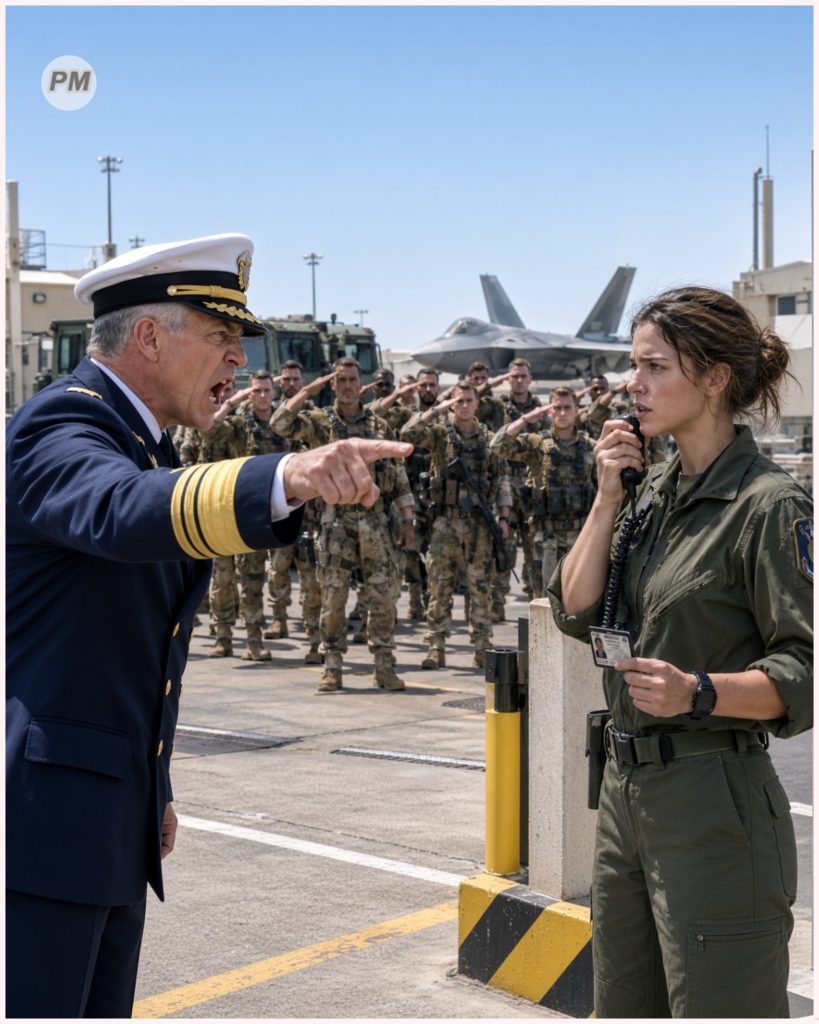
The morning fog still clung to the tarmac at Naval Air Station Jacksonville when Lieutenant Commander Mara Callaway drove her beat up Ford pickup through the main gate for what she believed would be one of the quietest arrivals of her career.
The gate guard, a young petty officer barely old enough to shave, looked at her credentials twice, then looked at her face, then looked at the truck as though the combination of all three simply didn’t compute.
She gave him a patient look, the kind she’d perfected over years of dealing with men who couldn’t quite place her, and waited until he waved her through.
She had no base sticker, no unit patch on her jacket, no rank insignia, just a folded letter on the passenger seat stamped in red ink.
Reassignment pending. Report to Admiral H’s office. 0800. It was 0747. She parked in a visitor space, killed the engine, and sat for a moment looking out at the runway.
Three F22 Raptors sat at the far end of the flight line, partially covered by tarps.
No tail codes, no unit markings. They didn’t belong to this base. She looked at them for exactly 4 seconds.
Then she got out of the truck. Admiral Dale H’s office occupied the second floor of the administrative building with a window that looked directly over the runway.
The kind of view that reminded everyone who sat behind that desk exactly how much power they held.
Hon was three stars 30 years in with a jaw that looked like it had been carved from a ship’s keel.
He had the posture of a man who had never once second-guessed himself and the reputation to back it up.
He commanded respect the way gravity commanded objects, not by asking for it, but simply by existing.
He did not offer Mara a seat. He had her folder open on the desk.
She could see even from across the room that it was thick. That was never a good sign.
You know why you’re here, he said, not looking up. I have a general idea, sir.
Your file. He tapped it for reassignments in three years. Two formal complaints from commanding officers.
Insubordination both times. One inquiry dismissed, yes, but still on record. You were pulled from a Pacific carrier group 6 weeks ago with no explanation attached.
He finally looked up. His eyes were pale gray, the color of cold ocean water.
I don’t accept transfers without explanation, commander. I understand that, sir. I don’t want you here.
She didn’t flinch. Didn’t shift her weight. Didn’t blink faster than normal. I know, sir.
He studied her for a long moment. Outside, an F/ A18 screamed down the runway.
The windows vibrated. The sound rolled through the room like a physical thing. Almost everyone, flight crew, ground personnel, even seasoned officers, turned instinctively toward that kind of sound.
Mara didn’t. She stood completely still, eyes on him as though the aircraft were nothing more than a distant car horn.
That bothered him. He couldn’t have explained why, but it did. You’ll be billeted off base, he said.
You’ll report to Commander Reyes in logistics tomorrow at 0800. You are not to access the flight line without an escort.
You are not to interact with active flight crews. And you are absolutely not to go anywhere near the SEAL training facility on the south end of this installation.
Do I make myself clear? Yes, sir. You are here in an administrative liaison capacity only.
I’ve been told you’re attached to some joint program I’ve been given zero information about.
I don’t like operating blind in my own command. He closed the folder with a sound like a small verdict.
One incident one. And I will have you removed before your security clearance clears the gate.
Understood. Understood, sir. Dismissed. She turned and walked out. She didn’t slam the door, didn’t sigh, didn’t let a single thing show.
Down the corridor, down the stairs, out onto the tarmac where the morning fog was finally beginning to lift.
She stood beside her truck for a moment, hands in her jacket pockets, looking at the runway.
The three F-22s were still there, still covered, still silent. She got in the truck and drove to find a motel.
The motel was 2 mi from the gate, clean enough, anonymous enough, exactly what she needed.
She unpacked with the efficiency of someone who had done it in worse places under worse conditions.
Clothes in the drawer, toiletries in the bathroom. A small hard-sided case slid under the bed, locked, untouched.
She sat on the edge of the mattress and read through the brief one more time, though she already had it memorized.
The program was called Cardinal. It was a joint operation between naval special warfare and an Air Force black program so compartmentalized that fewer than 40 people in the entire United States government knew it existed.
It involved a ground element SEAL team six operators and an air asset that required a pilot with a very specific set of qualifications.
Qualifications that in the entire active duty military only one person currently held. Her call sign wasn’t in the file H read.
The file he had was the cover file, the one built over four years of deliberate misdirection.
Each reassignment a calculated move. Each complaint a carefully constructed layer of obscurity designed to make her look like exactly what she appeared to be.
A mid-career officer going nowhere slowly. Her real call sign was ghost. She’d earned it not because she was quiet, though she was.
Not because she disappeared into crowds, though she could. She’d earned it because four years ago, over the skies of a country whose name she was still not permitted to say aloud in an unsecured room, an enemy air defense network with a combined radar coverage rated among the most sophisticated in the world had tried to track her F22 for 11 minutes straight.
They had found nothing. She had come home, landed, climbed out of the cockpit and asked the debrief officer for a coffee.
That was it. No celebration, no debrief drama, just coffee, then answers. She set the brief aside, turned off the bedside lamp, and stared at the ceiling in the dark.
Tomorrow, she would report to Commander Reyes. She would file paperwork. She would smile at the right moments and defer at the right moments and be precisely as invisible as the job required.
And somewhere on that base, three F22s were sitting under tarps with no markings, waiting.
She closed her eyes. She was very good at waiting. Commander Elena Reyes was the kind of officer who had made peace with being underestimated.
She ran the logistics office at NAS Jacksonville with quiet iron. Every supply chain accounted for, every requisition tracked, every contractor held to deadline without exception.
She was sharp, organized, and completely unimpressed by rank. When Mara walked into her office at exactly 0800 the next morning, Reyes looked up from her desk, looked her over once, and gestured to the chair across from her.
“Sit down,” she said. Not unkindly, just efficiently. Mara Saturday, I’ve been told you’re here as administrative liaison for a joint program.
Reyes said, I’ve also been told I’m not cleared for the details of that program.
So, here’s how this works. You do your liaison business. You stay out of my people’s way.
And if you need anything from this office, you ask me directly. Not my staff.
Me. Clear. Clear. Mara said Reyes studied her. You’re not what I expected. What did you expect?
Someone making noise about being here. She tapped a pen against her desk. Everyone Admiral H doesn’t want on his base makes noise about it.
You’re very quiet. I find quiet more efficient. Something shifted in Reyes’s expression. Not warmth exactly, more like the recognition one precise person gives to another.
She slid a base access badge across the desk. Administrative areas only. That badge will get you into the main building, the records annex, and the cafeteria.
Anywhere else, you check with me first. Understood. Mara spent the first 3 days doing exactly what she was supposed to do.
She filed routing documents. She reviewed joint communication logs. She attended two tediously uneventful coordination calls with a Washington liaison named Ferris, who spoke in the flattened tones of someone who had spent too many years in bureaucratic rooms.
She ate lunch alone in the cafeteria, always at the same corner table with her back to the wall and a clear sightline to the door.
On the fourth day, she was crossing the central courtyard between the administrative building and the records annex when she heard it.
Not saw, heard, but she cataloged what she heard. The count cadences, the movement patterns, the particular silence between exercises that told her these weren’t regular sailors, seals without question.
She kept walking. It was on the sixth day that the collision happened, and it wasn’t her fault, though she suspected it wouldn’t have mattered either way.
She was coming out of the records annex with an armload of coordination files, turned the corner of the building’s east entrance, and walked directly into a solid wall of a man moving in the opposite direction.
The files went everywhere. The man, tall, broad, wearing a gray PT shirt with no unit identification, looked down at the scattered papers, then up at her.
He was somewhere in his late 30s. Closecropped dark hair, a jaw that had clearly met a fist at least once, and the particular stillness in his eyes that she recognized immediately, the stillness of someone trained to assess a threat in under a second.
“My fault,” she said, already crouching to gather the papers. He crouched at the same time, picked up a stack, looked at the routing headers.
His expression didn’t change. Administrative liaison. That’s right. He handed the stack back without a word, stood, and kept walking.
She watched him for half a second. The way he moved, the placement of his feet, the slight favoring of his right shoulder that suggested an old injury managed but never fully healed.
Master Chief, special warfare. Without question, she went back to her table, refiled the documents in order, and thought about the three F22s under their tarps at the end of the flight line.
The window was closing. She could feel at the way a pilot feels weather coming, not through instruments, but through instinct built over 10,000 hours of flight.
Ferris called that afternoon. His voice was tighter than usual. Timelines moved, he said. We’re looking at 72 hours, not two weeks.
Mara looked out the window of the records annex at a sky so blue it looked painted.
Does Admiral H know. Admiral H doesn’t have the clearance to know, Ferris said. She was quiet for a moment.
Then we have a problem, she said. The restricted briefing room was on the third floor of the main building, accessible only with a Yankee White clearance badge and a secondary biometric scan.
Mara didn’t have that badge. What she had was something better. A memo from the Washington liaison office authorizing her temporary access to joint program coordination materials, countersigned by a deputy director whose name meant nothing to anyone at NAS Jacksonville, but meant a great deal to the duty officer who checked at 2,100 on a Tuesday night when the building was nearly empty.
The duty officer, a lieutenant junior grade named Wills, who looked like he hadn’t slept properly in a week, read the memo three times, checked it against his authorization matrix, and then, with the expression of a man choosing between two equally uncomfortable options, led her through.
She thanked him, and took the stairs. The briefing room was dark when she entered, lit only by the ambient glow of a wall-mounted mission board that someone had forgotten to power down.
It was a large board, the kind used for multi-element joint operations with track lines, timing windows, objective markers, and in the upper left corner, a column of call signs assigned to air assets.
She found it on the third line, ghost F22A, Cardinal Primary Air. She stood in front of it for a long moment, hands in her pockets, completely still.
Someone on this base had been briefed. Not H. If H had seen this board, the conversation in his office would have gone very differently.
But someone had built this, had laid out the operational architecture, had placed her call sign in that column as though it were simply a known fact.
She was already here before she arrived. She photographed the board with a small encrypted device she carried in her inside jacket pocket, standard protocol, and then stood a moment longer reading every other element on the display.
The ground element call signs were listed in a separate column. 12 of them with a team lead designation at the top.
Ironside. She knew that name. Not the man’s real name. She’d never been given that.
But the call sign she knew from a classified operational report she’d read twice during her Pacific deployment.
The one involving a hostage recovery in a situation that the official record described only as a maritime interdiction.
Ironside had led that ground element. The report summary had been four lines long. The casualty count on the opposing side had been significant.
The man she’d collided with outside the records annex, the one with the managed shoulder injury and the flat measuring eyes.
She was almost certain. She left the briefing room, returned the access memo to the duty officer with a polite thank you, and walked out into the night.
The base was quiet at this hour. The flight line lights cast long, pale reflections on the tarmac.
Far down the runway, the shapes of the three covered F-22s were just visible in the darkness.
Her aircraft was here. Her team was here. The mission was real and moving in 72 hours was now closer to 60.
And tomorrow morning, Admiral Dale H was going to try to remove her from the base.
He’d cited the lack of orders transparency, her unauthorized presence in the main building after hours.
Wills had reported it, of course. She’d expected that, and what he called pattern of access behavior inconsistent with an administrative liaison role.
He wasn’t wrong. He was just missing the context. She was sitting at her corner table in the cafeteria with a coffee when Commander Reyes appeared and sat down across from her without asking.
That was new. Reyes set her own coffee on the table and looked at Mara with the direct assessing gaze of a woman who had spent years reading situations faster than the people in them.
He’s filing the displacement this morning. Reyes said, “You have maybe until end of day before it’s processed.”
Mara looked at her. “Why are you telling me this?” “Because I’ve been in this uniform for 18 years,” Reyes said.
“And I know what a cover file looks like. I’ve processed enough of them. She wrapped both hands around her coffee cup.
I’m not asking you what you are. I’m telling you that if you need anything from this office in the next 12 hours, ask now.
Mara was quiet for a moment. Outside the cafeteria windows, ground crew were moving across the tarmac in the morning light.
I need a vehicle authorization for flight line access. She said joint program coordination. It’ll route through the Washington liaison office and it’ll be stamped by 1400.
Reyes nodded once. I’ll have the form ready. Ferris called at 0930. His voice was controlled, but only just.
We’ve had a schedule compression. The window opens in 40 hours, not 72. Weather system over the target area is clearing faster than modeled.
Mara walked out of the administrative building and stood in the open air where no one could overhear her.
What’s the status on the ground element? Ironside team is fully briefed and staged. They’ve known since last week and the aircraft pre-flight begins tonight at 2200.
Chief Master Sergeant Okafor is leading the ground crew. He’s been on Cardinal since the beginning.
He knows what he’s doing. Does H know his flight line is being used? A pause.
He knows there’s pre-flight activity on the joint assets. He doesn’t know the operational specifics.
By the time the displacement order processes will be past the point of relevance. Mara looked across the base toward the southern end where the SEAL training facility sat behind a secondary fence line.
Ironside, she said. Tell me he’s been read in on the air coordination. He has.
He’s been asking about the cardinal pilot for two weeks. What’s he been told? That the pilot has the qualifications.
Nothing else. She stood in the sun for a moment thinking. The displacement order, the 40-hour window, the three aircraft being prepped tonight, everything moving on separate tracks that would converge at exactly one point, one moment, one decision.
I need to meet with Ironside before we fly, she said. That’s outside the protocol.
The protocol was written for a 72-hour window, she said. We don’t have that anymore.
Ground and air need to be synchronized at the human level, not just on a coordination board.
If something goes wrong in that window, Ironside needs to know the voice on his radio well enough to trust it instantly.
That doesn’t happen from a briefing document. Another pause longer this time. I’ll make a call, Ferris said.
The call came back 2 hours later. The meeting was approved. 1800 South Fence access point.
No documentation, no witnesses beyond the team itself. She arrived at 1757 and waited. He came alone.
That surprised her. 12 operators staged at a facility and their team lead walked to the meeting point without a single one of them in trail.
He came around the corner of the south fence access building at 1800 exactly saw her standing there and stopped.
They looked at each other. “You’re the pilot,” he said. “I’m the pilot,” she agreed.
His name, she had since learned through proper channels, was Master Chief Petty Officer Daniel Reyes.
No relation to Commander Reyes, she had checked. He was 39 with 17 years of special operations service for combat deployments and a record that the unclassified portions alone were enough to make clear he was not someone who wasted time or words.
They told me you were qualified, he said. They didn’t tell me much else. What do you need to know?
He studied her with those flat measuring eyes. In 40 hours, my team is going to be in a very specific place doing a very specific thing that requires air cover from someone I’ve never flown with.
If the air cover hesitates or misreads a situation, my people die. He said it without drama, without emphasis, the way another man might say, “If the weather turns, we get wet.”
So, what I need to know is whether you’ve been in a situation where hesitation was an option and you chose not to hesitate.
She looked at him steadily. I’ve been shot down once, she said. Over denied territory.
I was on the ground for 3 days with a broken collarbone and no radio.
I walked out. She paused. Hesitation is a choice. I stopped making it a long time ago.
He was quiet for a moment. Then he nodded. One single nod. The way a man gives his word.
I’ll brief my team tonight, he said. They’ll know your call sign. Ghost, she said.
Something moved in his expression, not surprise exactly, more like recognition. Ghost, he repeated quietly.
He looked at her for another half second, then turned and walked back the way he’d come.
She drove back to the main building. At 1847, Admiral H signed the displacement order.
She was given 24 hours to vacate the installation. She read the notification on her phone in the motel parking lot, sitting in her truck in the dark.
She read it once, put the phone away, and went inside to sleep. She had 11 hours before pre-flight.
She arrived at the flight line at 2,148, 12 minutes before pre-flight began. The tarmac was quiet, lit by low ground lights that threw long shadows across the concrete.
The three F22 Raptors had been uncovered, pulled forward from their staging positions, and stood in a loose line with the particular silent authority that aircraft have when they are real and ready rather than simply stored.
Ground crew moved around them with the focused efficiency of people who have rehearsed every step until it is reflex.
Chief Master Sergeant Okaphor met her at the edge of the apron. He was a compact man in his late 40s with closedcropped silver hair and hands that looked like they had been building aircraft engines since before Mara was born.
He handed her a helmet bag without ceremony. She’s fully loaded and ready, he said.
Fuel, systems, weapons, all green. She’s been waiting for you. Mara took the helmet bag and looked at the aircraft.
Even at night, even in low light, the F-22 was something that demanded attention. Angular, almost predatory, every line of it built for a single purpose.
She had flown 847 hours in the platform. She knew every instrument, every response, every particular way it communicated urgency through the seat of the flight suit.
She walked the aircraft. She was on the third point of her walkound when she heard the sound of boots on the tarmac behind her.
Multiple sets moving in formation. She didn’t turn immediately. She finished checking the control surface, then turned.
The ironside team had arrived. All 12 of them. Full kit, tactical gear, weapons slung, faces set in the expression of men who have made peace with what comes next.
They moved in a loose column behind Master Chief Reyes, who led them onto the apron with the kind of presence that required no announcement.
Ground crew stepped aside without being asked. Reyes brought the column to a halt 15 ft from where Mara stood.
He looked at her in her flight suit, helmet bag in hand, standing in front of the F22 with the low ground lights illuminating the call sign stencled below the cockpit.
Ghost. She watched him read it. Watched the moment the letters assembled into the full context.
The operational reports, the name on the briefing room wall, the conversation at the south fence, the story that the cover file had been designed to conceal.
All of it clicking into place in the span of a single second. He turned to his team.
He said three words. You know her. What happened next lasted approximately 45 seconds and would be described differently by every person present for the rest of their lives.
Master Chief Daniel Reyes called his team to attention with a single word. 12 operators, men who had operated in conditions that most people cannot imagine, who had earned their rank and their position through tests of will that filter most human beings out before the first year is done, came to attention simultaneously.
The sound of 12 sets of boots snapping together on the concrete was quiet but absolute.
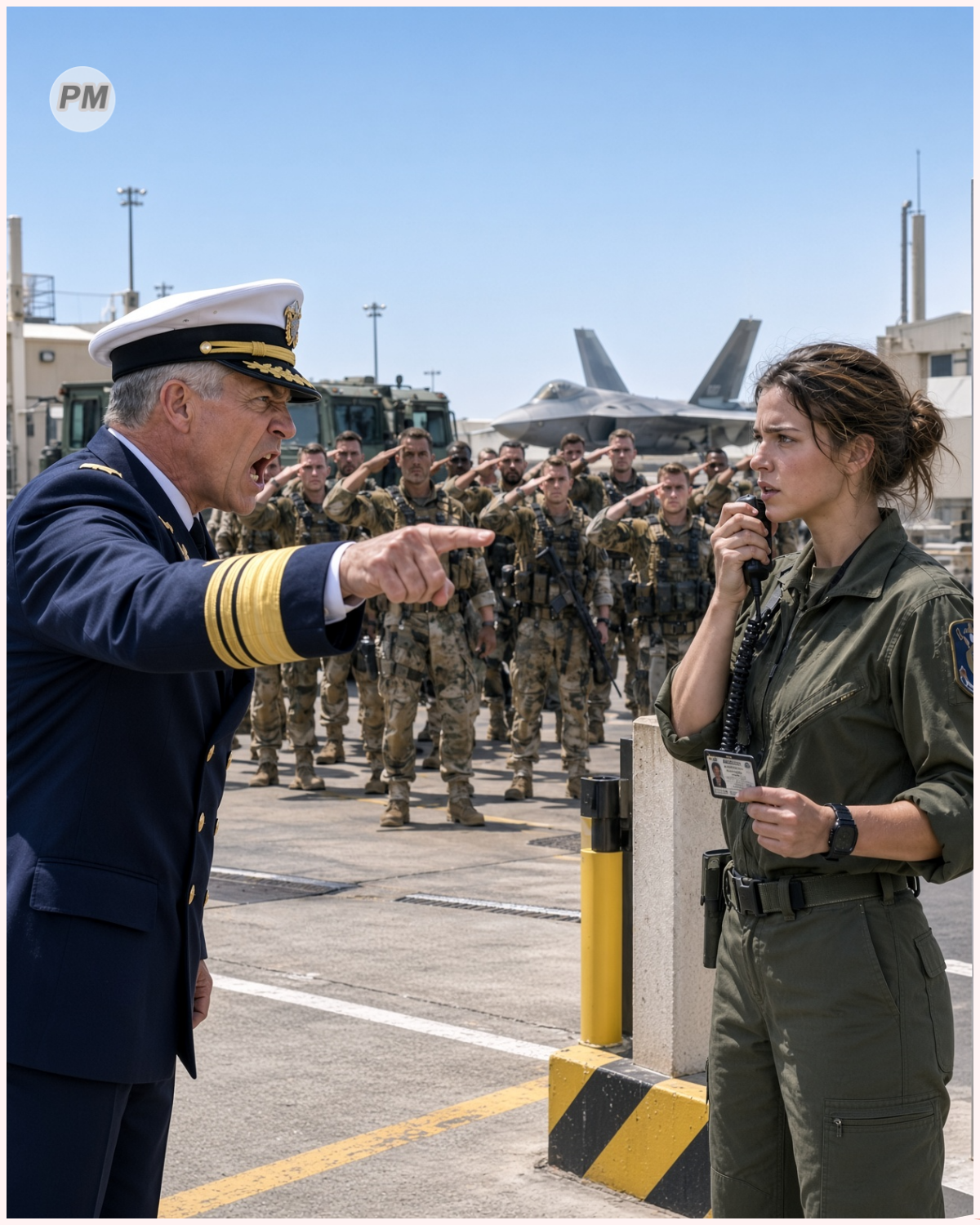
Then Reyes raised his right hand in a salute and every single one of them followed.
12 decorated naval special warfare operators standing in full combat kit on a night flight line saluting a woman in a flight suit who the base commander had signed displacement orders on 17 hours earlier.
The ground crew had stopped moving. Even Okafur was still. Mara Callaway looked at them for a long moment.
Then she returned the salute. She held it the way it deserves to be held.
Not the brief formal gesture of ceremony, but the full deliberate acknowledgement of one warrior to another, sustained and real.
When she lowered her hand, something had shifted in the air between all of them.
Not sentiment, not ceremony, something harder and more lasting than either the specific recognition that passes between people who have all in their different ways gone to the places that most people never go and come back.
Wheels up in 90 minutes, she said. What none of them knew in that moment, what Mara didn’t know until Okaphor quietly told her 4 minutes later while she was strapping into the cockpit was that Admiral Dale H come to the flight line.
He had come because the pre-flight activity on his base had triggered a security notification he was required to respond to.
He had come expecting to find something he could document and escalate. He had parked his vehicle at the edge of the apron at 2203, stepped out and seen the entire thing, the team at attention, the salute, all of it from 40 yards away in the dark.
He had not moved or spoken. He stood at the edge of the apron while his base ran an operation he had not been briefed on, while a woman he had tried to remove carried out a mitten he had no information about, while 12 of the most capable operators in the United States military paid her a respect that he had seen given perhaps three times in 30 years of service.
He stood there until the F-22’s engines came online and the sound filled the entire base with controlled enormous power.
Then he went back to his office and sat in the dark. The mission ran 6 hours and 14 minutes.
The operational specifics remained classified, but the outcome was unambiguous. The target was achieved. The ground element was extracted without casualties, and three F-22s returned to NAS Jacksonville at 0441 in the pre-dawn dark.
Reyes was waiting at the base of the ladder. He didn’t say anything. Neither did she.
He extended his hand and she shook it, a firm, brief grip that said everything that words would have made smaller.
Then she walked back across the flight line toward the administrative building. She had 4 hours left on her displacement order.
Admiral Dale H arrived at his office at 0600 and found a folder on his desk.
It was thin, maybe 12 pages. It had no classification markings on the outside, which was itself a kind of marking.
His name was on the front in plain typed letters. No sender, no routing stamp.
It had been placed there sometime between 0400 and his arrival by someone with access to his office, which narrowed it to exactly four people.
He sat down and opened it. The first page was a service record, not the one he had read before, the real one.
He knew the difference immediately. The one he’d been given had the administrative architecture of a legend, the kind built in careful layers over years.
And this one had the stark and unccommented directness of actual truth. Mara Christine Callaway, age 34, commissioned officer, United States Air Force, attached to naval special warfare for joint program purposes on rotational basis beginning four years prior.
Total flight hours 1,847. F-22A platform hours, 143. Combat flight hours in denied airspace, 311.
He read that last number twice. 311 hours in denied airspace. For context, he knew pilots, decorated, celebrated, career-defining pilots who had half that number and had built entire reputations on it.
The second page was a mission summary. The incident four years ago, the one that had generated the ghost call sign.
The air defense network, the 11 minutes of active radar coverage, the absence of any return.
The debrief officer’s notation at the bottom. Subject displayed no physiological stress indicators consistent with the reported operational environment.
When asked how she maintained composure under pursuit, subject stated, “I wasn’t being pursued. They just didn’t know that yet.”
He set that page down carefully. The third page was a list of the reassignments, all four of them with their actual purpose notated alongside the official record.
Each one a deliberate relocation to position her near a specific asset or operational theater.
Each complaint from a commanding officer. He read this slowly, either fabricated by her as part of the cover or generated by an officer who had been read in and agreed to file it.
The fourth page was accommodation classified, countersigned by people whose names he recognized at a level of authority significantly above his own.
It was for an operation whose name he still didn’t have clearance to know. The language used was precise and formal, the way military commendations always are, but even through that formal register, the substance was unmistakable.
She had made a decision in the air that had preserved the lives of a ground element when every alternative course of action would have resulted in their loss.
She had made it in under 3 seconds with incomplete information. She had been right.
He read all 12 pages. Then he closed the folder and sat for a long time.
Outside his window, the morning was fully established now. Blue sky, the runway empty and clean in the light.
He could see at the [clears throat] far end of the flight line the three F-22s being walked back to their staging positions by Okafor’s crew, covered again, unremarkable again, invisible again.
He thought about the salute. He had watched it from 40 yards in the dark and had felt something he wasn’t entirely prepared to name.
Not shame exactly, though something adjacent to it. He had spent 30 years learning to read people, learning to trust his instincts about who was real and who was performance.
And he had looked at Mara Callaway’s file and seen the wrong picture entirely. Not because he was careless, because the picture had been built by professionals specifically to be seen wrong.
He opened his desk drawer and took out a sheet of personal stationery, the kind without official letterhead, the kind used for correspondence that isn’t a command.
He began to write. Commander Callaway, I’ve now read your complete record. I want to acknowledge plainly and without qualification that the conclusions I drew from the file I was given were wrong.
Not because the file was inaccurate by its own design, but because I made judgments about your character and competence that your actual service does not support in any respect.
I am aware that an apology from the officer who signed your displacement order carries a certain irony.
I offer it anyway because it’s accurate and because in 30 years of service, I have found that accuracy is worth more than pride.
What I saw on the flight line last night, I won’t pretend it didn’t affect me.
I’ve seen soldiers saluted. I’ve seen operators pay that kind of respect perhaps three times in my career.
I know what it means when men like that make that choice. I should have known what it meant about you before I signed that order.
If your program brings you back through this command, my door is open. H RADM.
He folded the letter, sealed it in an envelope, wrote her name on the front, and set it on his desk.
Then he picked up the phone and called the liaison office in Washington. I want to know, he said without preamble, what it takes to get read into Cardinal.
The pause on the other end lasted exactly 2 seconds. Sir, the liaison said, “We’ve been waiting for you to ask.”
Mara Callaway checked out of the motel at 0730. She loaded her bag into the truck, the locked hard-sided case last, and stood in the parking lot for a moment in the morning air.
Her phone showed one message from Ferris. Mission assessed successful. Standown authorized. New tasking in 60 days.
60 days. She’d had longer. She’d had shorter. She thought about Reyes and his team already in debrief, already moving toward whatever came next for them.
She thought about Bokehor putting the aircraft to sleep. She thought about H standing in the dark at the edge of the apron, watching something he didn’t have the context to understand.
And to credit, she acknowledged this, not interfering. She got in the truck. She rolled the windows down.
The morning air smelled like jet fuel and sea salt and the particular freshness that only exists.
But the day has fully committed to being itself. She drove, not back to the base.
Not yet. Somewhere quiet, somewhere she could have a real breakfast and sit for an hour without being anything to anyone.
She’d earned that much. The road ahead was long and straight and bright with morning sun.
And she drove it the way she flew, steady, unhurried, completely sure of where she was going, even when no one else could see the path.
End.