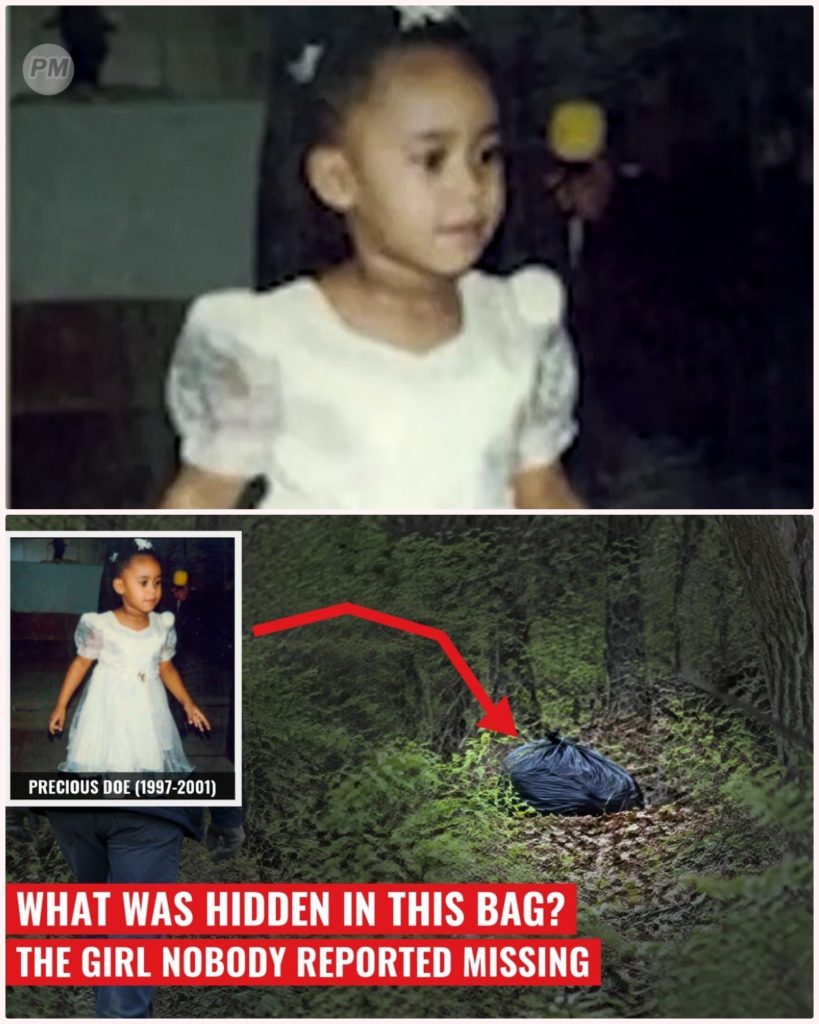
That is his own account
That is his own account. And it has never been tested in court. But if it is even partly true, it means the answer to Kansas City’s four-year question was ringing on a detective’s phone again and again from Oklahoma.
And this is where the case turns on one more person who refused to let her be forgotten.
In Kansas City, there was a community activist named Alonzo Washington. He made comic books about missing black children because he believed those children were too often ignored by the news and too quickly forgotten by everyone else.
From the beginning, he had been one of the loudest voices demanding that the city keep pushing for Precious Doe.
He was one of the first and one of the most persistent to keep calling the media and the police about her.
By the spring of 2005, the tip from Muskogee reached Alonzo Washington. And according to news reports from that time, Thurman McIntosh sent him something.
Hair samples from the mother of the little girl he believed was Precious Doe. Hair from Michelle Johnson.
>> [clears throat] >> Washington took the information to police in Kansas City and in Muskogee and he challenged them to run the DNA.
Compare the mother’s hair to the child in the grave. If it matches, you have your name.
So, that is how the four year silence finally broke. Not through a lab or a database, through an 81-year-old man in Oklahoma who would not protect his grandson and an activist in Kansas City who would not let a dead child become a file in a drawer.
By the spring of 2005, detectives in Kansas City were listening. They followed the information south to Muskogee.
They found the people who had known a little girl named Erica. They found Betty Brown who had raised her.
They looked at the photographs of Erica as a toddler. And he looked at the face that the lab in Louisiana had sculpted from her skull.
On a Monday in early May 2005, Michelle and Harold Johnson were taken into custody in Muskogee on unrelated charges.
While they sat in custody, investigators did what Alonzo Washington had asked. They ran the tests.
On May the 5th, 2005, the Kansas City Police Chief stood in front of the cameras.
Four years and one week after a little girl was found in the woods, he said the words this city had waited for.
The little girl we’ve known for four years as Precious Doe finally has a name.
Her name was Erica Michelle Marie Green. That same week, police charged two people with her murder.
Her mother, Michelle Johnson, 30 years old, and her stepfather, Harold Johnson, 25. Both from Muskogee, Oklahoma.
Imagine what that moment felt like in Kansas City. For 4 years, people had asked one question about this child, who is she?
Now they had the answer and it came with a second answer that nobody wanted.
She had not been stolen by a stranger, she had been killed at home by the people who were supposed to protect her.
And the reason nobody reported her missing was that her own mother knew she was dead.
Some people who had held vigils for her said they felt sick. Others said they felt relief because at least now she was not alone.
At least now someone could could say her real name. And in Muskogee, Betty Brown, the woman who had raised Erica and loved her, learned that the little girl she had last seen leaving with her mother had been dead for 4 years, mourned by strangers in another state under a name that was not hers.
The case that followed took years to get to trial. Michelle Johnson made a decision that shaped everything that came after.
She agreed to testify against her husband. The trial of Harold Johnson began in October 2008, more than 7 years after Erica died.
His defense attorney, Chris Luscher, didn’t tell the jury that Harold Johnson was innocent. His argument was narrower than that.
He told them his client was not a premeditated killer. Whatever happened in that house, he said, it was not planned.
Then the jury heard from Erica’s mother. Michelle Johnson the stand and described the night.
Erica would not go to bed. Harold was high on drugs. And she watched him kick her daughter in the head.
She told the jury she tried to bring Erica around with cold water in the bathtub.
She told them why they never called for help. Both of them had outstanding warrants.
And they were afraid of being arrested. And then she said something that made the courtroom go still.
Erica lay on the bedroom floor, she said, for what seemed like days. Harold Johnson’s side of it was different.
He contended it was hours, not days. Hours or days. Either way, a 3-year-old lay on a bedroom floor.
And the two adults in the room chose themselves themselves over her. Prosecutors also told the jury that Harold Johnson had tried to get his wife to change her story.
Reports from the trial said he had urged her to tell it differently. Then came the witness that for many people decided everything.
A pediatric neurosurgeon took the stand. A doctor who treats children with exactly this kind of injury.
