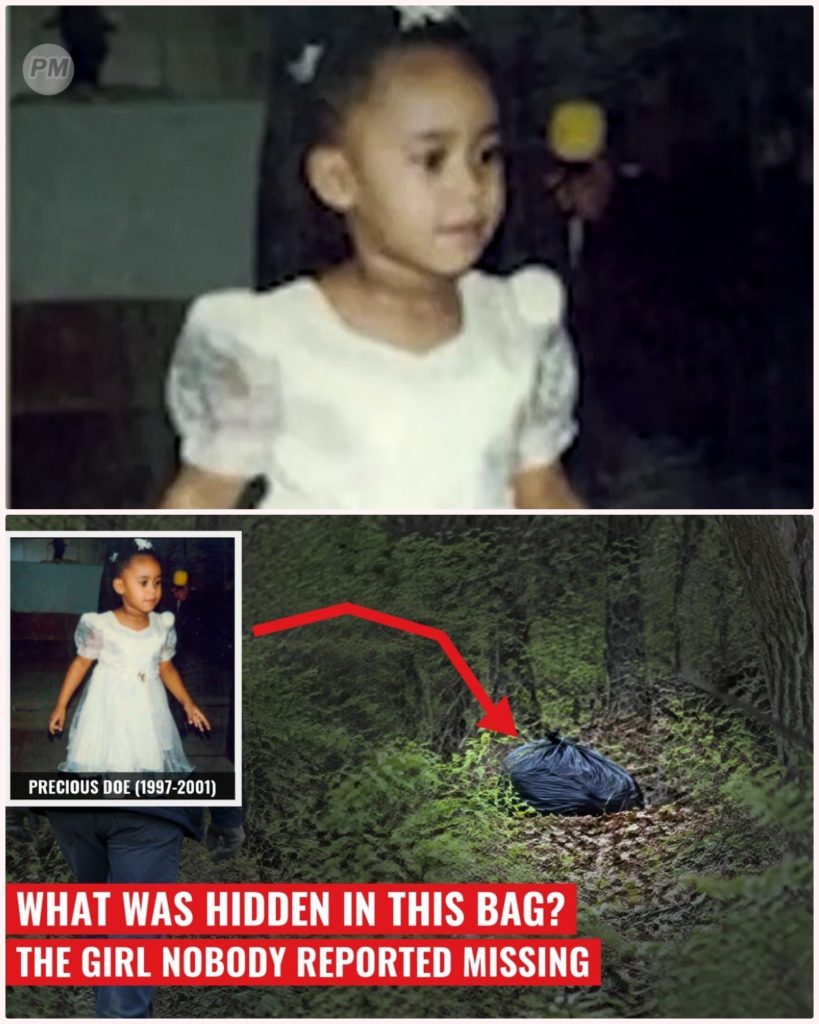
But the face problem remained
But the face problem remained. The photographs from the medical examiner could not be shown to the public.
They were too painful and too damaged to be fair to anyone trying to recognize her.
The drawings helped, but a drawing is an artist’s guess. So, in 2003, investigators tried something new.
On May the 23rd, 2003, police released new sketches of the girl from the front and from the side.
They hoped a different angle might trigger a memory in someone who had seen her in profile, playing in a yard, sitting in the back seat of a car.
When that brought no answers, they were forced to take a step none of them wanted to take.
On July the 15th, 2003, more than 2 years after she was found. Detectives went back to Memorial Park Cemetery and they exhumed her.
Frank Bender’s bust had not been enough. This time her skull was taken to Louisiana State University to a lab that specializes in rebuilding the faces of the unidentified for a second more exact likeness.
Forensic artists there would do what bones alone cannot. Layer by layer using the depth of tissue typical for a child her age and build they would sculpt her face back onto her skull.
So, the people could see her the way she looked when she was alive. That is patience.
That is care. A team of strangers in another state working on a little girl from Kansas City trying to give her face back so that someone, anyone might say, “I know her.
On September the 19th, 2003 police began circulating images of the finished bust. A small round face soft cheeks a child’s face looking out from posters and television screens across the country.
It went everywhere. Newspapers national crime shows missing child networks. If anyone who had known her saw that face there was no way they could miss it.
And still for more than a year after that, nobody came forward to say, “That is my daughter.
That is my granddaughter. That is the little girl who used to live next door.”
In August 2004 the city did something else for her. Near the woods where she was found, a memorial park was dedicated in her honor.
A place where people could sit and remember a child they had never known. Three years after her death, she had a funeral, a grave, a park, a name of sorts, and the love of thousands of strangers.
She still did not have her own name. Now, I need to take you somewhere else.
About 300 miles south across the state line to Muskogee, Oklahoma. Muskogee is a small city in the eastern part of the state on the Arkansas River.
It is the kind of place where people know their neighbors, where families go back generations, where a child growing up is watched by more than just her parents.
In Muskogee, there had been a little girl named Erica. Erica Michelle Marie Green was born on May the 15th, 1997.
And the first fact of her life tells you almost everything about what came after.
She was born while her mother was in prison. Her mother, Michelle, had been locked up for about 5 weeks when Erica arrived.
A baby born to a woman behind bars has to go somewhere. And Erica went to a woman in Muskogee named Betty Brown.
Betty was a friend of the baby’s paternal grandmother. She was not a relative. She did not have to say yes.
She said yes anyway. In Betty Brown’s home, Erica was not a nameless child. She was a baby who grew into a toddler with a bed of her own, with someone who knew when she was hungry, who knew what made her cry and what made her laugh.
Betty would later be called her foster grandmother. For most of Erica’s short life, Betty was the closest thing she had to a mother.
Now, remember what Kansas City did not know. For 4 years, investigators asked who this child was, and the answer was a woman in Oklahoma who had raised her from a newborn.
A woman who would have known her face instantly. So, why didn’t Betty Brown call?
Hold that question. Because the answer is not what you think. And it is one of the cruelest details in this case.
At some point, before the spring of 2001, Erica’s mother came back for her. Michelle was out of prison, and she said she was going to Kansas City to look for work.
Her name was Michelle Johnson. She took Erica to live with her and her husband, a man named Harold Johnson.
Harold was not Erica’s father. He was her stepfather. Not long after that, the family went north to Kansas City.
When a child is taken out of a home where she was cared for, and moved to another state with a mother and a stepfather, the people she leaves behind do not always know where she has gone.
Sometimes they assume she is fine. Sometimes they are told she is fine. Is fine as Sometimes they ask, and they are told a story.
And because she is with her own mother, nobody files a report. Why would they?
A child living with her mother is not missing. That is how a little girl can disappear in plain sight.
Not taken by a stranger. Taken home. Years later, Betty Brown said the words that anyone who has ever let a child go will understand.
I’m sorry I let her go. She also said this, “I keep thinking if she’d never gotten with her mother, this would have never happened.”
Almost to herself, “She could have brought her back to the house to me.” Because that is what haunts this case.
There was a home a home in Muskogee with a bed in it for Erica.
