The group kept moving, its resources were inadequa…
The group kept moving, its resources were inadequate, three men continued in search of assistance, and the others waited.
The notebook changed the investigation because [music] it preserved those decisions in their own order.
The desert supplied locations, donors supplied the chronology that couldn’t connect them. The renewed effort to locate the remaining crew included a joint army and air force operation known as Operation Climax.
The search extended beyond the place where the five men had been found. Shelley and Ripslinger were eventually located farther along the desert journey.
Their discoveries were consistent with Tonner’s account of three men leaving the others to seek help.
Moore wasn’t found. The published accounts don’t agree on every distance between the recovery sites.
That’s a reason to be cautious about a map covered with the exact mileage. Even when the broad patterns is clear, the five had stopped together.
At least two of the three who continued were later found beyond them. The group had traveled many dozens of miles after leaving the airplane.
There was one more discovery in 1960 in August, where Afka was found much closer to the original bailout area.
He hadn’t survived the jump. His location helped explain why he never joined the other eight.
The missing man in the diary’s opening entry was therefore part of a different section of the story from the man who continued on foot.
That distinction is easy to obscure when all nine are described simply as having vanished in the desert.
By the end of these recoveries, eight of the nine crew members had been located.
The historical records used for this account still leave Vernon Moore unaccounted for. The investigation had answered the central question about the aircraft’s disappearance.
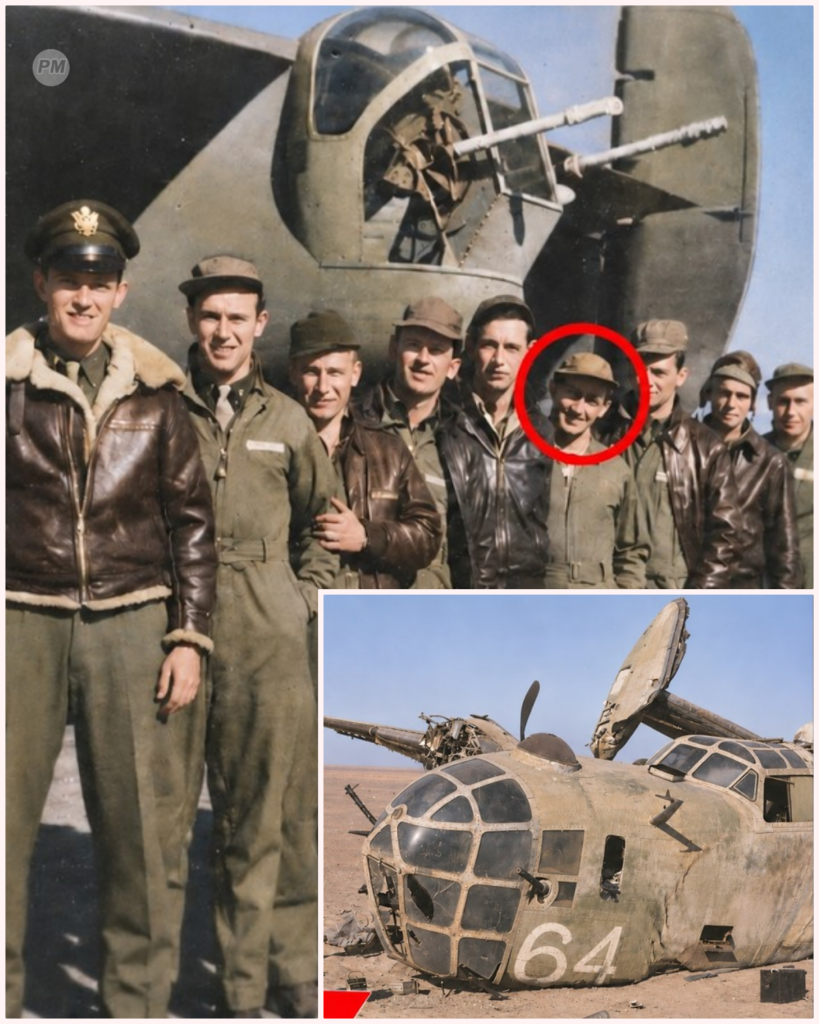
It had passed beyond its intended destination and come down in Libya’s interior. The crew had parachuted, and the survivors of the jump had attempted to walk out.
It had also answered enough questions about the ground journey to restore the individual action to the story.
[music] The men assembled, looked for their missing colleague, moved north, left evidence along the way, and eventually divided so that some could continue seeking assistance.
Those actions were reconstructed from things that could survive, objects, locations, and words written in a notebook.
There was no recording of the final flight, and no survivor to resolve every ambiguity.
Finding most of the crew didn’t produce total knowledge. It produced a much more exact account of what had happened to them.
The one man’s location and parts of the final sequence still beyond the recovered evidence.
The condition of the airplane has the courage one particularly painful question. Could the men have survived if they had found it?
Reports of the recovery describe supplies remaining on board and radio equipment that was still usable.
Those details make the wreck look in retrospect like a possible refuge. A large aircraft could also have been more visible to searches than a small group of men on foot.
But possibility is the right word. A discovery doesn’t prove that returning to the airplane was an available choice or that the man knew where to find it.
It doesn’t prove that a radio transmission from the wreck would have reached someone in time.
The crew left an aircraft in [music] flight. The investigators found an aircraft at rest.
