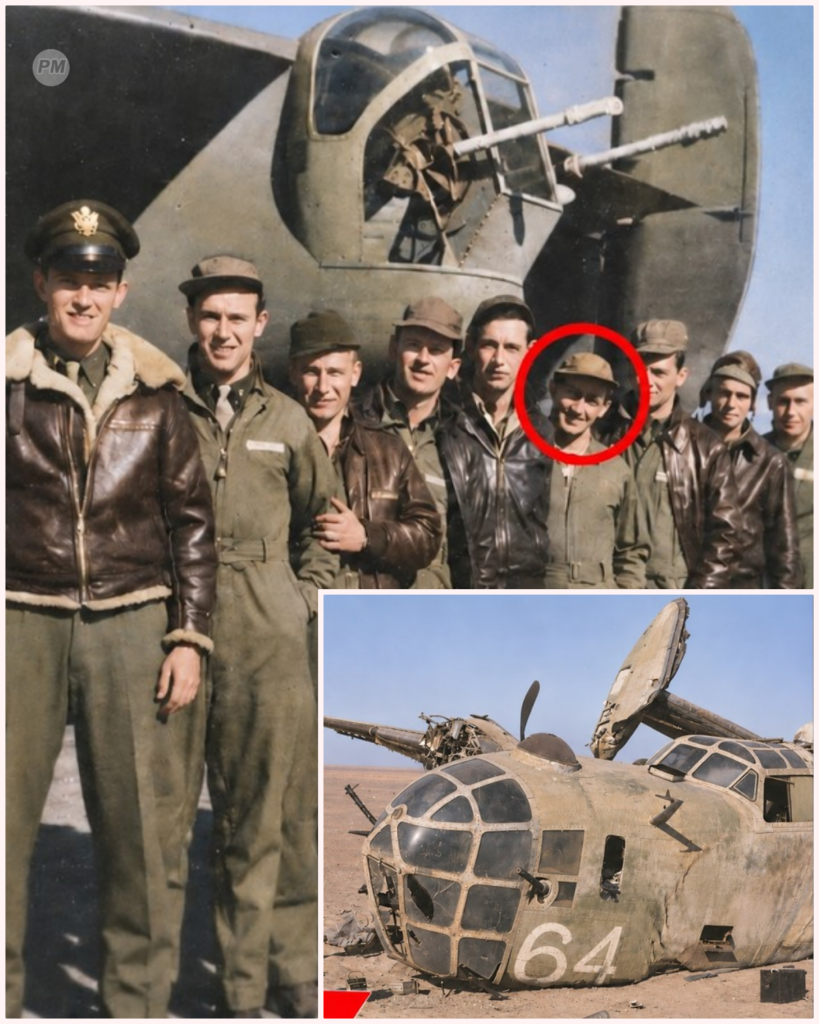
The detail belongs to the reconstruction of the ai…
The detail belongs to the reconstruction of the airplane’s final condition. It doesn’t mean the photographer witnessed the engine stopping or that every step of the descent can be recovered from one picture.
Survival [music] could itself be misleading. A recognizable airframe looks like something its crew might have survived inside, but the crew had already made a different decision.
At altitude and in darkness, their fate had separated from the fate of the machine before it reached the ground.
The first extensive search around the site found equipment rather than the men. Parachutes, boots, and other objects began to establish that people had been on the desert floor and had moved away.
Some material had been arranged as arrow-like markers. These were especially important because they could indicate intention.
A random piece of equipment shows presence, and improvised markers can suggest a direction deliberately left for someone else to follow.
Searchers now had a much better question than simply asking where the crew had disappeared.
They could ask whether scattered objects formed a connected [music] trail, or rather, the trail led toward more evidence.
The search continued through difficult conditions. Vehicles, ground parties, and aircraft covered the area, yet finding equipment didn’t produce a quick discovery of the crew.
Eventually, the first sustained search was suspended. The airplane had been found, but the ground journey remained incomplete.
The recovered objects suggested that at least some of the men had survived the jump.
They didn’t yet establish [music] how long the journey continued while the group separated or were intended.
The case had advanced from an empty patch of sea to a trail in the desert.
It was still a trail without its final pages. In February 1960, oil workers found five members of the crew.
The identification work connected them with Hatton, Toner, Hayes, Adams, and Lamotte. Among the personal effects was Toner’s diary.
The notebook joined the geographical evidence to a sequence of days. It described the early assembly of eight men, the direction of travel, periods of walking and resting, and a decision that explained why the five men were found together.
On April 9th, Toner recorded that Shelley, Ripslinger, and Moore had separated from the others to try to get help.
Five remained behind. That entry gives the search a structure. The missing crew was no longer one group of nine.
Those members might all lie near the airplane. There had been one man absent from the beginning, eight traveling together, and then a division into five and three.
The number of people at the recovery site could now be compared with the decision recorded during the ordeal.
The document and the geography supported one another. Toner continued making entries after the three [music] men left.
He recorded waiting for help and the passing of further nights. The final written entry is under Monday, April 12th.
It’s brief and reports that help hadn’t arrived. The printed spaces for the following days are blank.
Those blank spaces shouldn’t be made to tell us more than they can. They establish where the surviving written records ends.
They do not, by themselves, establish the precise moment of anyone’s death. The diary entries are compressed.
Toner recorded particular moments and decisions [music] under extreme circumstances, leaving other parts of a journey unexplained.
It supplies a chronology, but not a continuous account. The diary preserves the change from a shared march to a divided group.
