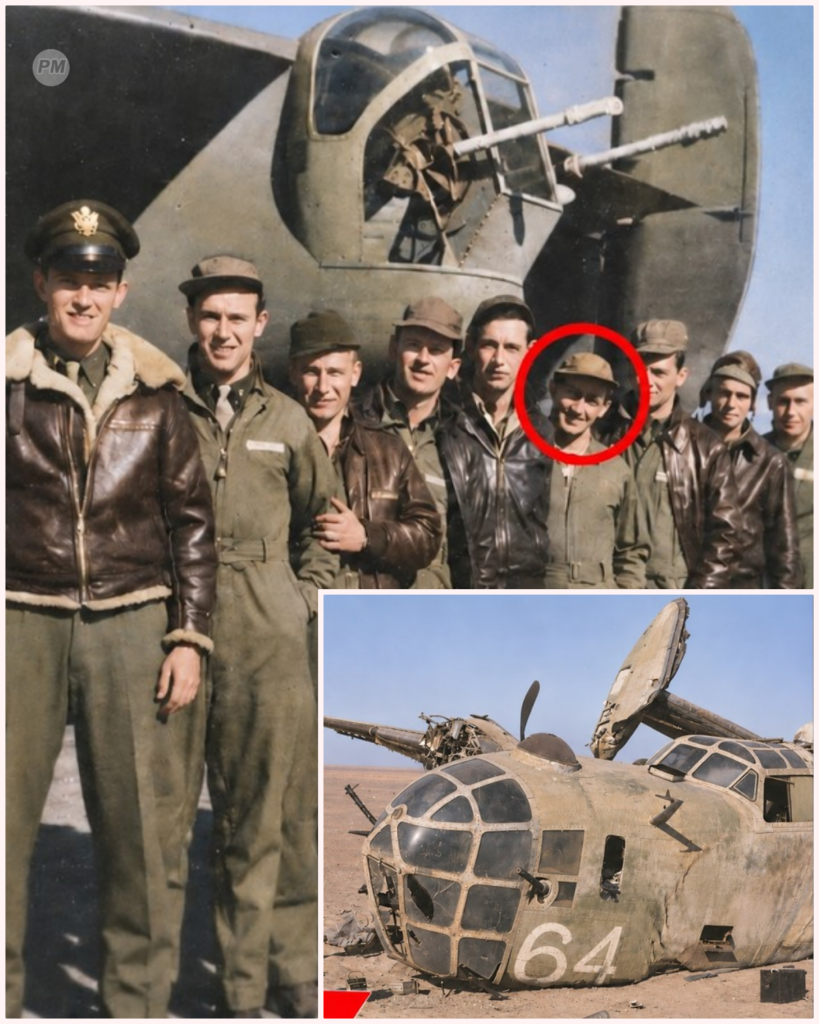
The later interpretation is that the crew may stil…
The later interpretation is that the crew may still have believed it was over the Mediterranean during part of the final flight.
That would help explain why they abandoned the airplane instead of attempting a landing on the terrain below.
Each remains an explanation inferred after the event, rather than a recovered cockpit conversation. [music] What comes next has a stronger source.
Tonner wrote that the crew had become lost returning, ran out of fuel, and jumped.
He recorded landing in the desert at about 2:00 in the morning. The night flight ended with men on the ground and an airplane continuing without them.
Tonner’s first sensor compresses the transition into a few lines. The mission, the confusion, the jump, and the desert appear together.
He also records the absence that would remain with the group. They couldn’t find John.
That was John Woraftka, when Bombardier eight men had assembled. The Nile joined them. The following entry says they started walking northwest.
The handwriting gives a direction plainly. It also records how little water they had and the fact that the missing man was still missing.
These are small details, but they change the nature of the evidence. We no longer have only a wreck and an investigator’s theory.
We have a participant recording the route the group was trying to take. The diary records movement from inside the uncertainty.
His [music] directions can be connected with objects and recovery locations, but they leave gaps in the route.
The exact hour by hour path remains unknown. The man’s immediate problem was much larger than finding their way across an unfamiliar field.
They had come down far inland with little water and no way to summon help from where they were walking.
Their aircraft was somewhere behind them, but they didn’t know where it had come to rest.
From our perspective, the wreck is an obvious landmark. From theirs, it was an unknown location.
An aircraft abandoned in flight can continue beyond the point where its crew leaves it.
The man couldn’t assume it had landed in tract. All they could reach it by following a visible trail.
A modern map brings the bailout area, the airplane, and the walking route together. The crew had to make decision before those connections were available.
Their northwestward movement was a choice made with limited information. The eventual location of the wreck reveals the scale the error, but not each man’s understanding of the route.
For the people searching in 1943, even the starting point of the walk remained outside the picture.
The missing airplane had directed attention toward the sea. The crew’s evidence was accumulating on land.
When investigators released Lady Be Good in 1959, the airplane offered evidence that had survived years of exposure.
There were no crew members in the wreck. The equipment and the condition of the aircraft supported the conclusion that the man had left it before it came down.
The National Archives preserves photographs of the inspection. They show people entering the aircraft, examining the nose, and working around the broken fuselage.
An original caption describes three engines with their propellers feathered, while a fourth was still operable according to the investigators.
A feathered propeller is positioned to reduce drag when its engine is not providing useful power.
