PART 1: Before Sunset
The first light of morning spilled across the San Pedro valley, painting the distant hills gold.
On any other morning, the village beside the river would have been waking to its familiar music: children chasing one another between the brush lodges, women laughing over cookfires, dogs barking at the hunters gathering their bows.
This morning, the village was silent.
People moved carefully and spoke in low voices. And nobody looked toward the open ground at the center of camp, where the council had already gathered in a half-circle.
Sanaba stood before them with her daughter’s hand in hers. The little girl, Chepi, was six years old, with her father’s round face and solemn eyes. Sanaba held her hand so tightly that her knuckles ached, as though letting go might make the whole earth disappear beneath them.
Beside her stood Nahleh, an older widow, gray in her braids, her back as straight as a lodgepole. Neither woman knew exactly what was coming. But both felt, in their bones, that it had already been decided.
The elders sat cross-legged in the dust. Some looked at the women. Most looked at the ground.
Sanaba searched their faces for kindness, and found none.
Eight months ago, her husband, Taklishim, had drowned in the spring flood pulling two children out of the swollen river. The village had sung over his body for three days and called him the bravest man of his generation. Since then, Sanaba had worked from before dawn until after dark, hauling water and firewood, tanning hides, doing anything she could to feed her daughter.
Nahleh’s husband had died the winter before, of a coughing sickness that took eleven people. She had no living children, no brothers, no one left to hunt for her. Little by little, the village had stopped seeing her at all.
Neither woman had broken any law. Neither had harmed anyone.
Yet here they stood, like two thieves awaiting judgment.
The eldest of the council, a stooped man named Biyaan, rose slowly to his feet. But it was not Biyaan who spoke.
It was the man at his right hand. Goyan.
He was perhaps fifty, still powerful through the shoulders, with a hard face and eyes that never blinked long enough. Goyan kept the village’s stores of dried meat and corn, and over the last bad year he had grown more powerful than anyone could remember.
“Our people face hard times,” Goyan said, his voice ringing across the silent camp. “The hunting has failed. The corn was poor. Every family is hungry. The council has decided that our food must go to those who can give something back to the people’s future.” He looked at the two women. “To those who hunt. And those who will bear strong sons.”
Sanaba’s stomach turned to ice. She looked down at Chepi, who was staring up at her in confusion.
“You will leave the village,” Goyan said, “before the sun goes down.”
For a moment, the whole world seemed to stop. Sanaba heard nothing but the pounding of her own heart.
Around her, people shifted uneasily. Several women dropped their eyes. One old man opened his mouth as if to speak, then closed it again.
No one objected.
Sanaba wanted to scream. She wanted to remind them that her husband had died in that river pulling their children out of it. That he’d been called a hero. That his daughter was standing right in front of them.
But she looked at Goyan’s flat, unblinking eyes, and she understood that the words would change nothing.
Because she knew something no one else in that circle knew.
Three weeks ago, Goyan had come to her lodge after dark. He’d offered to take her as his second wife. Food for her and the girl. A warm place for the winter. All she had to do was say yes.
She’d told him no. And she’d told him what she thought of a man who came to a grieving widow’s lodge with dried meat in one hand and a bargain in the other.
He had smiled, very slowly, and said, You will be sorry.
Now she was.
The council broke apart. People drifted back to their lodges, careful not to look at the widows as they passed. Some were ashamed. Some simply wanted no part of it.
Sanaba and Nahleh gathered what little they had. A buffalo robe. A cooking pot. A small pouch of dried mesquite meal. Taklishim’s knife. A tiny beaded doll Chepi wouldn’t let go of.
It wasn’t much to carry into a wilderness.
By late afternoon, the sun hung low and red over the western hills. A small crowd had gathered at the edge of the village. Some came out of curiosity. Some came because they still couldn’t quite believe it.
Sanaba knelt in the dust before her daughter.
“It will be all right,” she whispered.
Chepi nodded bravely, though tears were spilling down her cheeks.
Sanaba wished she believed her own words.
Beyond the village stretched endless miles of rocky hills, dry washes, and open desert, where mountain lions hunted at dusk and bandits rode the old trails north from Mexico. Two women and a small child, with no horse and no weapon but a knife, would have very little chance.
Still, they started walking.
Every step carried them further from the only home they’d ever known. The village grew smaller behind them. Nahleh walked with her chin up, but Sanaba could see her hands trembling.
Then a sound broke the silence.
Hoofbeats.
Every head turned toward the trail that came down into the valley from the east. A rider was coming, steady and unhurried, in a long plume of dust.
As he drew near, some in the crowd recognized him.
Luke Daniels.
He ran cattle on a small spread six miles up the river, and he passed through the valley every few weeks, trading flour and coffee for hides and deer meat. He was known as a quiet man who dealt fairly and never once cheated anyone, white or Apache, and who never asked more questions than he needed.
He reined in at the edge of the village and looked around. Something was clearly wrong. He swung down from his saddle.
“What’s happened here?”
No one answered at first. Then a young man, barely more than a boy, stepped forward and told him, haltingly, in broken English.
Luke listened. With every sentence, his face grew darker.
When the boy finished, Luke turned and looked out at the two women and the little girl walking alone toward the red hills.
For a long moment, he said nothing at all.
Then he handed his reins to the boy and started walking after them.
The crowd watched him go in silence.
Sanaba heard footsteps behind her and turned.
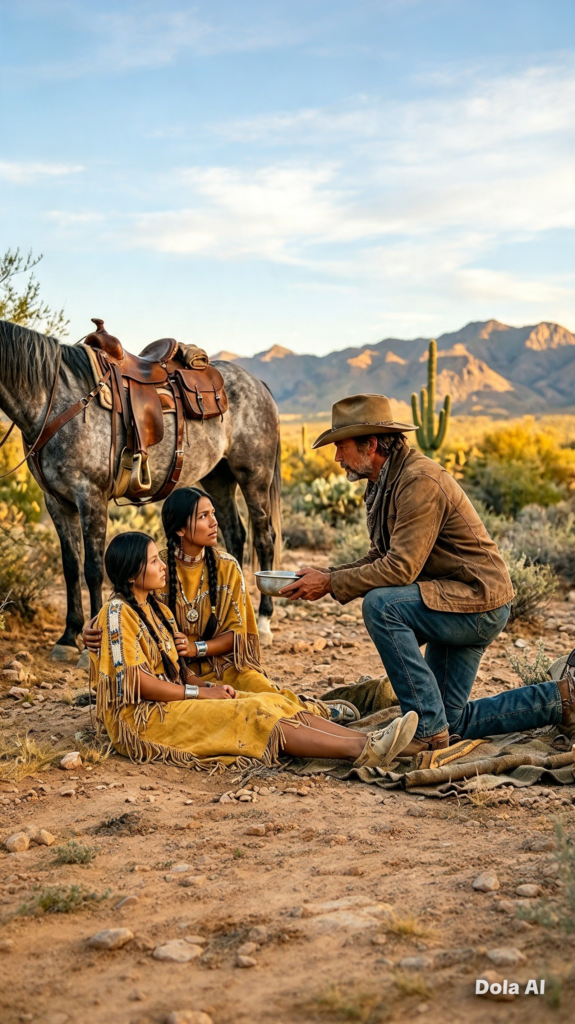
The cowboy stopped a few paces away. He was perhaps thirty-five, lean and sun-browned, with a weathered face and quiet gray eyes. He took off his hat.
“Is it true?” he asked gently. “They’re sending you out?”
She lifted her chin. “We have been told to leave.”
Luke looked back toward the village. Then down at Chepi, clutching her little beaded doll, her face streaked with dust and tears.
Something in his eyes went hard as stone.
“Come with me,” he said.
The words carried clear across the open ground. At the edge of the village, the watching crowd went utterly still.
Sanaba stared at him. “You do not know us.”
“Maybe not.” Luke turned his hat slowly in his hands. “But I know you’ve got no business being out here alone with a little one when night’s coming. I’ve got a house with an empty room. And a pot of beans that’s going to burn if I stand here jawing much longer.”
For the first time that day, something flickered in Sanaba’s chest. It was very small and very fragile. But it was there.
She looked at Nahleh. Nahleh looked back at her.
Then, carrying everything they had left in the world, the two widows turned and followed the cowboy back toward his waiting horse.
From the edge of the village, Goyan watched them go.
His face showed nothing at all. But his hand had tightened on the hilt of the knife at his belt until the knuckles went white.
It was full dark by the time they reached the ranch.
Luke had walked the whole way, leading his horse with Chepi asleep in the saddle and Nahleh’s tired feet resting in the stirrups. Sanaba had walked beside him in silence. Once, crossing a dry wash in the starlight, she’d stumbled, and he’d caught her elbow without a word and let it go just as quickly.
The ranch was smaller than she’d imagined. A low adobe house beneath two big cottonwoods, a barn, a horse corral, and a few fenced fields running down to the river.
Luke stopped at the edge of the yard.
Something was wrong.
The front door hung open, creaking in the wind. The corral gate stood wide. His three horses were gone.
He handed the reins to Sanaba and walked slowly toward the house, his hand resting on the pistol at his hip.
Inside, by the light of a match, he saw it all. His kitchen table overturned. The flour sacks slashed open and scattered across the floor. The shelves torn down. And nailed to the doorframe with a skinning knife, a scrap of paper, its message scrawled in charcoal.
INDIAN LOVERS AREN’T WELCOME IN THIS VALLEY. LAST WARNING.
Luke stared at it.
How had anyone known? It had been less than four hours. Somebody must have seen him at the village. Somebody must have ridden hard.
Behind him, he heard Sanaba draw a sharp breath. She’d read enough English to understand.
“We will go,” she said quietly. “We will leave now, before—”
The crack of a rifle split the night.
The lantern hanging by the barn door exploded in a shower of glass and burning oil. Chepi woke screaming in the saddle. Luke’s horse reared.
And out in the darkness beyond the cottonwoods, Luke heard horses moving. Several of them. Circling the house.
He drew his pistol and stepped in front of the two women and the child.
“Get inside,” he said quietly. “All of you. Now.”
A second shot rang out of the dark. A bullet slammed into the adobe wall a foot from his head.
PART 2: Family
They spent the night on the floor of the dark kitchen, behind the overturned table. Luke crouched by the window with his rifle across his knees. Nahleh held Chepi in her arms and sang to her very softly in their own language until the little girl stopped shaking and fell asleep.
Sanaba sat beside the cowboy in the dark, Taklishim’s knife in her hand.
The riders circled the house twice more, shouting things in English that Sanaba was glad Chepi was too young to understand. Then, an hour before dawn, the hoofbeats faded away to the south.
When the sky turned gray, Luke went out alone and followed their tracks.
He came back an hour later with his three horses on a lead rope, found grazing loose along the river. His face was very grim.
“Five riders,” he said. “Shod horses. They went south, toward the Kettering place.”
“Who is Kettering?” Sanaba asked.
“Ambrose Kettering. Owns the biggest spread in the valley. Been trying to buy me out for two years.” Luke looked at the knife note still pinned to his doorframe. “Reckon he figures this is as good an excuse as any.”
Sanaba stood up. “Then we have brought you trouble. We will go.”
“Go where?” Luke asked quietly.
She had no answer.
He pulled the skinning knife out of his doorframe, crumpled the note, and threw it into the cold fireplace.
“I’ve got a ranch that’s falling apart around my ears and a herd I can barely keep fed,” he said. “My last two hands quit in the spring. I’m working sixteen hours a day and losing ground. If you’re willing to work, I’m willing to have you. And I don’t take kindly to people trying to tell me who I can feed at my own table.”
He set the kitchen table back on its legs.
“You’ll stay as long as you want.”
From that day forward, everyone worked.
Sanaba was up before Luke most mornings. She mended the corral fence that had been sagging for a year. She hauled water, mucked stalls, and gentled a wild young filly that had thrown Luke three times. She learned to rope by watching him once. She never complained. Not even on the days her palms bled.
Nahleh found her own place. Years of watching her grandmother had taught her more about plants than any doctor in the territory. She knew which roots stopped a fever, which leaves drew poison from a wound, which tea settled a sick calf’s stomach. Within a month, Luke’s herd was healthier than it had been in years.
And Chepi followed Luke everywhere. To the barn, to the river, to the hay meadow. She asked him the English name for everything she saw. He told her. Then he asked her the Apache word, and she told him, solemnly correcting his pronunciation until he got it right.
Slowly, the ranch began to change. Fences stood straight. The fields were cleared. The cattle filled out. Work that had taken Luke a week alone now took the three of them two days.
One evening in late summer, Luke sat at the kitchen table going over his accounts. For the first time in three years, the numbers came out ahead.
He looked up. Across the room, by the fireplace, Sanaba was helping Chepi trace English letters on a scrap of slate. Nahleh sat by the window, grinding herbs in a stone bowl, humming.
The house didn’t feel empty anymore.
It felt alive.
Sanaba noticed him watching. “Something is wrong?”
He shook his head. “No. Just thinking.”
“About what?”
A slow smile crossed his face. “About how much has changed.”
Sanaba looked around the warm room, and she understood exactly what he meant.
But not everyone was pleased.
The town of Benson lay eight miles down the valley: a scatter of saloons, a general store, a church, and a railroad depot where news traveled faster than the trains. Before long, stories about Luke Daniels and the two Apache widows became the most popular topic in town.
At first, the talk was harmless. People wondered why he’d taken them in.
Then the stories grew darker. People who’d never laid eyes on Sanaba or Nahleh began saying things about them. That they were thieves. That they were spies for raiders. That they’d put some kind of spell on him. The rumors passed from mouth to mouth until people who’d started out doubting them were repeating them as gospel.
Everyone in town knew where the stories came from.
Nobody said it out loud.
One afternoon in September, Luke rode into Benson for flour and coffee. When he walked into Hadley’s General Store, every conversation stopped.
Ambrose Kettering stood by the counter. He was a big, florid man in a fine broadcloth coat, a gold watch chain across his belly, three of his hands lounging behind him.
“Daniels.” Kettering smiled. “Still keeping those squaws out on your place?”
The store went silent.
Luke met his eyes. “Those women have names.”
“People are talking, Luke.”
“They’re free to talk.”
Kettering stepped closer and lowered his voice. “You ought to think about your reputation. The bank’s thinking about it. So’s the cattle buyers. Funny thing, nobody wants to do business with a man who keeps Apaches in his kitchen.”
Luke said nothing.
“My offer for your land still stands,” Kettering said pleasantly. “Two dollars an acre. It won’t stand forever.”
Luke paid for his flour and coffee and walked to the door. Then he stopped and turned back.
“Five riders came to my place in the dark three months ago,” he said, loud enough for every person in the store to hear. “Shot at a little girl. Shot at two women who’d just been thrown out of their own village with nothing. One of those riders had a horse with a split right forehoof.” He looked at the three hands behind Kettering. One of them shifted his weight uncomfortably. “I’d keep that horse out of sight, if I were you, Ambrose.”
He walked out. The store stayed silent behind him.
The pressure got worse.
The cattle buyer in Benson stopped answering Luke’s letters. The bank called in a note. One morning in October, he found a fence line cut and twenty head of steers missing.
Sanaba saw it in his face that night, when he came in late, after riding the fence line in the dark.
“Things are worse in town,” she said quietly. “Because of us.”
“No.” He set his hat on the table hard. “Because some people are afraid of anything they don’t understand. And some people use that fear to get what they want.”
She was silent a long time.
After supper, she finally said it. “Maybe Nahleh and I should leave. If we go, the trouble stops.”
The kitchen went quiet. Nahleh looked up from her grinding bowl. Chepi stopped drawing on her slate.
Luke stared at Sanaba. “You can’t be serious.”
“We never wanted to bring trouble.”
“You didn’t.”
“Where we go is not your burden, Luke Daniels.”
He leaned across the table toward her. “When everybody else turned their backs on you, I made a choice. That hasn’t changed. And it isn’t going to.”
“We do not want you to suffer for us,” Nahleh said softly.
“You’re not a burden.” He looked at them each in turn: Nahleh, Sanaba, and the little girl with her slate. “You’re family.”
The word hung in the warm air of the kitchen.
Family.
Neither woman had heard it spoken to them in a very long time.
Sanaba felt the tears come, hot and sudden, and turned her face toward the fire so he wouldn’t see.
That winter came early and hard.
By the middle of November, a storm came down off the Dragoon Mountains that buried the whole valley under four feet of snow. Then another. Then a third. The roads vanished. The railroad stopped. Cattle froze standing in the fields.
Ranches up and down the valley began to starve.
At the Daniels place, they didn’t. Nahleh had spent the autumn drying mesquite beans, wild onions, and prickly pear, hanging strings of squash and chilies from every rafter in the barn. She knew which roots could still be dug from under the snow. She knew how to stretch one sack of cornmeal across two weeks.
And Sanaba worked like a woman possessed: digging paths through the drifts, hauling hay to the stock, breaking ice on the river every morning so the cattle could drink. Luke’s herd came through the first month of that winter nearly whole.
Then, on the night before Christmas, someone hammered on the kitchen door.
Luke opened it, rifle in hand.
On the step, half frozen, his beard white with frost, stood Ambrose Kettering.
He wasn’t wearing his fine broadcloth coat. His face was gray. And his eyes were the eyes of a man who has run out of every other door to knock on.
“Daniels,” he croaked. “Please. It’s my girl. Annie. She’s eight. She’s had a fever four days and she can’t breathe, and the doctor can’t get through from Benson. My wife says—” His voice broke. “My wife says she heard the Apache woman out here knows medicine.”
He looked past Luke into the warm kitchen. At Nahleh, sitting by the fire.
“I’m begging you,” Ambrose Kettering whispered. “I’ll give you anything. Please.”
Nahleh rose slowly from her chair. She looked at the man who had spread lies about her through every saloon in Benson. The man whose riders had shot at a six-year-old child in the dark.
Every eye in that kitchen was on her.
And Sanaba, standing beside her, saw something no one else in the room had noticed.
Behind Kettering, on the snowy porch, half hidden in the shadows, stood a second man. His face was wrapped in a scarf against the cold. But Sanaba would have known those flat, unblinking eyes anywhere.
Goyan.
He was holding a rifle. And it was pointed directly at Chepi, sitting by the fire.
PART 3: What Was Hidden
“Don’t move,” Goyan said, in his own language. “Any of you.”
Kettering spun around. His face went white with genuine shock. “What the hell? Who are you? I didn’t bring—”
“Be quiet, white man.” Goyan stepped into the doorway, rifle leveled. Snow swirled in around him. He looked at Sanaba with a cold, terrible smile. “You thought you could run to a white man’s house and be safe from me?”
“Goyan,” Sanaba whispered. “What do you want?”
“The girl.” He nodded at Chepi. “Taklishim’s daughter belongs to the people. Not to some white rancher’s kitchen. I have come to take her home.”
Chepi whimpered and pressed herself against Nahleh’s skirts.
Luke hadn’t moved. His rifle hung at his side, pointed at the floor. But his eyes never left Goyan’s face.
“Sanaba,” he said very quietly. “What’s he saying?”
She told him. Her voice shook.
Luke was silent a moment. Then he said, very calmly, “Tell him a man who wanted that child to be part of his people wouldn’t have thrown her out to starve in the desert.”
Sanaba translated.
Goyan’s face twisted. “The girl is not why I came,” he snarled. “The girl is the price. Her mother refused me. She shamed me. And then she ran to the white man’s valley and made the whole village look at me with questions in their eyes.” He laughed harshly. “Did she tell you, white man? Did she tell you why I sent her away? Not because there wasn’t enough food. There is enough food. There has always been enough food.”
Nahleh lifted her head sharply.
“I keep the stores,” Goyan said. “I decide who eats. And when I want something, I take it. Now I want the girl. Because the mother will follow her back. And then she will finally learn what it means to say no to me.”
He lifted the rifle toward Chepi.
And Ambrose Kettering, standing frozen in his own snowy footprints with his own little girl dying eight miles away, did the one thing nobody in that room expected.
He swung his heavy fist straight into the side of Goyan’s head.
The rifle went off into the ceiling. Plaster rained down. Goyan staggered. Luke was across the kitchen in two strides and tore the rifle from his hands, and Goyan crashed back against the doorframe and slid down into the snow.
Kettering stood over him, breathing hard, shaking his bruised hand.
“I don’t know who in God’s name you are, mister,” he panted, “but I’ve got a little girl too.”
They tied Goyan in the barn.
Then Nahleh wrapped herself in two buffalo robes, filled a bag with dried herbs and roots, and told Luke to saddle the strongest horse he had.
“You don’t have to do this,” Luke said quietly, as he helped her up into the saddle behind Kettering. “After what he’s done to you.”
Nahleh looked down at him. Her old face was very calm in the lantern light.
“A sick child is a sick child,” she said. “It does not matter whose.”
They rode out into the white darkness. Sanaba stood at the door and watched until the lantern disappeared.
Nahleh stayed at the Kettering ranch for six days.
She brewed willow bark and boiled the tops of creosote into steam that she made the little girl breathe beneath a blanket tent. She rubbed her chest with goose grease and crushed sage. She sat beside the bed every night, singing very softly in Apache, the same songs she’d sung to Chepi on the floor of a dark kitchen.
On the third night, Annie Kettering’s fever broke.
On the sixth day, she sat up in bed, ate a whole bowl of soup, and asked Nahleh to teach her the song again.
Ambrose Kettering stood in the doorway of his daughter’s room and wept like a child.
When the snow finally thawed enough to travel, Kettering rode up to the Daniels ranch himself.
He brought back Luke’s twenty stolen steers. He brought a wagon full of flour, coffee, and cornmeal. And he brought the five hands who’d ridden to the ranch that night in the summer, and made them stand in the yard, hats in their hands, and apologize to Sanaba and Nahleh one at a time.
Then he stood before the two women himself.
“I told lies about you,” he said gruffly. “All over the valley. I wanted Daniels’s water rights, and I figured you were an easy way to get them.” He cleared his throat. “My girl’s alive because of you, ma’am. I’ll spend the rest of my life telling the truth about it. To anybody who’ll listen.”
He kept his word. By spring, there wasn’t a family in the valley who hadn’t heard how the old Apache woman rode eight miles through a blizzard on Christmas Eve to save the daughter of the man who’d slandered her.
People stopped seeing two exiled widows.
They saw two women whose courage and kindness had saved lives when it mattered most.
That spring, word came down the river that the village was in trouble. A sickness had spread through the lodges. The children were thin. The old ones were dying.
And there was a rumor, too. That Goyan, still in irons in the Benson jail awaiting the circuit judge, had been hoarding the village’s stores all along: a cache of dried meat and corn hidden in a cave up in the hills, enough to have fed every family through the hungry year. That he’d traded much of it to Mexican smugglers for rifles and whiskey.
One morning in April, a group of riders came up the trail to the Daniels ranch.
It was the council. Old Biyaan rode in front, bent with age. Behind him came the other elders. The same men who had sat in the dust and said nothing while two widows and a child were sent into the desert to die.
They didn’t ride in proud. They rode in slowly, with their heads down.
Sanaba stood in the yard, with Nahleh beside her and Chepi clinging to her hand. Luke stood just behind them, silent, offering no pressure at all. Only his presence.
Old Biyaan climbed down from his pony with difficulty. He stood before the two women for a long time.
“We found Goyan’s cave,” he said at last. His voice shook. “There was food there. Enough for every family. Enough so that no one would ever have been sent away.” He bowed his white head. “We were wrong. We were afraid of the hunger. And we were afraid of him. And so we let him do what he did, and we called it the council’s will.” His voice cracked. “We sent the widow of Taklishim into the desert. The man who died saving our children.”
Sanaba felt her breath catch in her chest. All the months of pain rose up in her at once: the walk into the red hills, the gunshots in the dark, Chepi crying on the kitchen floor.
She said nothing.
Nahleh stepped forward, calm and steady.
“You turned us away when we needed you most,” she said.
The silence stretched long. The elders stared at the ground.
Then Biyaan lifted his head. “The children are sick,” he said simply. “Our healer died in the winter. We have heard what you did for the white man’s daughter.” He swallowed. “We have no right to ask. But we are asking.”
Sanaba looked at Nahleh. Nahleh looked back at her.
Then Sanaba turned and looked at Luke.
He didn’t say anything. He just nodded, very slightly. Whatever you decide.
Sanaba drew a long breath.
“We will help,” she said finally. “Not because we have forgotten. We will never forget.” She looked down at her daughter. “But because we choose not to live the rest of our lives in anger. That is what Taklishim would have wanted.”
The old elders bowed their heads very low.
Nahleh and Sanaba rode back to the village that same day, their saddlebags heavy with herbs and dried food from Luke’s barn. Luke rode beside them, leading a packhorse loaded with flour and coffee.
They stayed three weeks. Nahleh doctored every sick child in the village. Sanaba organized the women to carry Goyan’s hidden stores down out of the hills and share them out, family by family, so that no one was left out.
When they finally rode back to the Daniels ranch at the end of May, half the village came out to the edge of the camp to watch them go. Not in silence, this time. In song.
That summer, Luke built a new room onto the adobe house for Nahleh: her own room, with a window facing the morning sun and shelves along every wall for her drying herbs. People came to her from every ranch in the valley now. And from the village too.
And on a warm evening at the end of August, Luke found Sanaba alone on the riverbank, watching the sun go down behind the Dragoons.
He sat down beside her in the grass. For a long time, neither of them spoke.
“You know,” Luke said finally, “the first night you were here, when those riders came, I thought maybe I’d made a mistake. Not because of the trouble. Because I didn’t know if I could keep you safe.”
Sanaba looked at him.
“And now?” she asked.
“Now I don’t know how I ever lived in that empty house before you came.” He turned his hat slowly in his hands, the same way he had on the day he walked after her across the valley. “I’m not good with words, Sanaba. Never have been. But if you’d let me, I’d like to spend the rest of my life keeping you safe. You, and Chepi, and Nahleh. Not because you need it. Because I want to.”
Sanaba was quiet a long while. Out on the river, a heron lifted off the water and flew slowly away into the golden light.
“Taklishim died saving other people’s children,” she said softly. “He would have liked you, Luke Daniels. You are the same kind of man.”
She reached over and took his hand.
They were married that autumn, beneath the two big cottonwoods in the yard.
Ranch families came from all over the valley. Ambrose Kettering came with his wife and daughter, and little Annie Kettering stood beside Chepi holding a basket of wildflowers. And the people of the village came too. Old Biyaan, and the elders, and the families whose children Nahleh had brought back from the edge of the grave.
For the first time anyone could remember, the two peoples of that valley stood together in one place, without suspicion.
Nahleh sang the blessing. And when it was done, Chepi tugged at Luke’s sleeve, very solemnly.
“What do I call you now?” she asked in careful English.
Luke knelt down in the grass so his eyes were level with hers.
“Whatever you like, sweetheart.”
Chepi thought about it a long time.
Then she told him the Apache word for father, and made him say it back to her three times, until he got the pronunciation right.