PART 1: The Girl at the Post
The sun hung low over the Arizona desert, stretching long shadows across the cracked red earth. Even as evening came on, the heat of the day still pressed down like a hand.
Ethan Cole guided his tired buckskin along the dusty trail into the frontier town of Red Creek. He had spent nearly two weeks on the open range, sleeping under the stars and pushing cattle along routes that ran for hundreds of miles. He was thirty, lean and sun-darkened, with a quiet face and the kind of loneliness that settles into a man who has belonged nowhere since he was fourteen. All he wanted now was a hot meal, a bath, and a bed with a roof over it.
Red Creek looked like any other frontier town. Wagons lined the main street. Children chased each other through the dust. Ranchers stood outside the general store talking about rain that never came.
But something felt off.
A crowd had gathered by a freight yard at the edge of town. Ethan tied his horse outside the Silver Spur saloon and walked over, curious. Some of the men were laughing. Others just watched, their faces carefully blank.
When he reached the front, his stomach turned.
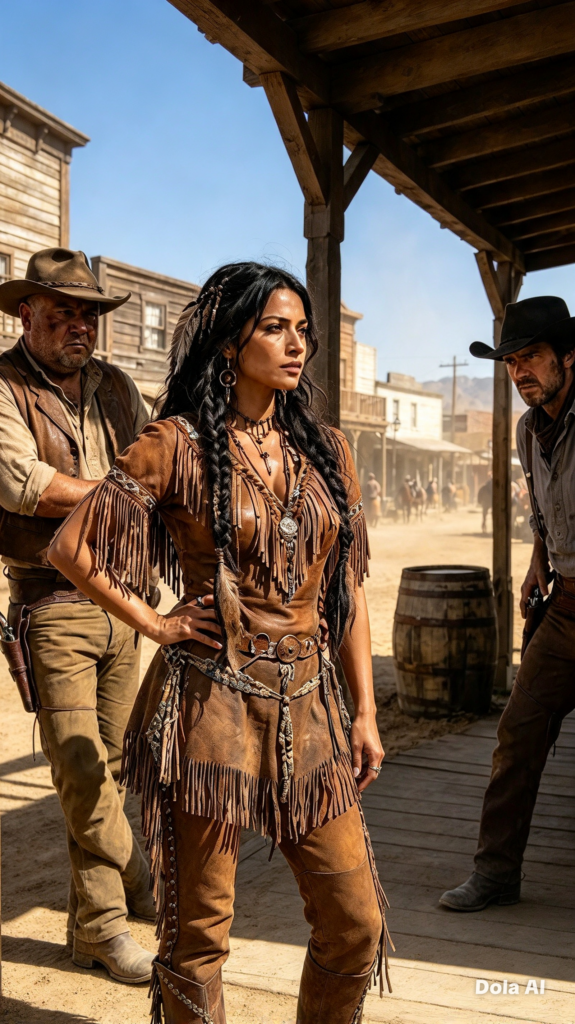
A young Apache woman was on her knees beside a stack of heavy wooden crates. She couldn’t have been more than eighteen. Her buckskin dress was torn and filthy, and her hands were raw, swollen, and bleeding at the knuckles. A thick rope ran from one wrist to an iron ring bolted into a post, the way a man might tie a mule.
A big, heavy-jowled man in a stained vest stood over her with a coiled whip in his fist.
“Move faster,” he barked. “Those crates ain’t gonna carry themselves.”
She struggled to lift another box. Her arms shook with exhaustion. The crate slipped, crashed to the ground, and split, scattering coffee beans across the dirt.
The man raised the whip.
“Who is she?” Ethan asked the grizzled old rancher beside him, quietly.
The rancher spat. “Silas Kemp’s property, he says. Kemp’s the biggest freighter between here and Tucson. Bought her off some bounty hunters up near the Mogollon Rim four months back. They claimed they took her after some trouble in the mountains.” He shrugged. “Most folks say she ought to be grateful she’s alive.”
“Bought her?” Ethan said. “Slavery’s been outlawed nearly fifteen years.”
The rancher wouldn’t meet his eyes. “Kemp calls it ‘indenture.’ Sheriff Pruitt calls it none of his business. Sheriff Pruitt plays cards with Kemp every Saturday night.”
Ethan looked back at the girl. She kept her eyes on the ground, and she didn’t make a sound as she reached for the next crate.
He had seen plenty of hardship on the frontier. This was different. This woman was being treated like a beast of burden in front of fifty people, and not one of them was going to do a thing about it.
Kemp grabbed her by the hair and wrenched her head back. “You hear me, girl?”
She flinched.
“That’s enough,” Ethan said.
Heads turned. Kemp let go of her and turned slowly, looking Ethan up and down: the trail dust, the worn boots, the gun on his hip.
“You got something to say, cowboy?”
Ethan held his gaze. “Looks like she needs water and a few hours’ rest more than she needs another order.”
A nervous murmur ran through the crowd. Kemp laughed, an ugly sound.
“Mind your own business, drifter. Or you can find out how Red Creek handles strangers who stick their noses where they don’t belong.” Behind him, two of his freight hands shifted their weight and let their hands drift toward their gun belts.
For a moment Ethan considered pushing it further. But he was one man against three, in a town where the sheriff was Kemp’s poker partner. A gunfight in the street would end with him dead, and the girl would be no better off.
He turned and walked toward the boardinghouse.
But he couldn’t stop thinking about what he’d seen.
That night he lay awake in his rented room, staring at the ceiling. Every time he closed his eyes, he saw the girl’s shaking arms and the whip in Kemp’s fist.
Around midnight, he gave up on sleep and stepped outside. The town was silent. Every window was dark except the saloon.
His feet carried him to the freight yard.
She was still there. She sat alone against the crates, still tied to the post, wrapped in a thin, ragged blanket. She’d had no supper, as far as he could tell. Moonlight fell across her tired face.
When she heard his boots, fear flashed in her eyes, and she pressed back against the crates.
“I’m not here to hurt you,” Ethan said softly. He crouched down a few feet away, slowly, and set his canteen and a wrapped piece of cornbread on the ground between them. Then he pushed it toward her.
For a long moment she didn’t move. Then she grabbed the canteen and drank as if she hadn’t had water in days. She probably hadn’t.
When she lowered it, she looked at him directly for the first time.
In that moonlight, Ethan saw something beneath the exhaustion and the fear. There was steel in her: a quiet, stubborn refusal to break, after everything that had been done to her.
“What’s your name?” he asked.
She was silent a long time. Then she whispered, “Naheema.”
“I’m Ethan.”
She studied him as if trying to work out what kind of trap this was. “You should go. If Kemp sees you…”
“I’m not going anywhere.”
Confusion crossed her face. “Why?”
Ethan looked at the rope cutting into her raw wrist.
“Because what’s happening here is wrong,” he said. “And somebody ought to have said so a long time ago.”
He went back to his room, but not to sleep. He sold his spare saddle and his good Sunday boots to the night hostler at the livery for twenty dollars and a second horse: a sturdy, sure-footed paint mare. He filled two canteens, packed a sack with jerky, cornbread, and a blanket, and saddled both horses behind the livery.
An hour before dawn, he went back to the freight yard.
Naheema watched him come with wide, unreadable eyes. He knelt beside her, drew his pocketknife, and with one quick stroke cut through the rope at her wrist.
She stared at the loose end hanging from her arm as if she didn’t believe it.
“You’re free,” Ethan said.
“No,” she whispered, shaking her head. “They’ll come after me. They’ll kill you.”
“That’s why you’ve got to leave right now.” He pressed the sack into her hands. “Do you know the way to your people?”
She nodded slowly. “The mountains. Four days east.”
“Then go.”
He led her through a narrow alley behind the livery, where the two horses waited in the shadows. The first grey light was creeping over the eastern ridges.
Before mounting the paint mare, Naheema stopped. She reached up and untied a small leather pendant from around her neck, a thin disk of hide carved with a symbol Ethan didn’t recognize: a hawk’s wing over a rising sun. She pressed it into his palm and closed his fingers around it.
“Why give me this?”
“It is a promise,” she said.
“A promise of what?”
Naheema looked at him for a long moment in the grey light. “My people remember kindness,” she said. “And they remember cruelty. Both.”
Then she swung up onto the mare and was gone, a small dark figure galloping into the dawn toward the far blue mountains.
Ethan watched until he couldn’t see her anymore. Then he walked his own horse back to the livery, unsaddled it, and went back to the boardinghouse to wait.
Silas Kemp discovered the cut rope at sunrise. His roar echoed off every building in Red Creek.
By noon, the whole town knew. By midafternoon, the night hostler had told Kemp exactly who had bought a paint mare in the middle of the night with a pair of Sunday boots.
Kemp came for Ethan at the boardinghouse with four freight hands and Sheriff Lyle Pruitt, a soft, sweating man with a star pinned to his vest who wouldn’t quite look anyone in the eye.
“You took my property,” Kemp snarled. “Four hundred dollars I paid for that girl.”
“You didn’t pay anything for a person,” Ethan said evenly. “You paid bounty hunters for a kidnapped girl. That’s not property, Kemp. That’s a crime.”
“Not in my town, it ain’t.” Kemp jerked his head at the sheriff. “Lyle. Arrest him. Theft of property, horse theft, and aiding a hostile.”
Sheriff Pruitt licked his lips. “Now, Silas, horse theft… he paid for that mare…”
“He stole my property and put her on a horse. That’s horse theft.” Kemp leaned close to the sheriff, his voice low and ugly. “And unless you’d like the whole county to hear about those gambling markers I’m holding, Lyle, you’ll lock him up.”
The sheriff locked him up.
Red Creek turned against Ethan Cole overnight.
Kemp made sure of it. He stood on the boardwalk outside the general store and told anyone who’d listen what the drifter had done. “That Apache girl will lead her whole tribe straight back here. You know they will. They’ll say this town stole her. They’ll come with fire and scalping knives, and every one of you can thank the cowboy in Lyle’s jail.”
The fear spread like a grass fire. Men started wearing their rifles to supper. Mothers kept their children inside. Every dust devil on the horizon set the whole town to running.
The only visitor Ethan had in the jail was an old rancher named Walter Haines, the same grizzled man who’d stood beside him in the freight yard that first evening.
Walter lowered himself onto the bench outside the bars with a groan.
“Most folks think you’ve brought the devil down on this town,” he said.
Ethan gave a faint smile. “And what do you think?”
Walter stared out the small barred window toward the distant mountains for a long time.
“I think you did what every one of us should’ve done four months ago,” he said quietly. “I stood in that crowd with the rest of ’em, son. Every day. Watched him work that girl like a mule. And I never said one word.” He rubbed his face with a gnarled hand. “I’m seventy-one years old. Never been so ashamed of anything in my life.”
“Then why’s everyone so afraid?”
The old man sighed. “Because fear’s easier than shame. If the Apache are monsters, then what we let happen to her don’t count.”
He stood stiffly and paused at the door.
“Kemp’s got the circuit judge’s clerk bought,” he said. “They’re calling it a trial. Saturday morning. Horse theft’s a hanging offense in this territory.” He looked back at Ethan grimly. “They’re already building the gallows behind the livery.”
He left. Ethan could hear the hammering through the jailhouse wall.
Five days passed.
Kemp’s “trial” took eleven minutes. A judge Ethan had never seen before, who smelled of Kemp’s whiskey, read the charge and listened to the night hostler, who wouldn’t meet Ethan’s eyes. Then the judge pronounced sentence without even asking Ethan to speak.
To be hanged by the neck until dead, Saturday at sunrise.
On the sixth morning, they led him out to the gallows behind the livery with his hands tied behind his back. The whole town had gathered in the grey dawn: some angry, some afraid, and some, like Walter Haines, looking at the ground.
Kemp stood at the foot of the gallows with his thumbs hooked in his vest, grinning.
“Any last words, drifter?”
Ethan looked out over the crowd. In his fist, tied behind his back, he still held the small leather pendant Naheema had given him. He’d kept it through five days in a cell.
“Just one,” he said. “Every one of you watched her suffer for four months. You’ll have to live with that. I won’t.”
Kemp’s grin twisted into a snarl. He nodded to the hangman, who settled the rough noose around Ethan’s neck and pulled it tight.
The hangman’s hand went to the lever.
And then, far out on the northern edge of town, someone screamed.
“RIDERS!”
Under Ethan’s feet, the boards of the gallows began to tremble. Then the whole ground shook. A vast cloud of red dust boiled up over the northern ridge, and out of it came horses: dozens of them, then a hundred or more, coming straight for Red Creek in a long, unbroken line.
Apache warriors.
PART 2: The Chief’s Proposal
Panic swept through Red Creek like wildfire.
Women snatched up children and ran for the church. Shopkeepers slammed their doors. The church bell began clanging wildly. Men grabbed rifles and scrambled for cover behind water troughs and wagons, their hands shaking so badly they could barely load.
On the gallows, the hangman abandoned the lever and fled. Ethan stood alone on the trapdoor with the noose still around his neck, watching the riders come.
They came straight down the main street at a steady, unhurried trot, more than a hundred warriors in perfect discipline. They didn’t fire. They didn’t raise their bows or give a war cry. The silence of it was more frightening than any scream.
At the foot of the gallows, Silas Kemp raised his rifle. “Shoot ’em!” he bellowed. “What are you waiting for? Shoot!”
Nobody fired. Every man in Red Creek could count. There were a hundred riders against thirty frightened townsmen, and a fight would end in a massacre.
The riders stopped in a great half circle at the edge of the livery yard, facing the gallows.
Then one horse moved forward alone.
Ethan’s breath caught.
It was the paint mare he’d bought with his Sunday boots. Riding it was Naheema.
She was almost unrecognizable. Her torn, filthy dress was gone. She wore beaded white buckskin, and her black hair was braided with eagle feathers. Her back was straight, and her head was high. Nothing was left of the broken girl at the post except her eyes.
Those eyes searched the crowd until they found Ethan standing on the gallows with a rope around his throat.
Her face went white with fury.
She said one sharp word in her own language. Two warriors swung down from their horses, walked up the gallows steps as calmly as if they were climbing their own porch, lifted the noose from Ethan’s neck, and cut his bonds.
Not a single townsman moved to stop them.
Then another rider came forward. He was an older man with a broad, strong face and long black hair streaked with silver, and he sat his horse with the stillness of someone who has never once needed to raise his voice to be obeyed. Even before he spoke, everyone in Red Creek understood that he was a leader.
He dismounted slowly and walked to the foot of the gallows. Kemp tightened his grip on his rifle, sweat pouring down his face.
The chief didn’t so much as glance at him. He looked up at Ethan.
“You are Ethan Cole,” he said. It wasn’t a question.
“I am.”
“My name is Takoda.” He paused, and his voice carried to every corner of the silent town. “You saved my daughter.”
A gasp rippled through the crowd. People looked from the chief to Naheema and back again.
Silas Kemp’s face went the color of old ash.
Takoda turned so the whole town could hear him.
“Seven months ago, my daughter rode with her cousin to trade horses at the agency. They never returned. We searched all through the winter. We found her cousin’s body in a dry wash with a bounty hunter’s bullet in his back.” His voice was very quiet. “We believed she was dead too. My wife has not spoken a word since the day we buried an empty grave for her.”
He turned his gaze slowly onto Silas Kemp, and Kemp took one involuntary step backward.
“When my daughter came home five days ago, she told us everything,” Takoda said. “She told us about the men who sold her. She told us about the rope, and the whip, and the crates. She told us how she lost hope.” He looked back up at Ethan. “And she told us about the stranger who risked everything to give her back her freedom.”
The silence in Red Creek was so deep that Ethan could hear a horse blowing on the far side of town.
“Among our people,” Takoda said, “a life saved creates a bond that cannot be ignored. We rode here expecting to thank a man. We found that man about to die for it.” His jaw tightened. “By the people who held my daughter like an animal.”
Kemp found his voice, though it shook. “She was legally indentured! I have papers! I paid four hundred dollars…”
Takoda turned and looked at him for the first time. It was only a look. But Kemp’s rifle sagged until its barrel pointed at the dirt.
“You will be dealt with,” the chief said softly. “Not by me. I have sent riders to the soldiers at Fort Apache with my daughter’s words and her cousin’s body. My people have learned that blood answered with blood only feeds men like you.” His voice dropped lower. “But you will be dealt with.”
Then he turned back to Ethan, and his whole face changed. The iron melted out of it.
“My daughter is precious to me, to my wife, and to all our people,” he said. “Her life is now joined with yours, by our ways. So we have come to offer you a place among us.”
Confused murmurs spread through the crowd. Takoda raised one hand for silence.
Then he said the words that nobody in Red Creek would ever forget.
“We ask that you become Naheema’s husband.”
The town went completely silent. Even the wind seemed to stop.
Ethan stood frozen on the gallows. He looked at Naheema. She sat very still on the paint mare, watching him, and her face showed neither expectation nor pressure. There was only a quiet, steady honesty.
High above Red Creek, a lone hawk circled against the bright morning sky as two worlds collided in a way none of them could have imagined.
“You need not answer today,” Takoda said gently, reading his face. “A choice such as this deserves time. Come to our camp. See who we are. Then decide freely, as she has.”
Ethan let out a breath he hadn’t realized he was holding. “I’d be honored to come,” he said.
That afternoon, as the Apache band rode out of Red Creek with Ethan Cole beside the chief, a few townspeople came out of their houses and stood in the street to watch them go.
Old Walter Haines took off his hat as they passed. One by one, slowly, a handful of others did the same.
Ethan spent the next week in Takoda’s camp in the high pines of the Mogollon Rim.
There he saw a side of Apache life that most settlers had never bothered to understand. Families shared meals around evening fires. Elders told stories passed down through generations. Children laughed and played and squabbled like children anywhere. The longer he stayed, the more his old assumptions fell away like dead leaves.
He met Naheema’s mother, Sonora. She hadn’t spoken a word in seven months. When she saw her daughter’s rescuer for the first time, she took Ethan’s face between her two hands and wept, and then she spoke. The first words out of her mouth in more than half a year were a blessing over him. The whole camp gathered to hear it, and many of them cried.
Naheema walked with him every evening. Away from the fear and cruelty of Red Creek, she was someone else entirely: quick to laugh, sharp-tongued, and fiercely proud. She told him about her childhood, her brothers, and the cousin who had died trying to protect her in that dry wash. Ethan told her about his years on the trail, the parents he’d lost to cholera at fourteen, and how he’d never stayed anywhere long enough to call it home.
On the fifth evening, they sat on a granite ledge overlooking the valley as the sun went down behind the distant peaks.
“You don’t have to accept,” Naheema said softly. “My father’s offer. It’s our way to honor a debt like this. But I would never want a husband who married me out of politeness.”
Ethan looked at her. “I know.”
She smiled faintly. “I would rather hear an honest answer than a comfortable one.”
“Then here’s an honest one,” Ethan said slowly. “When I cut that rope, I didn’t expect anything back. I just couldn’t stand there and watch. But these last days…” He stopped. “I don’t feel like I’m repaying anything. I feel like I’m finally somewhere I want to stay.”
Naheema looked away quickly, out over the valley, but not before he saw her eyes shining.
They sat in silence as the stars came out. Then Naheema said something that made the warmth drain out of the evening.
“I wasn’t the only one, Ethan.”
He turned. “What do you mean?”
“In Kemp’s freight barn,” she said quietly. “There’s a cellar under the floor. Before he put me to work on the crates, he kept me down there with two others. A boy and a girl from the Chiricahua band, maybe nine and eleven years old. Bounty hunters brought them in the same week as me.” Her voice shook. “He said he was holding them for a buyer in Mexico. I heard him say it. When you freed me, I begged you to go. I couldn’t think of anything but running. I didn’t tell you they were there.” She pressed her hands over her face. “I’ve told my father. He sent word to the soldiers. But Fort Apache is ten days away, Ethan. And if Kemp knows the soldiers are coming…”
Ethan was already on his feet.
“Then he’ll move them tonight,” he said. “Or get rid of them.”
He rode down the mountain alone in the dark. Takoda wanted to send fifty warriors with him. Ethan refused. A war party in Red Creek would start the very bloodbath everyone feared, and Kemp would have the children across the border before the first rider crossed the town line.
“One man can slip in where an army can’t,” he said. “Give me until dawn.”
He reached Red Creek a little after two in the morning. The town was dark and silent. He tied his horse in the cottonwoods behind Kemp’s freight barn and slipped inside through a loose board in the back wall.
The barn smelled of hay, coffee sacks, and lamp oil. He found the cellar trapdoor exactly where Naheema had said, under a pile of empty grain sacks in the back corner, with a heavy padlock on the hasp.
He knelt, pressed his ear to the boards, and heard it: muffled crying, very faint, from somewhere far below.
He worked the padlock with his pocketknife for three long minutes until the cheap mechanism gave. He hauled the trapdoor open and lowered himself into the black cellar.
“It’s all right,” he whispered into the dark. “I’m a friend. Naheema sent me.”
At her name, two small shapes stirred against the far wall, chained to a beam by their ankles. They were a thin boy and a smaller girl, filthy and hollow-eyed, clinging to each other.
Above his head, the barn door creaked open.
Lamplight flooded the floor above the trapdoor. Heavy boots crossed the boards. Then came a voice Ethan knew.
“Well, now,” said Silas Kemp, looking down into the cellar with a lantern in one hand and a shotgun in the other. Behind him stood two of his freight hands. “Figured the squaw would tell you about my little investment sooner or later. I’ve been sitting up waiting for three nights.”
He smiled.
“You know what’s funny, cowboy? Folks around here will believe anything about an Apache. A drunk drifter breaks into a barn full of lamp oil and burns himself up trying to steal a couple of Indian kids. A real shame.” He nodded to his men. “Douse it.”
The two freight hands began splashing lamp oil across the floorboards and down the cellar stairs. The stink of it filled the air.
Kemp slammed the trapdoor shut. Ethan heard the padlock snap closed again, then a heavy wagon being dragged across the boards over his head.
Then he heard the crackle of flame.
Smoke began curling down through the cracks between the boards. In the black cellar, the two chained children screamed.
PART 3: The Choice
Ethan didn’t waste a breath on shouting.
He felt along the beam in the dark until he found the children’s chains. They were bolted to the beam with heavy iron staples, rusted, and old. With his knife blade, the heel of his boot, and every ounce of his strength, he pried at the first staple until it screeched loose from the old wood. Then he started on the second.
Above, the fire roared. Smoke poured through the cracks, thick and choking. Heat came down through the floor like an oven. The boy was coughing so hard he could barely stand.
“Get down low,” Ethan rasped. “Faces to the dirt. The air’s better there.”
The second staple came loose.
He scooped up both children, one under each arm, and slammed his shoulder against the trapdoor. It didn’t move. The wagon was on top of it. He tried again and again, and it moved half an inch. Burning embers were starting to drop through the cracks onto his back.
Then, above the roar of the fire, he heard something else: hooves, and a woman’s voice screaming his name.
“ETHAN!”
Naheema hadn’t stayed on the mountain. Neither had her father. Takoda had followed with six warriors, and they had stayed back at the edge of town exactly as Ethan asked, until they saw the red glow rising over the barn roof.
The wagon on the trapdoor screeched across the burning floor as four men heaved it aside. The trapdoor flew open in a blast of smoke and fire, and hands reached down into the black: Takoda’s hands, Naheema’s, and an old pair, gnarled and liver-spotted.
It was Walter Haines. The old rancher had seen the fire from his window and come running in his nightshirt with a bucket.
They pulled the children out first, then Ethan. He staggered out of the burning barn with his shirt smoldering and collapsed in the street just before the roof came down in a tremendous geyser of sparks.
The whole town was awake by then, pouring into the street with buckets and blankets. The fire lit up a sight Red Creek would remember for the rest of its life: a cowboy coughing on his knees in the dirt, an Apache chief kneeling beside him, and two small, chained, half-starved Chiricahua children being wrapped in quilts by the same townswomen who had locked their doors in terror a week before.
And in the firelight, everyone could see the ankle chains still hanging from those small feet.
Nobody in Red Creek could pretend anymore.
Silas Kemp didn’t get far. He was spotted at dawn trying to drive a wagon out of town on the south road. It wasn’t Apache warriors who stopped him. It was nearly every able-bodied man in Red Creek, led by old Walter Haines on a borrowed mule with a shotgun across his knees. Sheriff Lyle Pruitt rode along at the back, as pale as milk.
“You’ve held your last human being, Silas,” Walter said quietly. “And I’ve stood by and watched my last time.”
Eight days later, a company of cavalry rode in from Fort Apache under a stern young major named Holloway. He had Naheema’s sworn statement in his saddlebag, and the body of her murdered cousin had been examined by an army surgeon. When he saw the burned cellar and the iron staples and heard the children’s story through an interpreter, he arrested Silas Kemp and the two freight hands on charges of kidnapping, attempted murder, and holding persons in involuntary servitude. Then he removed Sheriff Lyle Pruitt’s star with his own hands.
The bounty hunters who had sold Naheema were hunted down within the month. The two Chiricahua children were returned to their families in the Dragoon Mountains with a cavalry escort. Takoda rode with them the whole way.
The morning Ethan gave his answer, Red Creek gathered at the edge of town: some out of curiosity, and some still out of fear. More and more of them, though, came out of something that looked a great deal like shame turning slowly into respect.
Takoda’s people waited on the ridge above town, beside the charred ground where Kemp’s barn had stood. The gallows behind the livery were gone. Walter Haines and a handful of townsmen had torn them down plank by plank and burned them the same night as the barn.
Ethan stood in the open ground between the town and the tribe, his hands still bandaged from the fire.
Takoda stepped forward. “Speak your answer,” he said simply.
Ethan looked at Naheema. She stood beside her father in white buckskin, steady and patient, and her eyes held no pressure at all, only honesty.
He took a slow breath.
“I’ve lived most of my life without a place to call home,” he said, loud enough for both sides to hear. “I told myself that was freedom. It was only distance.” He looked out over the crowd: the townspeople, the warriors, and the old rancher in his Sunday hat. “When I cut that rope, I didn’t expect anything back. I just couldn’t stand there and do nothing anymore. But I’ve learned something these last weeks. I’ve learned that people can choose something better than fear, if somebody goes first.”
He turned to Takoda.
“I accept,” he said. “Not as a debt, and not as a favor. As a choice.”
A wave of shock and murmurs moved through Red Creek.
Then Naheema stepped forward, and the murmurs stopped.
“I choose this too,” she said clearly, in English, so the whole town could hear her. “Not because I owe him. Not because my father asks it. Because the first time anyone in this town looked at me and saw a person, it was him.” She took Ethan’s bandaged hand in hers. “And I want to spend my life with the kind of man who cuts the rope.”
For a long moment no one spoke.
Then Takoda nodded once, firmly.
“Then it is decided.”
Behind them, Naheema’s mother began to sing, high and clear, the first song anyone had heard from her in seven months. One by one, the women of the band joined her. Then something happened that nobody in Red Creek ever expected. Old Walter Haines took off his hat, and slowly, the people of Red Creek began to applaud.
They were married beneath the pines on the Mogollon Rim when the aspens turned gold. Takoda performed the old ceremony, and a traveling preacher Walter Haines brought up from town performed the other one. Nobody saw any reason to choose. Half of Red Creek rode up the mountain to attend. Walter Haines stood beside Ethan as his best man in a borrowed suit and cried through all of it.
Ethan and Naheema built a horse ranch in the green valley below the Rim, halfway between the town and her people, on land Takoda gave them and the territorial office recorded in both their names. Over the door, carved into the lintel, was the same symbol she had once pressed into his palm in the grey light of an alley: a hawk’s wing over a rising sun.
Ethan wore the leather pendant every day for the rest of his life.
Years later, children in Red Creek still heard the story of the drifter who cut the rope and the Apache girl who came back with a hundred riders to save him from the noose. Most of all, they heard about the morning a frightened town finally stopped looking away.
Ethan Cole never became a hero because he wanted recognition. He became one because he chose compassion when silence would have been easier. And Naheema proved that strength isn’t found only in battle. It’s found in trust and forgiveness, and in the courage to believe in a better future, even after the world has given you every reason not to.
THE END