Lavine's behavior changed, the man wrote
Lavine’s behavior changed, the man wrote.
He stopped the teasing and paid Dany more attention.
The man believed Danyy’s threat was the reason.
Years later, Carl Jr.
told investigators.
>> Carl also stated that his brother Danny was usually with Lavine on the weekends and specifically Friday nights.
>> In October 1991, Lavine was the pastor of St.
Joseph’s Parish in Shelurn Falls.
On a Friday, state police arrested him at his parents’ home in Chapi.
The charges, sexually assaulting boys.
He pleaded not guilty at Greenfield District Court and was released on $5,000 bail.
The bishop removed him from ministry.
Days later, the public learned something else.
For 19 years, Lavine had been a suspect in Danny Croto’s murder.
District Attorney William Bennett reopened the case.
More people came forward.
Carl Jr.
went back to police about that phone call.
By 1993, >> Carl Junior Jr.
told investigators that the male voice was familiar to him and that he recognized the caller’s voice as belonging to Richard Lavine.
And Joe, Danyy’s older brother, also told police that in 1971, Lavine had taken him fishing at the very spot where Danyy’s body was found.
In June 1992 at Newberry Port Superior Court, where the trial had been moved because of publicity in Western Massachusetts, jury selection was underway.
Then Lavine changed his plea.
Guilty.
Two counts of indecent assault and battery on two boys.
The rest of the charges were dropped.
Judge Guy Voltera sentenced him to 10 years of probation, a bar on serving as a parish priest, and 7 months to a year of treatment at the St.
Luke Institute in Maryland.
No jail unless he violated probation.
One offending priest is one too many, the judge said.
Two years later, the dascese paid $1.
4 million to settle claims from 17 people.
The one thing this case had never had was physical evidence.
In 1995, that might change.
Bennett won a legal fight to get a sample of Lavine’s blood.
At the scene, a piece of rope and a plastic straw carried traces of type B blood.
Danny’s was type O.
Type B is Lavine’s type.
About 9% of people share it.
Hope.
Then the DNA results came back.
Nothing tied Lavine to the scene.
His lawyers called it proof of his innocence.
Prosecutors called it inconclusive.
In October, Bennett ended the active investigation.
Like every unsolved homicide, the case stayed open.
A year later, a judge sealed the files.
In 2003, another wave of victims came forward.
Bennett said the case was active again and ordered new DNA tests.
A Boston Globe reporter, Kevin Cullen, spent months on the case.
He found Lavine painting his mother’s house in Chapi.
He told him he’d found a new witness and other statements that implicated him.
Did Lavine want to give his side? Lavine wiped his hands on a rag and smirked.
My silence has been my salvation.
The Dascese was still sending him $1,30 a month.
In November, the Vatican defrocked him.
It was the first time in the Dascese’s history that a priest had been removed against his will.
The news didn’t come out until January.
By 2004, the Republican newspaper and a lawyer for more than 40 alleged victims had spent 17 months fighting to open the murder files.
The district attorney argued against it, saying the case was still active.
In July, Massachusetts highest court ruled, “Open them”.
The next day, Bennett said 16 months of new DNA tests hadn’t linked Lavine to the scene.
Then the files came out, 235 pages.
After 32 years, Danyy’s friends had told police the priest could turn violent when crossed, and the AP reported that police had checked the tires on Lavine’s car against the tracks at the scene.
They didn’t match.
Bunny hoped the pages would help others abused by priests.
32 years of statements, tests, and sealed files.
None of it was a case.
So, what do you think was left? What could investigators still try? Tell me in the comments.
Because months before those files went public, investigators had searched Lavine’s home for one piece of paper.
On April 6th, 2004, state police arrived at a house in Chapie, Massachusetts with a search warrant.
They were at Richard Lavine’s door.
They weren’t looking for a weapon.
They were looking for a letter.
Two weeks earlier, on March 23rd, Lavine had shown that letter to someone, an acquaintance, an employee of the Dascese of Springfield.
The letter was typed, unsigned, no return address.
Lavine told him it must have been written by the murderer himself because of the guilt it described.
The employee wrote it all down in emails to his superiors at the dasis and the dascese said nothing to investigators.
Not until a grand jury forced its hand in a separate investigation of another member of the clergy.
Only then did police learn the letter existed.
That’s how they ended up at his door at the house.
After reading him his rights, investigators asked him about it.
It had arrived in January.
Lavine said the same month word got out that the Vatican had defrocked him.
He was suspicious.
He said, “No return address”.
>> He described an elaborate process of opening the letter with tweezers and placing it in a plastic bag prior to reading it because, quote, he knew about fingerprints and DNA.
>> And how did he feel reading it? Chilling, he said.
Investigators took the letter.
According to the portion the DA later made public, it speaks to someone as you.
It talks about compulsions, about being driven over the brink, and it [clears throat] mentions a boy along the Chapi River who wrote it.
The killer, Lavine said, or someone else.
It would be 17 years before the DA’s office hired an expert to compare that letter with Lavine’s own writing.
In the meantime, the case waited.
In 2008, Judge John Augustini ordered more of the files released, 115 pages.
One witness told police in 2004 that she saw a priest standing over a boy under the bridge.
She said the bishop threatened to excommunicate her father and that the district attorney told her he could arrest her for filing a false report.
The judge’s order said she claimed they threatened her if she went public.
Lavine’s lawyer questioned her account.
She said the witness claimed to have had these visions as part of a post-hypnotic dream.
Then Bennett held a press conference.
His office, he said, had tried every DNA test he could think of.
Every path came up empty.
The Crotos asked for a new independent investigation.
Bunny said she would keep at it as long as she had breath.
The case stayed open.
In 2010, Carl Croto died.
In 2011, a new district attorney, Mark Mastriani, took over.
The Republican would later write that no opening appeared in Dy’s case while he was in office.
In January 2015, Anthony Galoon took office.
In 2016, Bunny died.
Carl and Bunny both died waiting for answers.
By 2019, Galoon had reopened the case.
Three prosecutors before him hadn’t been able to solve it.
In March 2020, shortly after Galoon created the Massachusetts State Police Unresolved Cases Unit, a trooper was assigned to focus on Danny Croto.
Investigators and prosecutors at the Hampton County District Attorney’s Office in Springfield combed through thousands of documents, decades of evidence.
What they found, opportunities for modern forensic testing, and leads to follow.
Remember the riverbank? The blood stained soil, the blood spattered rocks.
Secured in 1972 when DNA testing didn’t exist yet.
Now 49 years later, the DA contracted with a forensic lab in Florida.
DNA Labs International.
They worked alongside the state police lab.
Everyone knew the odds.
Nearly half a century had passed.
The evidence had likely degraded.
Testing might fail.
Dozens of tests, several rounds, there were moments of hope.
Then came the results.
>> Ultimately, other than confirming that Danny’s blood was present on stones from the crime scene, the resulting information failed to provide significant additional evidence to investigators.
DNA was where this case was always supposed to break.
It didn’t.
So what did? Everything else had failed.
All that was left was the letter and Lavine himself.
On March 5th, 2021, Guloon hired a forensic linguist, Dr. Robert Leonard.
Forensic linguistics applies the science of language to legal questions.
An examiner compares a disputed document with writings of known authorship, looking for patterns in the language.
It can’t say for certain who wrote a document, but it can include someone or rule them out.
Leonard is a tenure professor of linguistics at Hofster University, and he’s been qualified as an expert in 14 states and six federal districts.
He was given two things, the 2004 letter and 10 writings known to be Lavine’s.
His answer would come in May, but the DA wasn’t waiting on paper.
Glooney directed investigators to try to speak with Lavine.
He was 80 years old, a patient at a medical facility in Greenfield.
It was time to try to get him to talk, Galloon later said.
Given his health, given his age, this was the same man who told a reporter in 2003 that his silence had been his salvation.
So [clears throat] what would he say now? The first visit was April 14th, 2021.
49 years to the day since a 13-year-old went out to play.
Everything so far points one way.
A boy in a river, a priest alone on the riverbank, a question about a stone, a voice on the phone, a letter, a guilty plea in a different case.
49 years of it, and not one piece of evidence that proves what happened to Danny Croto.
What’s left is a former priest in a medical facility in Greenfield, Massachusetts, and a tape recorder.
Massachusetts State Police Trooper Michael McNed a series of interviews with Lavine, totaling a dialogue of approximately 11 hours.
All interviews were audio recorded with Lavine’s consent.
The interviews were conducted at a local medical facility where Lavine was a patient.
The investigator’s status as a Massachusetts State Police Trooper and his role as an investigator into the circumstances surrounding Daniel Croto’s death on April 15, 1972 were made clear to Lavine.
Prior to speaking with Lavine on each date, Lavine was oriented to time and place and was not under the influence of any medications that would adversely affect his decision-making or ability to communicate.
Lavine voluntarily agreed to speak with the investigator on each day and was advised he could stop questioning or request that the investigator leave his room at any time.
Lavine was also provided Miranda warnings in three instances when it was deemed legally appropriate.
Every conversation is recorded with his consent.
Five visits, April 14th, April 15, April 16, April 17, and May 4th.
Look at those dates again.
The night Dany vanished, the day he was found, the day the priest was seen alone on the riverbank, the day of the phone call, and the question about a stone.
The DA’s release doesn’t say whether that was planned.
11 hours in all.
>> He was a He was a strange um interesting kid, you know, not too bright.
Always trying to make jokes about things.
And if he didn’t answer, he increased his voice.
Then you turn around and feel like saying, “Will you shut up?” >> Why did you go down there with him >> to the river? >> Yes.
>> You wanted to see the waterfall up close.
>> And what happened? So I took a long way on the side of your walked up and down and uh that’s all I can remember about them.
Why did you hit him when he was down by the riverbank? Why would you do it down there? >> I don’t remember hitting him though, brother.
Getting a good shot.
>> You did give him a good shot.
>> And why did you give him a good shot? >> Because he was being what should I say? Well, for the same reason you’d probably uh push your own son, “Hey, Billy, you don’t do that”.
No.
>> Explain to me how you came across the body.
>> You saw it floating.
>> And how did you know it was D? Was just And what did you do after you saw the body in the water? >> I don’t remember what it did.
I don’t remember telling anyone.
>> Did you tell the police? >> I don’t believe I did.
>> I don’t believe you did either.
Did you confide in any friends? No, it’s not something that’s replening I was responsible for giving him a good shove, you know.
And you remember seeing him face down in the river? Yeah.
>> And that was after you left in there.
>> That was the same day you left in there.
>> And in [clears throat] all 11 hours, Lavine never says he killed Danny.
The DA says it plainly.
>> Lavine refused to affirmatively admit that he killed Danny Croto.
Lavine at times was ky and evasive, continuing his long running longunning attempts to mislead and distract investigators.
However, he made several statements to indicate that he was the last person to see Danny Croto alive.
>> Remember what he asked police on April 17th, 1972? Whether blood would still be on a stone thrown into a river.
He tells no one, not the police, not Danny’s parents.
He doesn’t try to pull him out.
He says people blamed him afterward that it was the worst experience of his life.
He says he thinks about Dy’s mother.
She must have been a mess of tears.
The father, he says he didn’t care about.
He insults him and Dy’s older brother.
Now go back to Friday night, April 14th, 1972.
About 10:30 pm Dy’s mother is on the phone with him.
Has he seen Dany? No.
In 1972, he told police he was at his parents’ house that night and didn’t see Dany until the next morning.
His lawyers later said police corroborated it.
The DA says he lied about the last time he saw Dany.
49 years later, he says he took Dany to the river.
Both can’t be true.
On May 4th, 2021, their last conversation, Lavine asks the trooper, “Do you think I killed him?” McN says he does.
Lavine responds with some indignance.
The Republican reports not a confession.
In another recording, according to the Republican, he says he assumes he’s going to heaven.
On Friday, May 21st, three things happened in a single day.
Doctor Leonard gave the DA’s office his answer on the letter.
The language in it was consistent with Lavine’s own writing to the point that Lavine couldn’t be excluded as its author.
It didn’t prove he wrote it.
The DA said the analysis can’t point to one person.
The same day, >> I authorized members of my office’s state police detective unit to present the facts of our investigation to a magistrate in order to obtain a complaint and arrest warrant for Richard Lavine for the murder of Danny Croto.
We were prepared to then prosecute Richard Lavine and prove his guilt beyond a reasonable doubt.
>> That evening at Bayate Franklin Medical Center in Greenfield, Richard Lavine died.
It was 5:40 pm He was 80.
Respiratory failure after COVID 19 pneumonia that began four days earlier.
>> Regrettably, due to Lavine’s death, there will be no pro prosecution or trial.
>> On Monday, May 24th, 2021, in Springfield, District Attorney Anthony Galoon stood at a podium and played reporters pieces of the recordings.
He said he believed he could have proved it in court.
Due to the credible and significant evidence that has been assembled in the last year that incriminates Richard Lavine, I am announcing today that the investigation into the murder of Danny Croto is now officially closed.
>> He said he was doing this for Carl and Bunny, who told reporters for decades they just wanted answers.
The answers came too late for them to hear.
Joe Croto spoke for the family.
We’re disappointed that he’s not being brought to justice, but just like district attorney, we believe there’s a higher power and he will face that higher power now.
Thank you.
Bishop William Burn, who leads the dascese of Springfield, said he was angered and sickened by Lavine’s unapologetic admissions.
He apologized to the Croto family.
>> We can’t rewrite history, but we can we can make the future one that children are safe where they should be in church.
And the first question of this story, who calls a grieving family to say it was an accident? What did Dany see behind the circle? Nothing the DA has released answers it closed.
But is it solved? Lavine never stood trial for Danyy’s murder.
He never will.
In 2003, Carl said that if a jury acquitted Lavine, the family could live with that.
But why not take a shot? He asked.
I think we owe that much to Dany.
No jury ever will.
So, I want to hear from you.
Do those tapes count as a confession? Is a case closed by a district attorney with no trial a solved case? Tell me in the comments.
Carl and Bunny are buried beside Dany in Hillrest Park Cemetery in Springfield, about a mile from the house where he grew up.
In 2003, a painting of Dany, inspired by his seventh grade school photograph, hung in their living room.
It had hung there for 31 years.
Behind the frame, withered palms from Palm Sunday.
and Bunny kept the cassette.
When she longed to hear her son’s voice, she played it.
On it, Dany talks about a medal his mother gave him.
He’s already decided who gets it.
Father Lavine will love the medal, Dany says.
The same Father Lavine who led his funeral mass.
Guloon has said he talked with Danyy’s family about exuming Dany for a second funeral, one that would have nothing to do with Richard Lavine.
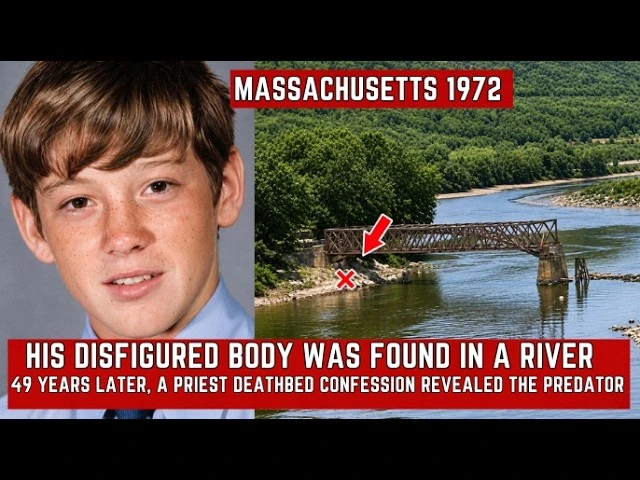
Danny Croto was 13.
A bright, talkative boy with freckles who loved to fish.
Who helped an elderly neighbor with her mail.
Not a case, not a headline.
A boy who went out to play on a Friday afternoon.
Thank you for staying with Danny’s story to the very end.
If you believe cases like his deserve to be told, like this video and subscribe to Cold Case Unmasked.
Another cold case is waiting for you on your screen right now because every cold case has a name and every name deserves the truth.