To hear the voice of a sociopath like that guy is…

To hear the voice of a sociopath like that guy is bone chilling.
It’s unbelievable.
I’m awfully glad that my parents will never hear this.
>> Saturday morning, April 15th, 1972.
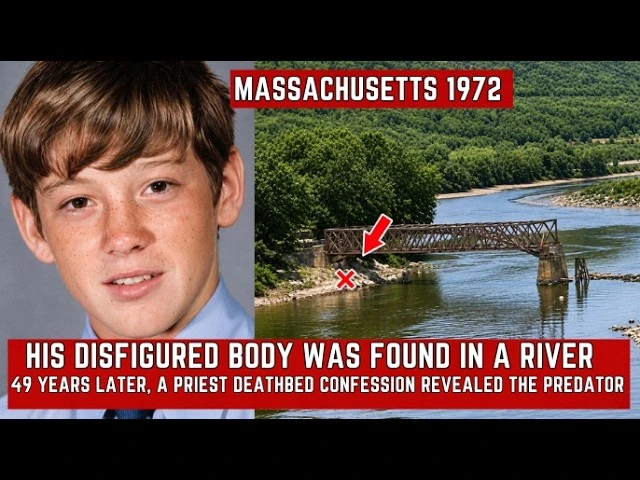
A fisherman spots something in the Chape River under the Governor Robinson Bridge.
A boy floating face down a few feet from the bank.
He’s still wearing his school uniform.
His name is Danny Croto.
He is 13 years old.
Police question more than one suspect.
Then 49 years later, in the last 5 weeks of his life, a former priest sits down with a state trooper.
11 hours, all of it recorded.
What he says in those recordings finally closes the case.
So what did he say? This is cold case unmasked.
This is how a 1972 cold case was solved.
But first, how did a 13-year-old end up in that river? It starts the day before, Friday, April 14th, 1972.
A brick ranch house in 16 acres Springfield, Massachusetts.
Danny comes home from school.
His mother, Bunny, is putting down a rug.
He helps her.
Then he heads back outside.
It’s sometime between 3:00 and 4:00 in the afternoon.
It’s a Friday.
He’s 13, and he’s going out to play.
Bunny never sees him again.
Daniel Thomas Croto was a seventh grader at Our Lady of the Sacred Heart School.
The fifth of seven children, the youngest of five boys, freckles, strawberry blonde hair, and Dany loved to fish.
His parents remembered him as bright and talkative.
His father, Carl, often worked several jobs at a time.
Things were tough, he later told the Boston Globe.
Sometimes he got laid off.
Dany did what he could to help.
He ran errands for an elderly woman in the neighborhood, collected her mail, rad her lawn.
She’d give him milk and cookies.
“That’s all he wanted,” Bunny later said.
Years later, a lamp shaped like Huckleberry Finn would sit in the Croto living room.
Bunny had made it.
That mischievous, adventurous boy reminded her so much of Dany.
A few months before that Friday, the family had recorded a cassette tape.
On it, Dany talks about a religious medal his mother had given him.
He had already decided who he was going to give it to.
For years afterward, whenever Bunny longed to hear her son’s voice, she would play that tape.
Hold on to it.
That night, there’s a boy scout meeting.
Dany doesn’t show up.
His parents start calling around.
Relatives, friends, anyone who might have seen him.
Around 10:30, Bunny is on the phone with someone who has been a regular guest at the family’s dinner table.
That August, in a written statement to Chico police, she’d say she couldn’t remember whether she called him or he called her.
She tells him Dany hasn’t come home.
Has he seen him? He says no.
Keep that call in mind.
Midnight passes.
Then 1:00 in the morning.
At 2:11 am, Carl and Bunny report their son missing.
Then morning comes.
Saturday, April 15th, 8:25 am The discovery is reported to police.
Danny loved to fish, and the place where he’s found is a fishing hole by day, something of a lover’s lane by night.
It’s miles from home.
He’s wearing the clothes he wore to school the day before.
In his pockets, his school tie, some chewing gum, a small box of dissecting tools, and an exam paper.
The exam is soaked through, but his name is still readable.
6 hours earlier, his parents reported him missing.
It doesn’t take police long to connect the two.
Years later, a former Chikape detective would say he believed Danyy’s body had been in the water for only a few hours.
So, where was Dany between Friday afternoon and Saturday morning? Carl is at work when the call comes.
He rushes home.
Police are waiting.
They tell him to go to the Chapi police station.
On the way, he stops at the rectory to tell the family’s priest that Dany has been found murdered.
That’s how Carl remembered it decades later.
The priest asks whether Carl wants him to come along.
Carl is grateful for the company.
At the station, Carl meets the detectives who will be working Danyy’s case.
They tell him Dany has been taken to a nearby funeral home.
The priest offers to identify the body.
Carl thanks him.
He’s relieved he won’t have to face it himself.
Chop police will work the case alongside the Massachusetts State Police and the Hampton County District Attorney’s Office.
State Police Lieutenant James Fitzgibbon will lead the investigation.
That day, the medical examiner performs the autopsy.
Multiple blows to the head and something else.
Dy’s blood alcohol level is.
18, more than twice the legal limit for driving.
He is 13 years old.
There’s chewed gum in his stomach.
How does a 13-year-old end up with that much alcohol in his blood? Investigators walk the riverbank.
Years later, a police statement of facts would describe what they found.
Blood stained sand, marks showing something heavy had been dragged 83 feet to the water’s edge, tire tracks in the sand, a piece of cotton rope, a plastic straw, the left pocket from Dy’s jacket, and several yards from where Dany was found, a rock with blood on it.
According to a former Chipe detective, they photograph everything, collect it, secure it.
In 1972, there’s no DNA testing.
Not yet.
But that evidence will still be waiting 49 years later.
On Sunday, April 16th, at about 4:30 in the afternoon, Shikapi Police Lieutenant Edund Radwanssky is back at the river studying the scene.
That’s when he notices the priest walking alone along the riverbank.
The lieutenant arranges to interview him the next day.
That same Sunday, a woman in Chapie calls police.
A week earlier, on April 7th, she says a boy knocked on her door around 10:30 at night.
He told her he was lost.
He asked to use her phone to call someone.
5 minutes later, a maroon Ford Mustang pulled up and the boy got in.
She says the boy was Dany.
According to the Boston Globe, it’s the same kind of car the priest drives.
On Monday, April 17th, Radwansky interviews him.
The priest says that whenever he took Dany anywhere, other kids came along.
His brothers, a gang of kids.
Then Rwansky asks about the woman’s story and the priest admits it.
A week before Dany died on that night of April 7th, he did pick Dany up.
He took him alone to his parents house in Chapi and Dany spent the night there.
The next morning, April 8th, he came back to his own house feeling sick.
Later, he threw up several times.
His mother told police.
Police believe the priest gave Dany alcohol that night, April 7th.
The priest denies it.
He says Dany might have gotten into his parents’ liquor cabinet.
Within days, police learned from the Crotos that the priest was often alone with Dany.
According to Radwansky’s report, the priest also asks two questions that investigators later considered strange.
First, and I quote, “If a stone was used and thrown in the river, would blood still be on it?” >> Second, how could the tire prints police took at the scene possibly help in a place like that? Nothing had been made public yet about how Dany died, the Globe reports.
So, how did he know to ask about a stone? Investigators wondered the same thing.
That same day, the phone rings in the Croto home.
Danny’s brother, Carl Jr.
, is 19.
He picks it up.
A man’s voice says, >> quote, “We’re very sorry what happened to Danny.
He saw something behind the circle he shouldn’t have seen.
It was an accident”.
The >> circle is a teenage hangout behind the 16 acres library in Springfield.
The caller would not identify himself and hung up.
>> Carl Jr.
would tell police he believed he recognized the voice.
Who calls a grieving family to say it was an accident? What did Danny see behind the circle? 49 years later, a recording would answer some of these questions, not all of them.
The funeral is Tuesday, April 18th.
Dany is buried at Hillrest Park Cemetery in Springfield, about a mile from home.
The mass is led by someone who knew Dany well.
Several weeks later, police tell Carl and Bunny what they’ve concluded from Danyy’s wounds.
He was killed with a stone and the attacker was probably left-handed.
According to the Globe, the priest is left-handed.
If Danny’s story has stayed with you so far, please take a second to subscribe to Cold Case Unmasked.
Every Cold Case we cover is a reminder that children like Dany should never be forgotten.
Your support helps keep these stories alive.
Now, who was the priest on the riverbank? And why did he ask about a stone? To answer that, we have to meet the other men first.
Remember what I said at the start? Police questioned more than one suspect.
Here they are.
Dany hitchhiked regularly.
Retired state police trooper Jim Mitchell later said Mitchell helped investigate Danyy’s murder, and he remembered a boy trying to grow up too fast.
So, the first possibility is a stranger.
A driver on the road that Friday afternoon, a 13-year-old with his thumb out.
No stranger is ever named.
Next, the men Dany knew, a produce manager at a nearby supermarket.
Dany had once gone to his house and painted his bedroom.
Police question him.
His alibi checks out.
Then, the leader of Danyy’s boy scout troop, the troop who’s meeting Dany never made it to that Friday night.
Police question him, too.
His alibi checks out.
Neither man, Mitchell said, came close to the suspicion that fell on someone else.
In 1991, a former Chap detective said police had two suspects in the case.
One was absolved, the other stayed.
He was the priest seen alone on the riverbank.
The priest who asked about a stone.
The priest Bunny phoned at 10:30 that night, who said he hadn’t seen Dany.
The priest who offered to ride along with Carl to the police station who offered to identify Danyy’s body and the priest who led Danyy’s funeral mass.
His name was Richard Lavine.
Father Richard Lavine.
He was 31 years old.
5 years earlier in 1967, he had arrived at the Croto’s Parish, St.
Catherine of Sienna in Springfield.
He was 26, a priest ordained just a year.
Bunny later said he showed up on their doorstep uninvited.
He said he wanted to help.
Carl was working several jobs and money was tight.
Lavine brought steak and roasts from the rectory freezer, Carl remembered.
He offered to babysit.
All five Croto boys served as alter boys, and Lavine took some of them on outings without their parents.
In 1968, he was reassigned to St.
Mary’s Parish, also in Springfield, but he didn’t drift away.
The outings continued.
Some of the boys slept over at the rectory, some at his parents house in Chapi.
He was charismatic, controversial.
In that time and place, the Globe wrote, “Having a priest take your children for sleepovers, was a status symbol”.
One day, Danyy’s older brother, Joe, 14, came home hung over after a sleepover.
Lavine told Carl that Joe must have gotten into his parents’ liquor cabinet.
Carl scolded Joe.
Hold on to that explanation.
Now, back to April 1972.
When Bunny’s sister Betty flies in from California, Lavine greets her at the Croto home.
He tells her he identified Danyy’s body.
Danyy’s face is mangled, he says, and Bunny shouldn’t see him that way.
The casket should stay closed.
Betty does what the priest asks.
After the funeral, State Police Lieutenant James Fitzgibbon talks to Danyy’s brothers, one at a time in a bedroom while Carl and Bunny wait in the living room.
Afterward, he tells the parents what their sons said.
>> The state police came in and asked us if we knew our sons had been assaulted and that Father Lavine is a first prime suspect of the murder of my son.
>> At first, Carl and Bunny can’t believe it.
>> Was here all the time.
It was like part of the family.
>> Carl said three of his sons told them they’d been molested.
Within days, Lavine calls Bunny.
Under the circumstances, he says it’s best he doesn’t come around for now.
They never speak again.
Within weeks, the phone rings at 3:30 in the morning in the home of Sandra Tessier, a parishioner at St.
Mary’s.
It’s Lavine.
He wants to meet her at an all-night diner.
She later told police he said he wanted to prove he didn’t murder Danny Croto.
He introduced a man in plain clothes who flashed a badge and said Lavine had nothing to do with it.
Years later, Tessier would say she kept thinking he protested too much.
Records that surfaced decades later show that on May 4th, 1972, 3 weeks after the murder, Lavine took a polygraph arranged by Diosis and lawyers.
Five questions.
Did you kill Danny Croto? Do you know who did? He answered no to all five.
But the examiner wrote that the responses were erratic and inconsistent.
He couldn’t give a definite opinion.
5 days later in Chicago, Lavine took two more.
The records show he passed both.
From then on, the Dascese’s lawyers pointed to those tests as proof he hadn’t done it.
He kept working in parishes.
No restrictions.
The Dascese would later say its first complaint about Lavine came in 1986.
But its own records suggest police told it he was a murder suspect within weeks.
One inconclusive test, two passes in another city.
Which would you trust? So why wasn’t he charged? Carl later said Fitzgibbon told him a lot of mistakes were made early.
Fitzgibbon died in 1982.
One mistake, Carl said, when police went to the St.
Mary’s rectory, the priest who answered the door wouldn’t let them in.
Retired trooper Jim Mitchell said police didn’t have enough evidence for a warrant.
Other officers thought Lavine’s contradictory statements and strange remarks might have been enough, but not to search a church rectory in Springfield in 1972.
Then there was the district attorney Matthew J.
Ryan Jr.
He and Bishop Christopher Weldon were well known to be good friends.
The Crotos and others believed that friendship made Ryan less aggressive.
Carl said he signed complaints against Lavine in 1972 and that Ryan told him he didn’t think he could get 12 jurors to convict a priest.
Ryan denied going easy.
He said he believed Lavine was the killer, too.
But what you think and what you can prove in court, he said, are two different things.
Law enforcement sources told the Globe in 1991 that Ryan never sought an indictment because of a tire track near Dy’s body, washed away by a sudden downpour before state police could get a print.
And years later, two of Ryan’s own nephews said Lavine had molested them.
A missing tire print.
A jury no one wanted to test.
A friendship, as the Crotos believed.
Which one stopped this case? and Dany.
Why would anyone want him silenced? The Croto family believes Lavine sexually abused Dany and killed him to keep him from telling.
The AP reports investigators never proved it.
The autopsy found no physical evidence of sexual abuse.
Lavine was never charged in connection with Danyy’s case.
His lawyer said flatly, “He didn’t do it”.
The family points to several details.
Police say Lavine’s pattern was to give boys alcohol before abusing them.
Dy’s blood alcohol level is.
18.
In 1991, Danyy’s best friend told police that after mass, Lavine would offer the boys wine from the chalice.
The friend didn’t like it.
Dany seemed to.
Afterward, Lavine would give them gum to mask the smell.
The statement of facts says gum in Dy’s pockets in his stomach.
The same friend told police that when Dany and his friends were playing street hockey, Lavine would park nearby.
Without warning, Dany would stop playing, start crying, say he had to leave, and run to Lavine’s big four-door car.
A man wrote to police in 1993 about a camping trip in Gan.
Lavine joined the other boys in teasing Dany, the youngest.
Dany, upset, told Lavine more than once, “I’ll tell.
I’ll tell”.