His prints approach
His prints approach.
Her phone falls beside a drain explaining the 4-second call ending.
She realizes Tobin is not there.
Lowell attempts to force her farther beneath the structure where machinery noise covers sound.
Claudia resists and marks his forearm.
He wears a long sleeve beneath the red polo during the later search despite the heat.
Police photograph fresh scratches after Elsie identifies him in the souvenir pictures.
Lowell claims the scratches came from repairing a fence.
Paint from the platform rail is embedded in one wound layered above Claudia’s skin cells.
The fence he names is unfinished wood with no matching paint.
He hides her behind a movable counterweight panel and attaches the wristband to the delivery cart.
At 4:22, a sensor reads the band near the west gate sending Aaron’s app a notification that Claudia completed a ride.
For 12 minutes, the family believes she may be walking back from the opposite side of the park.
The cart operator remembers Lowell asking him to move a tool case.
Camera footage shows no case, only the blue wristband strap hanging beneath the handle.
Lowell was extending Claudia’s digital path after her death.
He then returns through employee tunnels, collects his own radio, and joins the search.
At 4:42, body camera from park security records him suggesting Claudia left voluntarily after a marital argument.
Nobody had mentioned an argument.
He had watched Claudia and Aaron speak tensely after she asked to leave.
Lowell interprets that private moment as a ready-made explanation, just as he used the children’s names in the park status system.
Ordinary family behavior becomes material for his story.
The old carnival investigation is reopened with modern examination of the swing latch.
Talia’s family preserved a damaged component returned after the case.
Tool marks show the safety pin was removed with a narrow driver found in Lowell’s old equipment chest.
More significant is the maintenance log.
Ink beneath the visible entry reveals erased pressure marks.
Talia had written, “Latch disabled by LD”.
The page was removed and replaced with Lowell’s note that the platform passed inspection.
Claudia told police she saw him make the replacement.
Her statement remained in a supplemental file never forwarded to safety regulators.
Lowell had benefited from administrative separation for 12 years.
Ride investigators saw the mechanical failure.
Police saw an employee fall.
Regulators saw the replacement log.
No one placed Claudia’s observation beside all three.
Talia’s brother was finally doing that when Lowell’s database alert found Claudia.
At trial, the prosecution alternates between the birthday photographs and credential audit.
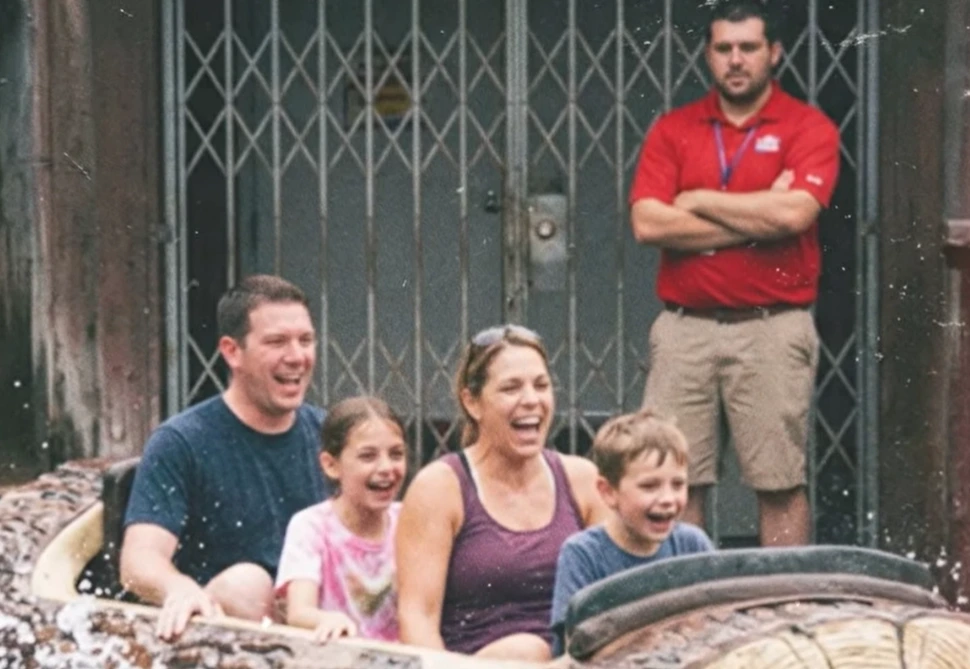
Each picture shows where Lowell’s body was.
Each badge event shows the employee identity he used.
The mismatch repeats across the afternoon.
At 1:49, Lowell appears north while his badge remains south.
At 2:46, Harris’s badge opens a gate while Harris is home.
At 4:03, Lowell and the stolen green clip appear together as Claudia enters the service area.
The two identities converge at the murder route.
The defense argues souvenir photos are promotional composites generated by software.
Park engineers provide original camera frames, trigger signals, and background sequences.
Other guests move continuously between adjacent photographs.
Lowell occupies real positions under unchanged light.
Elsie’s package selection did not insert him.
It merely collected frames already stored.
The child testifies only about opening the app and recognizing the same shirt.
Adults establish the technical chain.
Prosecutors avoid asking her to describe the body search or the old carnival case.
Aaron testifies that Claudia wanted to leave and that he dismissed her concern as an employee doing his job.
He does not turn that mistake into responsibility for Lowell’s actions.
His testimony explains why uniforms and access systems made the lure credible.
Lowell’s final defense is that Claudia followed voluntarily to confront him over Talia, making her the aggressor.
The false medical status predates Gate 7, and the 4-second call records her asking where Tobin is.
She entered because he reported her child hurt.
The planned lie is preserved before any confrontation begins.
Lowell is convicted of murder, kidnapping, identity misuse, and evidence tampering.
The reopened investigation results in a separate conviction for Talia’s murder after mechanical and documentary evidence is combined with Claudia’s preserved statement.
Before sentencing, Imogen reviews the park’s response during the first 90 minutes.
Employees followed procedure at every step and still repeated Lowell’s false information.
Tobin’s medical flag made the injury credible.
Claudia’s West Gate wristband ping redirected teams.
Lowell’s radio responses made him appear available.
Harris’s badge made restricted doors look properly staffed.
No single employee intended to delay the search.
Lowell built a version of events that each system confirmed for the next person.
The review changes how investigators describe the failure.
Claudia was not simply lost in a crowded park.
At 4:03, an employee used trusted access to remove her from public view.
Afterward, other trusted systems reported that she was elsewhere.
The distinction shortens future emergency response.
A missing adult last seen crossing an employee gate now triggers immediate preservation of credentials, wristband movement, and raw photo frames before staff interpretations are added.
Talia’s case receives a similar correction.
The original report said she entered a restricted platform without permission.
Payroll records show she was scheduled to inspect it, and her handwritten latch note was part of her assigned work.
Lowell transformed an employee performing a safety check into a trespasser after killing her.
Both women were blamed through roles he controlled.
One as a careless worker, the other as a confused guest who wandered away.
At sentencing, Talia’s brother reads Claudia’s original statement from 12 years earlier.
Claudia described the disabled latch, Lowell’s argument with Talia, and the replaced page.
She had given investigators the essential sequence while still 19 years old.
The evidence was present.
The agencies never assembled it.
Aaron reads Claudia’s 4-second call.
He does not play the audio.
He states only the time and her question, “Where is he?” The false report about Tobin remained the reason she crossed the gate, even after Lowell tried to recast the encounter as voluntary.
Harris asks that reports identify his credential as stolen rather than shared.
He had followed policy by storing it in a locked staff bag, but Lowell knew the locker combination from years of working beside him.
That precision supports planning and prevents suspicion from remaining attached to an absent employee.
The park’s database reveals 17 old name alerts created by Lowell.
Most concern former co-workers or people connected to complaints.
Investigators contact each person and find no additional killings.
The alerts show monitoring behavior without being inflated into unsupported crimes.
Claudia’s was the only alert match to an active reservation.
Lowell checked it monthly for more than a decade.
Forensic accountants discover he also purchased dormant Carnival records after the company dissolved hoping to control which files survived.
He failed to acquire the supplemental police statement and the physical latch preserved by Talia’s family.
His control over databases never reached the evidence kept outside them.
The souvenir photographs become the same kind of external record.
Lowell managed security cameras and badges, but a commercial system designed to sell family pictures preserved angles he did not monitor.
The evidence that follows him through the park was generated because Elsie wanted a birthday album.
Crestwick Adventure Pier closes for review.
Staff access can no longer be paired with personal phones.
Medical flags require confirmation from first aid, and photo databases cannot carry private name alerts.
The family receives hundreds of ordinary pictures from Elsie’s birthday.
Ice cream, rides, blurred hands, and closed eyes.
Lowell appears in nine.
Aaron removes those from the printed album but keeps the originals for the case.
Elsie chooses the entrance photograph as the last image in her album because all four family members are together.
Claudia is looking away from the camera, but her children are beside her.
The final sequence follows the photographs without narration.
Entrance arch.
Lowell sees Claudia.
River ride.
He waits behind a gate.
Game booth.
He reads the wristband screen.
Carousel glass.
Claudia photographs his reflection.
Gate 2 7.
He tells her Tobin is hurt.
Each image was sold as a memory of where the family went.
Together, they show the employee who followed them there.