The Power of One Single Hail Mary: What Padre Pio Believed About the Prayer That Can Change a Soul
Could one Hail Mary, spoken with genuine faith, carry more spiritual meaning than hundreds of prayers repeated without attention?
For generations, Catholics have turned to this simple prayer during moments of illness, uncertainty, grief, and fear.
Its familiar words are often among the first prayers children learn and among the last that elderly believers remember.
Yet behind its simplicity lies a theological tradition connecting the Annunciation, the Incarnation, Mary’s intercession, and the Christian hope of eternal life.
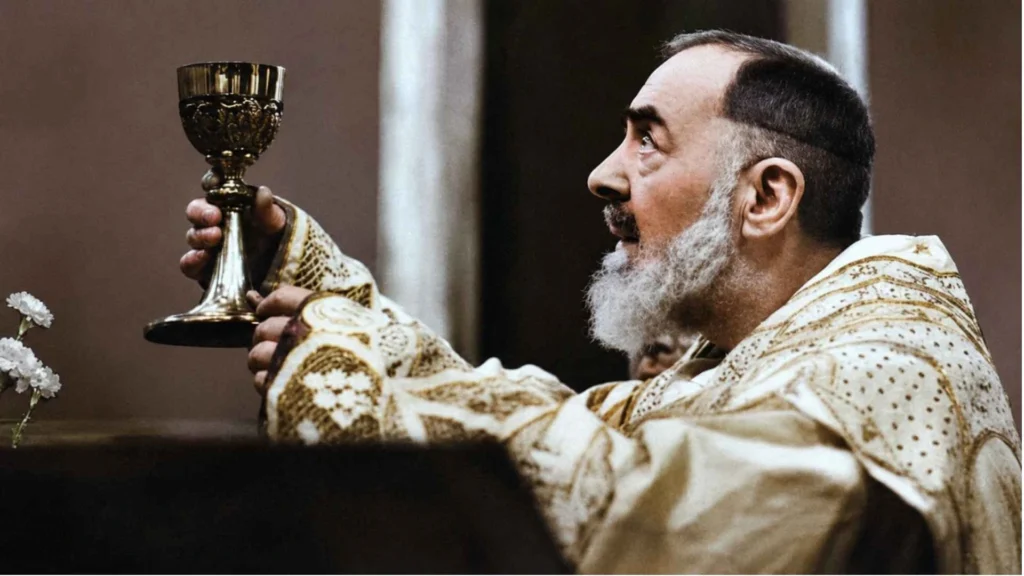
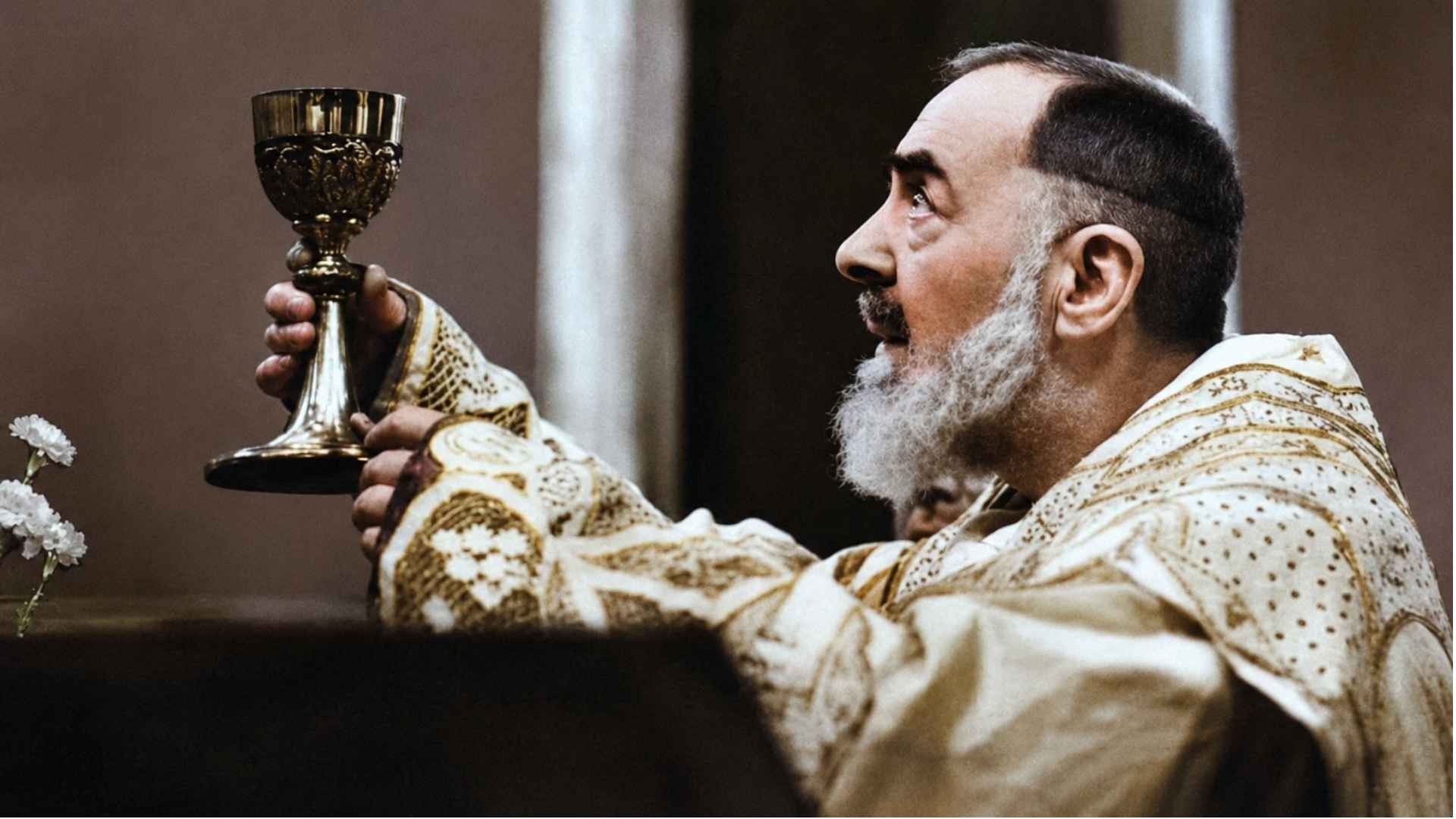
Few modern saints are more closely associated with this devotion than Padre Pio of Pietrelcina.
The Italian Capuchin friar, renowned for his intense prayer life and devotion to the Rosary, encouraged countless people to seek spiritual strength through prayer.
But one extraordinary story attributed to him raises a question that deserves careful examination.
Did Padre Pio actually witness a single Hail Mary ascending into heaven and bringing about a miraculous healing?
The popular account describes a farmer named Joseph living near San Giovanni Rotondo, the southern Italian town where Padre Pio spent much of his religious life.
Joseph’s young son, Anthony, was reportedly suffering from a life-threatening illness.
According to the narrative, doctors believed that recovery was unlikely.
Overwhelmed by fear and unable to find words for an elaborate prayer, Joseph knelt beside his bed and recited one Hail Mary.
He prayed slowly, entrusting his son’s future to God through the intercession of the Blessed Virgin.
The story then claims that Padre Pio experienced a supernatural vision in which Joseph’s prayer appeared as a flame ascending toward heaven.
Mary supposedly presented the petition to Jesus, after which Anthony recovered unexpectedly.
It is an emotionally compelling account.
However, the alleged vision, the named family, and the dialogue attributed to Padre Pio cannot be established from reliable documentation presented with the story.
They should therefore be understood as an unverified devotional narrative rather than a confirmed historical miracle.
Nevertheless, its central message reflects an important principle of Catholic spirituality.
Prayer is not measured simply by the number of words spoken.
The Hail Mary itself offers a remarkable example of how a brief prayer can contain centuries of theological meaning.
Its opening words originate in the Gospel of Luke.
At the Annunciation, the angel Gabriel greets Mary and announces that she will become the mother of Jesus.
The biblical greeting provides the foundation for the prayer’s opening invocation.
The next portion draws upon Elizabeth’s greeting during the Visitation.
Filled with the Holy Spirit, Elizabeth recognizes Mary’s extraordinary role and blesses both her and the child she carries.
These two biblical moments connect the Hail Mary directly to the mystery of the Incarnation.
The prayer does not begin by asking Mary for material favors.
It begins by acknowledging God’s action in her life and directing attention toward Jesus.
This distinction is essential to Catholic understanding.
Mary is honored because of her unique relationship with Christ, not because she possesses divine power independently of him.
The second portion of the prayer developed gradually within the Church’s devotional tradition.
It asks Mary, the Mother of God, to intercede for sinners in the present moment and at the hour of death.
The title Mother of God has particular historical significance.
At the Council of Ephesus in 431, the Church affirmed Mary’s title as Theotokos, meaning God-bearer, in defense of the teaching that Jesus Christ is truly divine and truly human.
Consequently, the Hail Mary contains far more than a familiar devotional formula.
It expresses central Christian beliefs about Christ, grace, intercession, repentance, and salvation.
Padre Pio’s devotion to Mary was deeply rooted in this Catholic tradition.
Born Francesco Forgione in 1887, he entered the Capuchin Franciscan order and was ordained a priest in 1910.
He eventually became internationally known for his spiritual counsel, extensive hours in the confessional, and reports of extraordinary religious experiences.
He also maintained a profound devotion to the Rosary.
Photographs and accounts of his life frequently show him carrying or praying with rosary beads.
For Padre Pio, Marian devotion was inseparable from his commitment to Christ.
The Rosary invited believers to meditate upon events in the lives of Jesus and Mary, including the Annunciation, the Crucifixion, and the Resurrection.
Its repeated prayers were intended to support contemplation rather than replace it.
This helps explain why attentiveness matters.
A person may recite many prayers while remaining distracted.
Another may offer a brief prayer with genuine humility and concentration.
Catholic teaching recognizes the value of perseverance in prayer while also emphasizing the importance of interior participation.
However, it does not establish a mathematical rule declaring that one attentive Hail Mary automatically outweighs a particular number of distracted prayers.
Nor does it teach that a single prayer guarantees a miracle.
Prayer is an expression of faith and petition, not a mechanism for controlling divine decisions.
This becomes especially important when discussing stories of unexpected healing.
Catholics may pray for the recovery of someone who is seriously ill.
They may ask Mary and the saints to intercede for that person.
They may also express gratitude when recovery occurs.
But an unexplained medical improvement does not, by itself, establish that a particular prayer caused the outcome.
The Church uses careful investigative procedures when evaluating alleged miracles in certain official contexts.
Medical documentation, expert assessment, and other evidence may be required.
The distinction between sincere belief and verified supernatural intervention protects the integrity of religious testimony.
Another popular story attributed to Padre Pio concerns a dying man who had abandoned his faith for decades.
According to the narrative, the man remembered the Hail Mary taught by his mother and began reciting it shortly before death.
The account claims that Padre Pio witnessed Mary protecting the man’s soul and guiding him toward purification rather than condemnation.
Again, the specific vision and reported conversation cannot be authenticated from the material provided.
Yet the underlying theme touches one of Catholicism’s most significant teachings: the possibility of repentance even near the end of life.
The Gospel of Luke recounts how a criminal crucified beside Jesus turned toward him in his final moments.
Christ responded with a promise of paradise.
For Catholics, this passage illustrates the extraordinary reach of divine mercy.
It does not mean that merely pronouncing a sacred formula automatically guarantees salvation.
Repentance, grace, and the mystery of God’s judgment cannot be reduced to the mechanical recitation of words.
The Hail Mary’s closing petition reflects this deeper understanding.
When Catholics ask Mary to pray for them at the hour of death, they acknowledge their dependence upon divine mercy during life’s most consequential transition.
The prayer expresses hope rather than certainty about an individual’s final judgment.
Its significance lies in entrusting that moment to God while seeking Mary’s intercession.
Padre Pio’s broader spiritual teaching also emphasized resisting temptation through prayer.
Catholic tradition frequently describes the Rosary as a spiritual weapon, language intended to communicate its role in strengthening faith and perseverance.
This imagery has sometimes been expanded into dramatic claims that particular prayers physically drive away demons or produce immediate supernatural effects.
Such claims require caution.
The Church encourages prayer during temptation, but it does not promise that every struggle will disappear after one Hail Mary.
Some temptations involve longstanding habits, emotional difficulties, or circumstances requiring practical intervention.
Prayer can support moral determination while remaining compatible with counseling, accountability, and other forms of assistance.
The same principle applies to financial hardship and family problems.
A person who has lost employment may find strength through prayer.
Someone facing serious debt may ask for guidance and courage.
But Catholic devotion should never be presented as a guarantee of receiving money, employment, or physical healing within a specified period.
Mary’s intercession is understood within God’s providence, not as an independent power capable of overriding it.
Another significant dimension of the Hail Mary concerns prayer for the dead.
Catholics traditionally pray for deceased loved ones and for souls undergoing purification.
This practice reflects belief in the communion of saints and the possibility of spiritual solidarity extending beyond earthly death.
The Catechism discusses prayer for the dead in connection with the Church’s teaching on purgatory.
However, claims that one Hail Mary removes a precise number of years from purgatory are not established Catholic doctrine.
Purgatory should not be imagined as a system in which spiritual penalties can be calculated through fixed numerical exchanges.
The Church encourages prayer for the deceased without claiming detailed knowledge of the duration or measurable effects of individual petitions.
This distinction allows Marian devotion to remain meaningful without depending upon unverifiable supernatural calculations.
The Hail Mary also has a natural place in preparation for the sacraments.
Before Confession, a Catholic may ask Mary to help cultivate honesty, humility, and sincere repentance.
Before receiving Holy Communion, the prayer can encourage reflection upon Christ and the mystery of the Incarnation.
Such practices are devotional aids rather than mandatory sacramental requirements.
They may deepen spiritual preparation, but they do not replace the conditions established by the Church for receiving the sacraments.
For believers wishing to pray the Hail Mary more attentively, the simplest approach may also be the most effective.
Begin by setting aside a brief moment without unnecessary distractions.
Recall that the opening words refer to the angelic announcement of Christ’s coming.
Reflect upon Mary’s acceptance of her vocation and the blessing associated with Jesus.
Then consider the meaning of asking for intercession.
What particular difficulty, responsibility, or person needs prayer today?
The intention may involve forgiveness, patience, courage, or concern for someone who is suffering.
There is no need to manufacture extraordinary emotions.
Some days prayer may bring consolation.
On other days it may feel dry, distracted, or difficult.
Catholic spiritual tradition recognizes that these experiences are normal.
The value of prayer does not depend entirely upon whether a person feels something unusual.
Perseverance, sincerity, and trust remain important even when immediate emotional rewards are absent.
This perspective also prevents devotion from becoming a source of anxiety.
A believer who struggles to concentrate has not necessarily offered a worthless prayer.
Someone who forgets a word or becomes distracted need not assume that Mary has rejected the petition.
The purpose of attentive prayer is to deepen a relationship with God, not to create another standard of perfection that frightened believers feel unable to meet.
Padre Pio’s enduring significance lies partly in his insistence that spiritual life requires humility, perseverance, and confidence in divine mercy.
His Marian devotion remains an important part of his legacy.
Yet respecting that legacy also means distinguishing his documented spirituality from sensational stories and quotations that circulate without reliable sources.
The alleged vision of Joseph’s Hail Mary may be memorable, but it cannot serve as historical proof of what Padre Pio saw.
The established Catholic tradition offers a profound message without requiring that story to be literally true.
A single Hail Mary contains the words of Scripture, an affirmation of Christ’s identity, and a request for prayer at life’s most vulnerable moments.
Its importance is not that it guarantees an extraordinary event.
Its importance is that it invites the believer into a relationship of faith, remembrance, and trust.
Perhaps that is the most remarkable power of this familiar prayer.
A person does not need theological expertise, perfect circumstances, or elaborate language to begin.
Whether spoken in a church, whispered beside a hospital bed, or remembered during a difficult night, the Hail Mary remains an accessible expression of Catholic devotion.
And the question worth considering is not how many miracles one prayer can compel, but how deeply its words can shape the faith, humility, and love of the person who recites it.