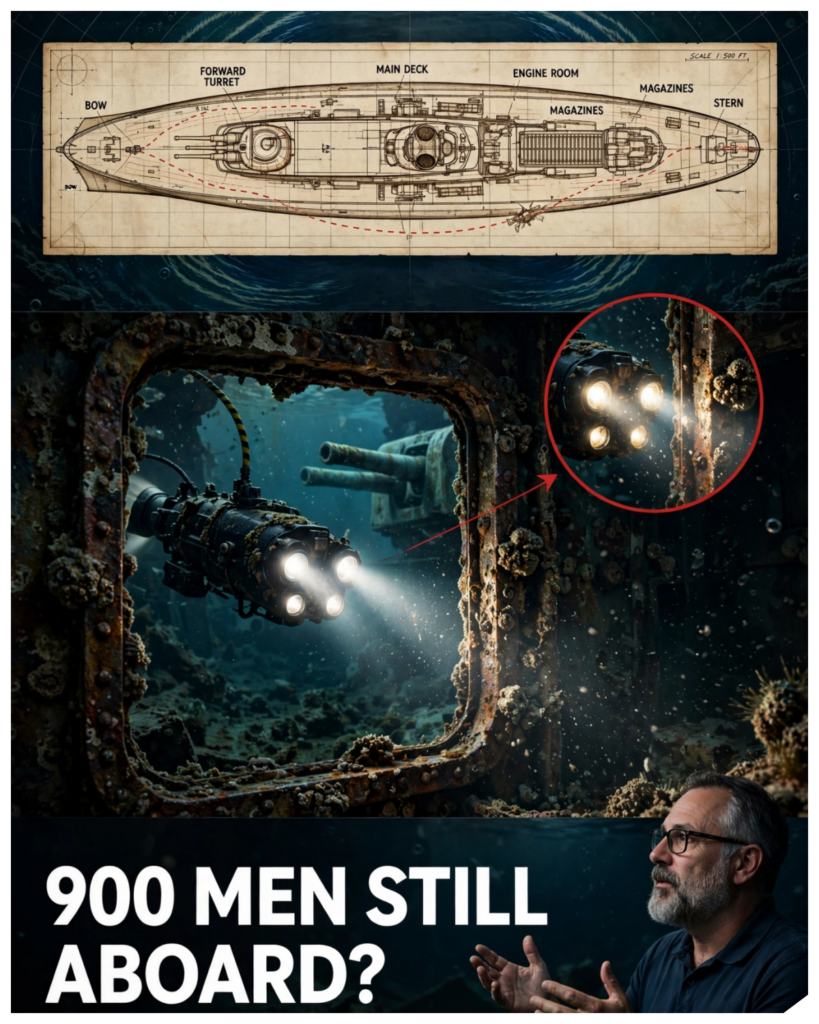
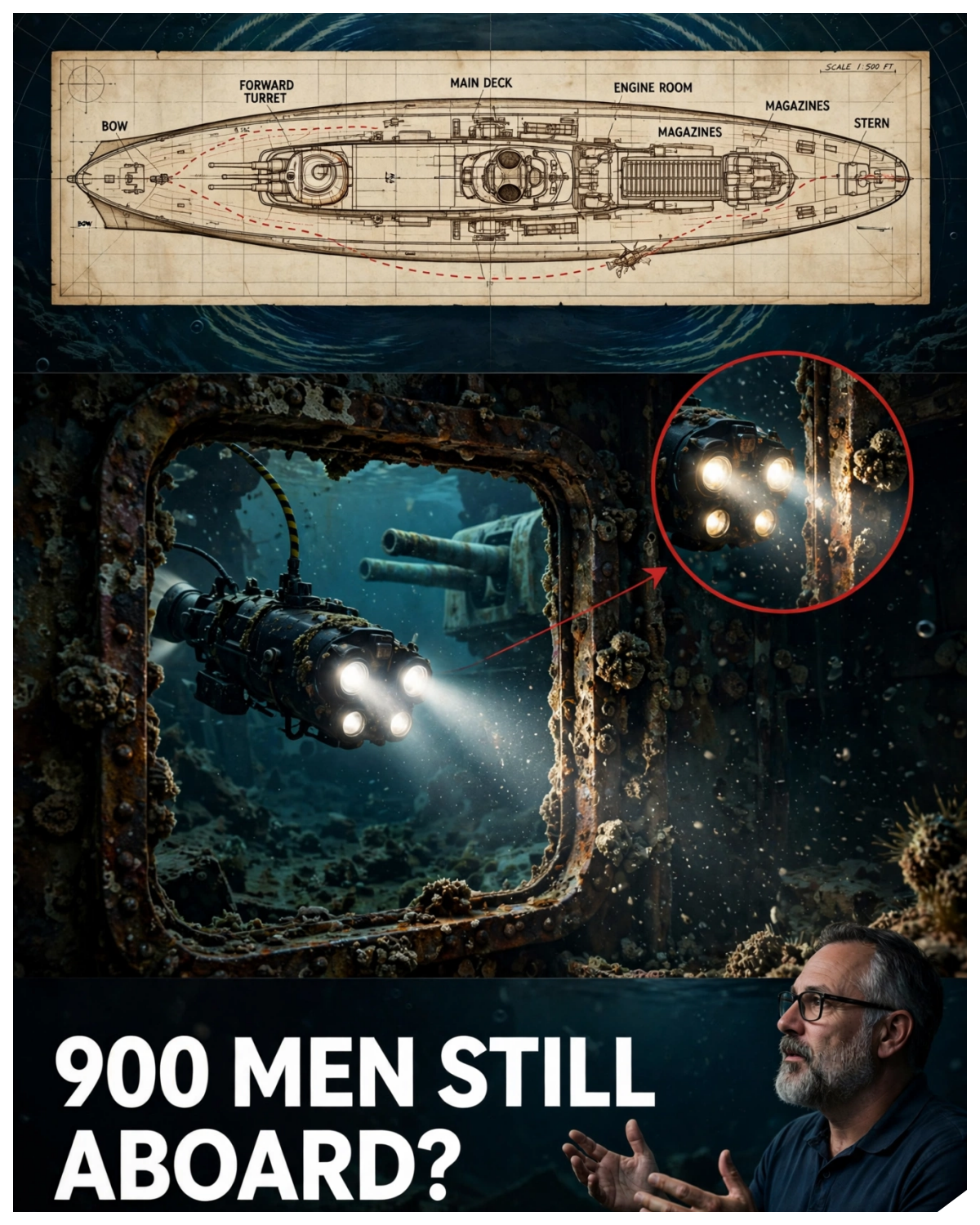
A small underwater drone trails its cable through an opening in the sunken battleship USS Arizona, and its lights push into rooms that have sat sealed in the dark since the morning she sank.
Above it, visitors at the White Memorial in Pearl Harbor look down at her deck through the green water.
Below it, sealed behind steel and silt, lie more than 900 sailors and marines who never got out.
No diver has been allowed inside since the war.
The park service forbids it out of respect for the men and because the old ship is dangerous.
And even the robots went in only with the survivors blessing.
The man who led the work called it a very sensitive matter.
So, what is really left in there?
And why does this ship still leak oil and still take back her own crew all these decades later?
I’m Thomas Hail and today we follow the cameras into one of the most sacred war graves on Earth.
A survivor of the ship watched one of her desks drift onto a monitor 75 years after he escaped her.
An old story said the oil would stop on a certain day, and that day came.
And deep inside, the robot found something hanging in a locker that stopped an entire control room cold.
Before we’re done, we’ll see what the cameras found, who is really still aboard, and why some families of the missing may learn something they never expected.
Before any robot could go in, someone had to find a way.
The park services underwater team, the divers who look after the country’s sunken historic sites, swam the length of the hull, hunting for an opening.
The bow was out of the question.
The explosion that killed the ship had peeled her steel back, steel several inches thick, and collapsed the decks around it.
So they worked the stern, checking every hatch, vent, and crack, and found many of them packed with silt.
Here and there, the old teak planking of her deck was still in good shape.
Their rule was simple.
Nothing would be dug out to make room.
If a weigh-in was blocked, it stayed blocked.
At one point, two of the divers came up beneath the memorial’s viewing well, the opening in the floor where visitors looked down onto the deck, and found themselves staring straight up into the faces of the people looking down at them.
Why had nobody been inside for so long?
In the weeks after the attack, Navy divers did go in.
They felt their way through black oil fouled compartments, cut away the masts, hauled out live ammunition and machinery, and lifted big guns off her to defend the island’s coast.
They also carried out the dead, 105, of the Arizona’s men.
On the bridge, they found the Naval Academy ring of the Admiral aboard, Isaac Kidd, fused to a steel bulkhead.
Kid himself was never found.
He was awarded the Medal of Honor after his death.
Then they stopped.
There weren’t enough hands.
The wreck was too dangerous, and the work was wearing the divers down in a way the records don’t hide.
In December of 1942, the Navy struck the Arizona from its list of ships.
And the men still aboard declared buried at sea, right where they lay.
They left one thing behind.
Two concrete mooring platforms poured onto her deck for the salvage meant to be temporary.
More than 80 years later, rangers found one partly collapsed and in the autumn of 2025, Navy divers sawed most of that concrete off her before its weight could break through the decks.
The first people to study the whole wreck properly came in 1983.
An underwater archaeology team from the park service, sometimes as many as 60 divers at once.
The harbor was so murky that they couldn’t always tell whether they were under an overhang or already inside the ship, so they would stop and wait until they could see where they were.
The Arizona is 608 ft long, about the length of two football fields, and nobody could see more than a sliver of her at a time.
The key equipment for surveying a battleship, it turned out, was the sort of thing you’d find in a kitchen drawer.
Tape measures and string stretched across the deck, piecing her together like a mosaic.
The string told them things nobody expected.
Near the explosion, the hull measured wider than the ship’s own plans, bent outward by the blast.
The forward turret still held its huge guns, guns long believed to have been taken off for coastal defense.
Under the memorial itself lay 5-in shells and bags of what looked like congealed gunpowder.
And the Navy’s explosive specialists had to come and take the shells away, and divers reported pockets of air still caught in some of the port holes trapped there since that Sunday morning.
What they did not do was go in.
One of the divers said the team simply figured that wasn’t their job.
Their leader admitted that when he worked alone at the end of a long day down there, he sometimes felt he was not alone.
Beyond a camera pushed through an opening here and there, the inside of the Arizona stayed out of reach for more than 30 years.
That changed in 2016 as the 75th anniversary of the attack drew close.
The park service team came back with partners, photographers from National Geographic, and two machines that could go where people could not.
One was a compact drone flown by the president of the company that makes it.
The other was a bigger robot customuilt with the scientist at Woods Hole and it was built to do more than look.
Directing the work underwater was Brett Seymour, deputy chief of the park services underwater team and its photographer.
To him, this was not just a shipwreck.
It was the shipwreck.
The drone went first.
Its cable carried a live picture up to the team on the surface.
In there, the camera could see a few inches, a foot at best, through water thick with silt.
The passages were a maze of obstacles and tight corners, and somewhere in it, the camera passed a hole punched by one of the bombs.
Oil coated the ceilings gathered there over decades as it crept up through the ship.
Then the room started to give things back.
A sink held fast to the floor by a deep bed of silt.
In the officer’s wardrobe, white soap dishes, porcelain by the look of them sitting on a shelf with no debris on them at all after 75 years.
Then the camera eased into the admiral’s cabin, quarters, the filmmaker said, had not been seen since the ship went down.
And then it came to a dusk.
What sat on it is best told by one of the people watching the screen because he had been aboard the morning she died.
Donald Stratton was 94, one of only a handful of Arizona survivors still alive.
On the morning of the attack, he was a young seaman high up on the ship’s sky control platform, helping director anti-aircraft guns.
They had been firing for about 6 minutes when, a little after 8, a heavy armor-piercing bomb punched through the deck near the forward turrets and set off the powder store below.
Stratton later described a ball of flame that went five or 600 feet into the air.
1177 of the Arizona’s men died.
Nearly half of all the Americans killed at Pearl Harbor that day.
The fire swept up toward the platform where Stratton stood.
He was burned over more than 3-fifths of his body from his face to his ankles.
He and five other badly burned men were trapped up there with fire below them until a 26-year-old sailor on the repair ship tied up alongside Joe George saw them and threw them a line.
George had been ordered to cut his ship loose from the burning Arizona.
He threw the rope anyway.
The six men went hand overhand along 70 ft of it high above the burning water to the repair ship’s deck.
Not all of them would survive their burns.
Stratton did.
Doctors urged amputation.
He refused, learned to walk again, went through boot camp a second time, and fought on across the Pacific aboard a destroyer.
Another who lived was a young fire controlman named Lauren Bruner, and we’ll meet him again before the end.
75 years later, Stratton sat in front of a screen and watched the drone move through the ship he had climbed away from.
The phone was there on the desk and the light bulb was in the socket.
He said, “It’s just kind of eerie.”
He said he never thought you could see something like that so many years on.
And he didn’t only watch.
As the pictures came up, he guided the team through his old ship from memory.
Joe George never heard thanks like that from his own Navy.
He died in 1996 with no official recognition, and Stratton and Bruner spent years pressing to fix it.
At a ceremony on the Arizona Memorial itself in 2017, a Rear Admiral presented the Bronze Star for Valor to George’s daughter with both of the men her father had saved there to see it.
Stories like that where the record finally catches up with the people in it are the reason General Discovery exists.
If you want more of them, subscribe.
For all the drone saw that day, its camera never once showed the men themselves.
75 years of silt had settled over nearly every surface, and whatever lay underneath it stayed covered.
No one disturbed it to find out.
Admiral Kidd, the man whose ring the salvage divers found, is still listed as missing in action and most likely lies somewhere in the ship below.
Around him are men who were family to each other in the plainest sense.
23 sets of brothers died aboard the Arizona.
So did Thomas Free and his son William, the only father and son on the ship.
The ship’s band was lost, too.
Every morning at 8, they played the national anthem as the flag went up.
All 21 of them were killed.
From the memorial above them, the one Elvis Presley helped pay for with a benefit concert at Pearl Harbor in 1961.
Visitors lean on the rail and watch something rise from the hull.
Small dark drops that spread on the surface into rainbow sheen.
People called them the black tears of the Arizona.
The day before the attack, she had filled her tanks with well over a million gallons of heavy fuel oil.
Much of it burned.
Somewhere around half a million gallons, maybe more, is still sealed inside her, and a little finds its way out every day, a gallon or two by the best current estimate.
For years, a story went around the memorial that the oil would stop the day the last survivor died.
It’s the kind of story people tell because it feels right.
Donald Stratton died at home in Colorado in his sleep in February of 2020.
And on the 1st of April 2024, Lu Conter died at the age of 102.
He had been on watch on the deck when the bomb hit and stayed to help pull his shipmates to safety.
He was the last living survivor of the USS Arizona.
The oil did not stop.
In the autumn of 2025, chemists from Woods Hole, the University of Houston, and the Park Service published a forensic study of the Black Tears.
They had fingerprinted samples from several leak points, molecule by molecule, and traced the oil to California crude, just what you would expect of a Navy ship fueled in the early 1940s.
Each leak carried its own chemical signature shaped by the path it had taken through the wreck.
“The strangest finding was how little the oil had changed.
Surprisingly, the oil has not changed that much in 80 years,” said the study’s senior chemist Chris Readydd.
“Spilled oil is normally eaten away by microbes, but the Arizona’s tank sits so deep in the hull, so tight and so short of air that the microbes have made almost no headway.
Nobody is in a hurry to pump it out either.
Ready calls the ship a national shrine.
The leak isn’t at a level that worries him.
And studies of her steel say the hull should hold together for at least another 150 years.
That old story about the tears and the last survivor turns out to be a myth.
The tears were never waiting on those men.
They have outlived every one of them.
What they really tell us is that the inside of this ship is starved of air.
And the robots had already measured exactly how starved.
That was the job of the bigger robot, the one built with woods hole.
As it worked its way deeper into the Arizona, it tested the water in every space it entered, and above all, it measured the oxygen.
Out in the harbor, the oxygen reading runs above 80%, the kind of water that eats a steel ship quickly.
On the second deck, the readings fell and Seymour saw what he called tremendous preservation with almost no rust.
Then the robot went down one more level into the cabins of the third deck.
There, the oxygen was down to 4%.
You would expect a cabin like that after 75 years under a harbor to be nothing but gray mounds of silt.
In one officer’s stateoom, the camera found a locker, the kind where the men hung their clothes.
Inside it on a wire hanger hung a Navy uniform jacket, its shoulder epolet still in place.
It wasn’t buried in silt.
It wasn’t even dirty.
It hadn’t so much as slipped off the hanger.
Beside it hung a pair of dress trousers with their leather suspenders.
Up on the surface, in Seymour’s words, everyone in the control room froze.
Of everything in this story, that hanger is the detail I can’t shake.
For a moment, the Arizona wasn’t a wreck or even a monument.
It was one man’s closet, his uniform hanging exactly where he had left it.
And the reason it survived is the same reason the oil has hardly aged.
The still water that holds her dead has kept their belongings nearly as they were.
Seymour has said that in more than 20 years, in some 400 dives, this is the only wreck where he has felt a personal emotional connection.
The team’s plan was to go deeper still below the third deck.
There is one more twist in who is actually down there.
The Arizona’s dead were never all in one place.
Some were carried out by the salvage divers.
Others were recovered at the scene, and the ones who couldn’t be identified were later rearied as unknowns in the National Cemetery inside the old volcanic crater above Honolulu that everyone calls the Punch Bowl.
For more than 80 years, most families of the missing had every reason to believe their man was in the hole.
Then a Virginia real estate agent named Kevin Klene decided that wasn’t good enough.
His great uncle, a gunner’s mate named Robert Klene, died on the Arizona and is still listed as missing.
In 2023, Klene started a project he called Operation 85 to find the relatives of the missing and get their DNA on file.
When he started, the government held DNA from barely two dozen Arizona families.
It needed more than 600 before a single grave could be opened.
The Navy’s own estimate was that gathering them could take a decade.
With a small team of researchers and genetic genealogologists, Klein did it in about 3 years.
I think this is a problem we can fix, he said.
On the 7th of December, 85 years to the day, the Pentagon’s agency for finding America’s missing plans to begin raising the Arizona’s unknowns from the punch bowl early that morning.
More than 700 family members are expected in Hawaii.
The plan covers the cemetery graves only, not the hole.
But the AY’s director has said up to 140 families could finally receive their man’s remains, which would mean learning that he is not intombed in her after all.
Was what that little drone captured really haunting?
I think it was.
And there is nothing ghostly about it.
The cameras found a Sunday morning stopped in place, and the science explains why it lasted.
The air inside the Arizona is nearly gone.
That much is confirmed on film and in the measurements.
What they never showed were the men themselves, and no one disturbed the silt to change that.
As for who is aboard, the number is more than 900, and not every name in that number is certain yet.
As of October 2026, the first caskets are due to come up from the punch bowl on the 7th of December.
And every identification that follows will tell a family where their man has really been all along.
There is one way into the Arizona that no robot could ever take.
Since 1982, survivors of the ship have been allowed to come back to her, and 45 of them have.
Divers carry each earn down and set it in the well beneath one of her gun turrets.
Among the men they served with, Lauren Bruner, the young man who went hand overhand along Joe George’s rope, lived to 98.
He pointed out that hardly anyone visits a cemetery while more than a million people a year come to the Arizona.
I thought, well, all my buddies are right here, he said.
On the 7th of December 2019, two army divers in the old round helmets and lead boots the Navy used for generations walked across her deck and carried his urn 22 ft down into the turret.
Two years later, another one came home.
Harvey Milhorn had been wounded that morning and swung to shore and he died in 2002 without ever telling anyone what he wanted.
His family only found out when they were getting ready to sell the house and turned up the request he had quietly filled out to be laid to rest aboard his ship.
The last survivors are gone now.
The robots have seen what they can, but the Arizona still has her crew and some of them chose to come back to her.
I’m Thomas Hail.
Thank you for spending this time with