1983 Oldsmobile 98 “Slicktop” Coupe: The Last Word in Yesterday’s Luxury
Well, I hope everybody in the US had a great Thanksgiving and now I have a little bit of time off, so I thought I’d make some videos on some classic cars that I found that are pretty unique.
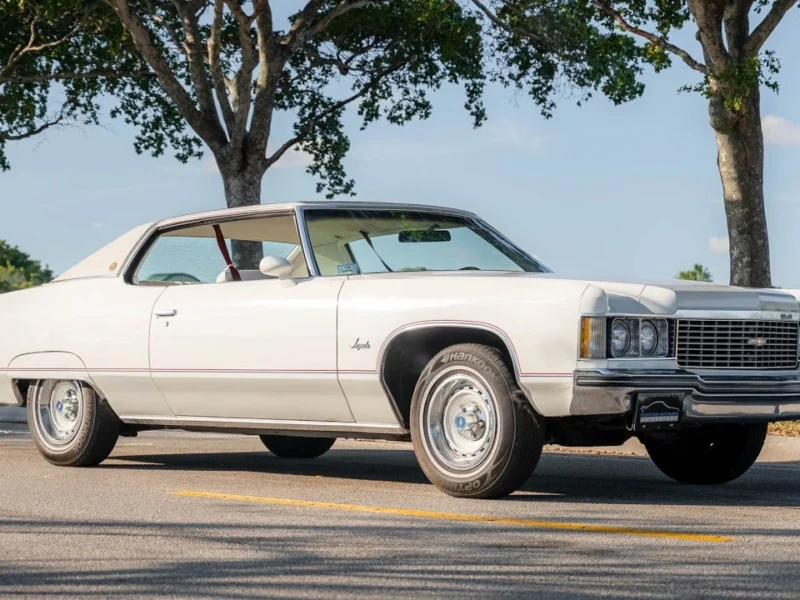
And the first is this 1983 Olds 98 coupe that is a slick top.
It doesn’t have a vinyl roof.
And I can’t remember the last time when I’ve seen one of these without a vinyl roof.
In any case, this comes from a time in America when somebody could announce their professional advancement without having to purchase a German automobile.
This was a time during which, you know, you were driving an old’s 98 or maybe a Cutless and you took it back to the dealership, traded it in and got the keys to a 98 and that signified that you had arrived.
You have to remember what was going on around this time frame as well during which this 98 came out.
The American luxury automobile was really an institution under siege.
The Europeans were selling sophistication by this point in making inroads.
The Japanese were selling quality and precision.
And Washington was really demanding fuel economy of these living rooms on wheels.
And that’s really what this car was, a living room on wheels with a V8, no vinyl roof in this case.
Uh, and most of these have velour, but this one actually also has a leather interior.
So, you have enough cow hides here to upholster the better part of a Holiday Inn lounge.
It’s pretty awesome.
And I have to say that there was considerably more intelligence in the proposition that the 98 that you see here offered than the contemporary automotive critics generally cared to admit.
Most of them really just criticized the car for its ponderous handling, that it was a land yacht, blah blah blah blah blah, but they never really understood what was so great about these cars.
No, they didn’t handle especially well.
No, their brakes weren’t overly great, but for the purpose that the buyers wanted to be driving around in pure comfort.
You’re not going around a racetrack on most roads.
Um, unfortunately I think the Buff Book magazines kind of got it wrong and these really were in general pretty gosh darn good cars.
Now the 98 Regency did carry a base price of about $13,500 and that was very expensive.
So that’s a little over $40,000 $45,000 base price in today’s terms.
And that’s base price.
Remember you had to pay optional.
You had to pay for everything pretty much.
It was extra.
So on this car, you’ll see the 5 L V8 was extra.
The leather interior was extra.
The wire wheel discs were extra.
Uh by this point though on the 98, you did get air conditioning, power locks, power windows is standard equipment.
So you did get some nice things that were standard, but there still was quite a bit of optional equipment that could run this window sticker up quite higher.
So, and again, while $40 to $45,000 base price, probably this car with the options it has is closer to the equivalent of about $50,000, remember that back then you couldn’t finance cars over 84 months.
Uh, you were financing [snorts] maybe over 36 months.
Um, and they just didn’t have the lease deals that they have today because cars depreciated more quickly due to rust and other things.
So, this was a pretty expensive car.
It wasn’t a Cadillac or Lincoln, but it was Cadillac adjacent transportation, let’s say, for people who could probably afford a Cadillac, but preferred not to advertise the fact.
Now, this old 98 was built on GM’s rear wheel drive Seabbody platform, and it measured 221 in and rode a top 119in wheelbase.
And remember, this was a downsized car.
was downsized in 1977 from the 1976 model year when it rode a top 127in wheelbase and was uh pushing 230ish in in overall length.
So, this looks big, but this is really a car that was a product of General Motors weight reduction program.
Of course, you still had the separate perimeter frame, the independent front suspension with coil springs, a coil sprung live rear axle, the old school recirculating ball power steering.
You did get power front disc brakes, and there wasn’t anything that was revolutionary about the engineering.
But by 1983, General Motors had spent decades perfecting the art of kind of preventing the American highway system from intruding upon the consciousness of its customers in these cars.
And so, the car did a lot of that well.
was the suspension was calibrated to absorb pavement irregularities rather than transmit a detailed intelligence about them.
The steering was light.
The brakes required little effort.
The seats were designed around the dimensions of actual American business people rather than malnourished uh Italian or German racing drivers.
So, it really was a great car in many respects.
Now, let’s talk a minute about the styling and how would I I guess describe the styling.
It’s kind of a handsome piece of uh industrial architecture, particularly in this twodoor form without the vinyl roof.
And uh let’s start with the front end.
And you of course have the composition here that’s characterized by four rectangular headlamps, this broad upright egg crate grill with the fine texture insert and uh pretty substantial chrome bumper.
And there’s no attempt here clearly to suggest aerodynamic efficiency.
Now, interestingly, Ozmobile designers kind of took a styling cue, I would say, from years past.
And remember back in the late ’60s, cars that had the big loop bumper like the Chevrolets and the fuselageer Chryslers into the early ‘7s in some cases.
Well, here they’ve kind of got a little bit of like a loop uh bright work trim around the grill and enveloping the headlamps and spilling over into the side and enveloping the uh parking lights as well.
And it makes the front end read as one graphic.
There’s no attempt here to really segregate the headlamps from the grill.
It makes it read like one wide theme.
And the only thing that really is segregated is that the grill is bisected by the Ozmobile logo.
And that dates back to 1968 when Ozmobile introduced that split grill theme.
I have no idea why General Motors design management allowed Ozemobile to have that split grill theme because that was a Pontiac theme that went back to 1959.
But had it for many years afterward and here it is here.
And you notice like the parking signals and we’ll see in the back the 98 has the vertical tail lamps.
But by this point, Omozemobile graphics and the lamp signatures were these blocky functional items.
That’s how you would characterize Ozemobile uh graphics of the time.
Just very architectural, blocky.
uh you you wouldn’t see really ornate style ozmobile tail lamps.
They just often were a big round square or something like that.
Um the one exception would be later the 1986 Tornado when it came out had this really thin beautiful crosscar tail lamp to try to make it look more expensive and emphasize the non-existent width really of that car.
But here uh just the functional graphics of the car speaks ozmobile.
You can also see that there’s a character line that gets picked up from the upper border of that bright work around the front and then the character line runs all the way rearward on this car.
Unfortunately, I can’t believe designers did this bodyside molding workout cuz it really doesn’t mesh with that character line.
It just looks awkward.
If this car didn’t have the body side molding, it would look so much better.
In fact, uh, if I were to buy a car like this, I’d probably have the body side molding taken off because it would just drive me nuts.
The car would look so much cleaner.
It already doesn’t have the vinyl roof, just take that body side molding off that somebody unfortunately paid for up front.
I guess people wanted to protect their investment and that’s why they got these body side moldings and that’s why on Cadillacs, they often came standard uh because again, people were trying to protect their investment.
Now, as we transition to this side view, again, imagine if this car didn’t have that body side molding.
Looks so much better.
It looks cool without the uh vinyl top.
And I love that character line that runs the length of the car.
I mean, it kind of needs something on the body side here.
This is a much stiffer car than the predecessor.
And part of that was packaging.
General Motors was trying to get the interior dimensions of these downsized cars to be pretty much the same as the cars that they replaced.
Now, that being said, there’s clearly a lot of uh inefficient use of the passenger compartment.
I mean, look at the size of the passenger compartment relative to the overall length of the car.
The trunk is enormous.
The hood that is enormous.
Um, but you have kind of this typical for the era GM styling with the belt line that kind of curves downward aft of the A-pillar.
Very thin A-pillars, very heavy formal C-pillar on the 98 with that vertical style.
uh formality to it.
And one of the reasons why designers did this was to emphasize the length of the rear quarter panel because the more that you have that SE-pillar being vertical, the longer the quarter panel is visually going to look.
And remember that in the early days when this car came out, GM was being criticized because they downsized cars and Ford did not.
So the Lincoln of the era were still these big, heavy cars until 1980.
GM had downsized their fleet in 1977.
So, one of the tricks that designers employed was kind of rotating those SE-pillars to be even more upright to give the car an even greater sense of length.
The 221in car a sense of length.
So, there you go.
Now, in this profile, the Omobile, I would say, kind of exhibited discipline styling, let’s just say.
And this is really the last of the Bill Mitchell era where he had the influence uh on these cars because he retired in 1977 as the lead of GM design.
But you have really pretty flat body sides.
Uh of course you have the skirted rear wheel on the 98 here.
Um, and they kind of that helps the car have this appearance and profile of the side profile of uninterrupted length.
And yeah, I think it’s handsome.
I wish this car were a dark color as opposed to this kind of taupey color, but it’s still pretty cool.
Now, we kind of rotate to this rear 3/4 view.
And I was mentioning the vertical kind of blocky tail lamps from before.
That would become a hallmark of the S’s 98 all the way till the end.
uh starting with 1963 and ever since then the 98 had these kind of Cadillacy vertical style tail lamps and so much so that when I drive my front-wheel drive 8698 that came out just a few years after this 85 would be the first year for the downsized again frontwheel drive uh 98 the first front-wheel drive 98 um it has the vertical tail lamps and some people ask me if it’s a Cadillac and I have to say Oh, see it says Omozemobile.
But regardless, you can see uh very kind of conservatively styled rear end treatment.
Not much to the deck lid, not much to the kind of upright uh tail lamps.
Um just a restrain treatment.
There’s some, you know, nice detailing around the reverse lights, which are huge.
And I guess you’re emphasizing some of the width of the car with the enormous reverse lamps.
Hopefully those bulbs in there were relatively decent wattage and uh maybe it helped the typical clientele who bought these cars to see when they were backing up at night.
And one more here of this uh rear end treatment.
Of course, you have the big bumper with the big rub strip because of the bumper impact standards, but I like, you know, designers were designing these.
cuz they have that little white strip in the middle there to help minimize its overall visual heft.
If that were just a big black rub strip, it would not look as, you know, let’s say as dainty as that one uh does.
But again, you can see relatively uh straightforward design in the back.
The deck lid does have a little bit of a kink before it goes more vertical.
Uh so it’s kind of a double kinkedked style deck lid.
Um, the uppermost one is more of a crease, kind of a crosscar crease.
The one a bit further down just above the Omobile badge is a little bit uh more rounded.
So, you know, you get some different highlights on the rear end of the car, but overall architectural conservativism is how I would characterize the styling of this car.
All right, now let’s rotate to the interior.
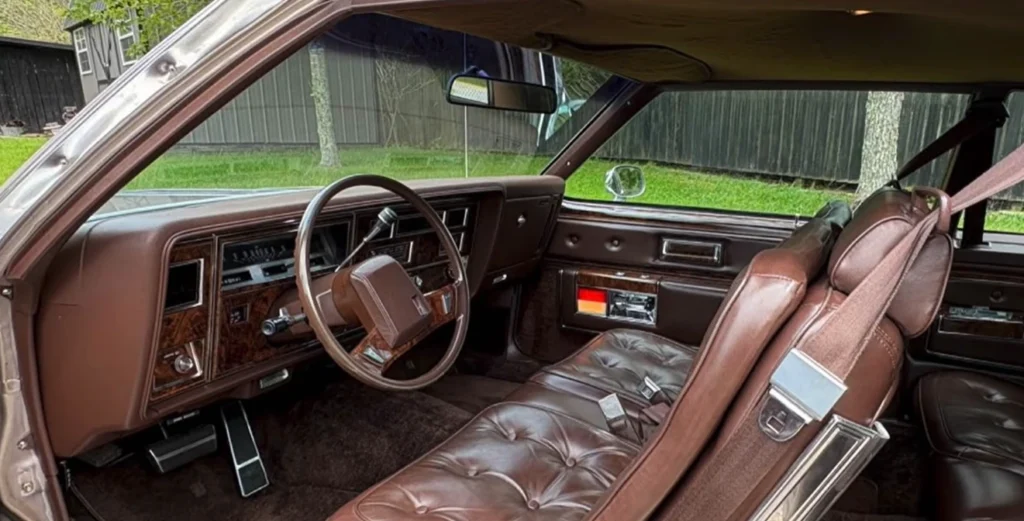
And uh this is old school American luxury at its finest.
And yes, I mean that uh in large part.
You’ve got the loose cushion style seating that was uh really a holdover from 1972 when introduced the 98 Regency in that year with that loose cushion style.
And that loose cushion style came about because Ozmobile uh division chief John Bells asked the interior team what could they do with a hundred extra dollars and that’s what they came up with and here it became so successful that it proliferated and continued uh for a number of years and other GM divisions started using this loose cushion style that really initiated on the S’s 98.
But you have acres of faux wood grain on the dash and the door panels.
You have the button tufting on the seats as well as the door panels here.
Unfortunately, you got the typical GM saggy 80s era headliner.
They all sag by this point.
It’s just uh kind of like foam on cardboard and the foam degrades and uh then you’re kind of stuck with uh this and you have to get it replaced.
But uh overall uh very very comfortable seats.
Uh obviously fashioned here in leather which was optional.
Great deep pile carpeting.
Where has that gone? You can’t get any car with deep pile carpeting these days with excellent sound insulation.
Um, and you also have a dashboard that is um relatively close to the windshield.
GM designers were trying to make the passenger compartment feel open and airy and so the dashboard was really pushed further forward so that it gave you the sense that there was more space.
Now, unfortunately, despite the luxury uh the luxuriousness of the interior here, it does have hard A-pillar trim and garnish trim, not padded like you would have seen on um or uh let’s say ched out like you would have seen on some of the earlier 98s of yester year back in the ’60s.
Um but by this point, GM was just using kind of hard trim, which was unfortunate uh because it kind of cheapens the look of the interior, especially the exposed screws.
But that’s just how they did things back then and that was acceptable.
Otherwise, the interior is pretty awesome.
And as we take a closer look at that IP, this had to have been a customordered car because it has a number of the options that I was mentioning before.
It doesn’t have the vinyl roof.
It has the 307 V8 under hood.
Um, but it doesn’t have cruise control.
It It I don’t think it has delay wipers either.
So, it’s just the standard two-speed wipers and no cruise control on the multi-function stock, but it does have the gauge package.
You can see that it’s got the gauges underneath the speedometer.
So, I’m surprised that no one ordered uh delay wipers or cruise control on this car, but it doesn’t have it.
Um, and that’s how you could order cars back then.
Back to like I said, everything was optional.
I don’t even think this has a tilt wheel, by the way.
So, somebody wanted the bigger engine.
They wanted the uh leather seats, but they didn’t want to be super comfortable behind the wheel and just push a button and activate the cruise control.
Very strange, but again, that’s how things were back then.
You could get whatever you want.
You can see it here better, I think, the hard A-pillar trim and the exposed screws.
But regardless, a nice interior.
I mean, uh I would I would take this on a cross country trip all day, although I think I would miss the cruise control.
That would be nice to have.
And now to the engine room side of things.
This car has the optional 307 V8.
Made around 140ish horsepower.
Some 140 150 around that zip code.
The standard engine actually in 1983 was the Buick sourced 4.
1 L V6 engine.
It was an enlarged 3.
8 L engine.
And that was the standard power plant in the I would say that this was before those engines were known for being super reliable.
They would last 100,000 miles, but they did have some bottom end issues.
They weren’t nearly as robust as they would become in the subsequent years.
Still not bad engines, but the old 307 was a great engine.
Very smooth.
Uh the Buick 4.
1 L V6 was a 90° V6 with no balance shaft, so it did have some vibrations, but the old 307 was buttery smooth, silky, longlasting.
uh you could get well over 150,000 miles out of the engine if the uh if the car body didn’t to degrade around it.
Had the 2004R transmission, a four-speed rear wheel drive uh automatic, which was decent.
Wouldn’t call it the best.
It was no turbo hydroatic 400, but did offer good fuel economy.
And these things are not fast, but the old 307 is very pleasant.
And uh it’s got a decent amount of torque, so it’ll scoot around pretty well.
Um I I have to say I don’t understand why these ladder omobile 98s toward the end of this generation through the 1984 model year seemed to be worth more than the 77 to 79s.
the 77 and 79s, you can get the old 403 V8 under hood, which had some bottom end issues of its own, but it was perfectly fine if you didn’t uh operate it north of 4,000 RPM for an extended period of time.
And you know, I would I would prefer one of those.
I think that the styling was a little bit nicer and you could get a much bigger engine.
Came standard with the old 350.
So, they came standard with an engine larger than what you could get in these, at least from a gasoline engine standpoint.
You could also get the wonderful 350 diesel in these.
They made 105 horsepower, but we’ll forget about that.
Regardless, I think the 77 to 798s are great buys.
They’re worth, for whatever reason, almost nothing.
You can pick a mint condition one up for maybe 12 grand, 13 grand, something like that.
You got a wonderful driving car.
Uh, even better, frankly, than this cuz you got more horsepower and torque.
So, what do you think of this cool 8398 slick top? Put a comment in the comment section.
Let me know.
Thanks again for watching.