1974 Chevrolet Spirit of America Impala: Chevrolet…
1974 Chevrolet Spirit of America Impala: Chevrolet Celebrates the Bicentennial Two Years Early!
Well, today we have a fun one and we’re going to talk about when Chevrolet went patriotic in interestingly 1974 a few years before the bicentennial.
I suspect that Chevrolet was just trying to capture what at the time was the spirit of pride amongst Americans in the forthcoming bicentennial and Chevrolet decided to celebrate it in a interesting way.
And why do I say interesting? Well, there were three vehicles that you can see here depicted in the brochure that offered what Chevrolet called the Spirit of America trim.
That was the Impala Sport Coupe, the Vega, and the Nova.
You could not get this on any other vehicles in the Chevrolet lineup, so couldn’t get it on the Caprice, couldn’t get it on couldn’t get it on the Monte Carlo.
I don’t know why, but for whatever reason Chevrolet program planners thought that these three vehicles would be best to have the Spirit of America print and interestingly you get it on the Impala Sport Coupe and then if you got it you got a extra quiet sound insulation package which I suspect was probably the sound insulation package from the Caprice.
And while the sound insulation package may have been from the Caprice on the Impala Sport Coupe, this is really a year in which Chevrolet tried to differentiate the front end styling considerably.
This wasn’t just a grill insert difference between the Impala and the Caprice.
They really did have different front end styling and strangely for me the Impala seems to have more Caprice if you will composition to the front end versus the Caprice itself which kind of appears more formal and ornate I guess with each element of the front end being its own kind of composition.
Let’s take a look first at the Impala grill.
You’ll notice you have the typical egg crate pattern which you can trace all the way back to Caprices of prior years that typical prow on the hood very Cadillac with egg crate grille, the prow on the hood.
You have these distinctive fender peaks.
And you’ll notice that the round headlights are kind of integrated into a bright surround.
You have the parking lamps outboard of the lights.
And I think the brightwork that surrounds the headlamps kind of makes this read as one entire treatment, the grille to the headlamps, because you have the grille and then you have the brightwork behind the headlights.
So it reads as one big opening when you see it.
You’ll also notice the drop center section to the bumper, which is kind of an ingenious way of designers helping make the front end that bumper look a little bit less chunky.
Imagine if it didn’t have that drop center to drop below the grille.
It would look really robust, and it looks robust as it is.
But it’s a trick that the designers employ to try to help minimize the visual heft of the bumper.
Now I’m going to add this inset of the Caprice right in the middle of the frame here so you can see the visual differences between the Impala and the Caprice.
Now obviously the hood is a common hood that’s shared between the two.
The fenders are shared between the two.
But notice how different the front end appearance is.
The Caprice has the turn signals inboard of the headlamps, kind of separating them from the grille and making it read as though it’s not a single composition.
You have the, I would say a more vertically oriented texture to the grille, kind of this more ornate, formal style architectural appearance to the grille, and it’s divided into 12 subsections.
Whereas the Impala, the principal read as opposed to being vertical is horizontal to emphasize the width of the front end.
So you got the Impala emphasizing the width.
The Caprice is not trying to do that for a number of reasons.
It’s trying to emphasize this kind of upright formality.
And that is exemplified by those, I’ll say that vertical texture to the grille, the turn signals that are inboard of the headlamps to distinctively identify the grille as a separate element from the headlights.
And as a result, your eye kind of reads the headlights separately from the turn signals from the grill.
And I think that was Chevrolet’s intention to try to give these two different appearances.
Now, they both have the same bumper, that dropped bumper that again helps minimize the visual heft of it, which I think is very effective.
But I think the Impala is actually the better looking car of the two.
And the Impala is also the only one that got the sport coupe, the hardtop coupe.
You could get the custom coupe in the Impala that had the big B pillar.
But if you wanted a Caprice, you had to have the big B pillar if it were a two-door coupe.
You could not get the hardtop styling on the Caprice for 1974.
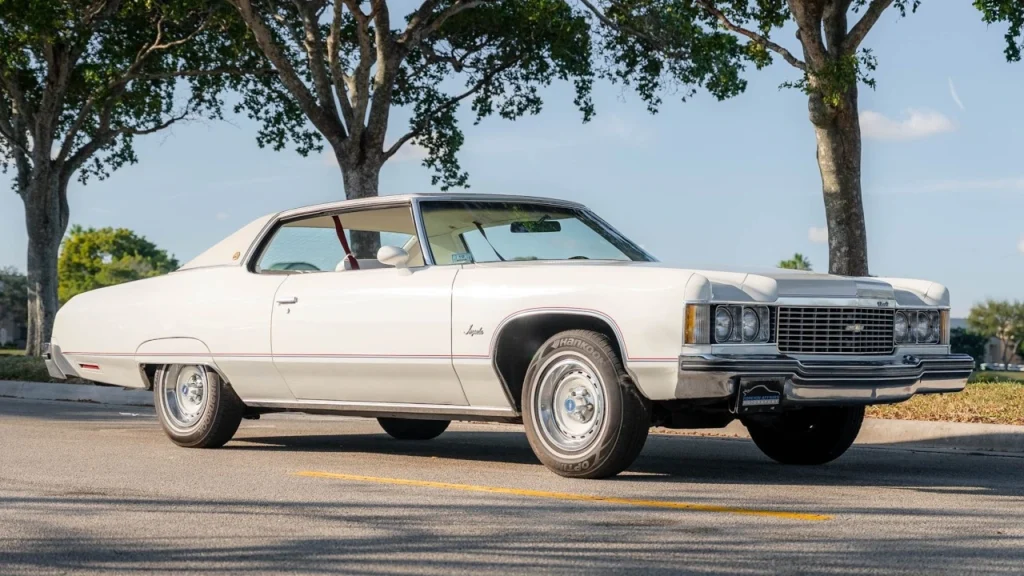
But let’s continue on with our styling from this front three-quarter view of the Impala sport coupe.
As I was mentioning, you can see the hardtop styling here with the drop rear quarter glass that would move.
It’s kind of the last of the era here of GM’s, let’s say, full-size coupes with the hardtop design for 1977.
When these cars would be redesigned, the hardtops would go away entirely on the four-door and the two-door.
But you could still get some hardtop variants across the full-size lineup in 1974.
Now, you notice that the surfaces on the side are pretty simple.
They just have this gentle crown.
And I have to wonder if they were in kind of influenced a little bit by the Chrysler fuselage cars that came out in 1969 with relatively clean and simple body sides, which creates this big long highlight.
I mean, notice that area above the crease that’s down by the rocker there, how it’s just one big highlight where the sunlight can kind of catch it.
And this was something that various, let’s say, car divisions were trying to have.
Some would break up the highlights, but if you wanted to make your already long car look longer, at least from this angle.
Uh that’s one of the things that you would do.
Now, there is some surfacing that it’s hard to see in this picture.
We’ll come back to that in a moment, but you can also notice the Spirit of America pin striping that you’ve got, the patriotic pin striping uh that you can see on this particular white car.
Now, here’s a little bit more of the top side surfacing so you can take a look at it.
Now, notice you have this feature line that runs from the front of the vehicle all the way back and kind of starts to dive down.
Then you have another crease that comes in near the rear quarter glass that also is this diving line that goes downward toward the rear of the car.
And there’s all just some different highlights and low lights on the rear of the vehicle, trying to minimize the heft of that quarter panel.
Designers are trying to I’ll say minimize the overall heft of the car by having this really pronounced tuck in at the rocker.
It’s relatively high on the Chevrolet.
But that interesting I’ll say series of surfaces on the rear quarter panel really breaks it up.
That’s a difference from the fuselage uh Chryslers that generally had very clean quarters that looked absolutely huge.
And I think that that made it look good.
Here you have different surfaces to catch the light.
And you know, the vinyl top workout on this car is not my favorite, particularly with that surfacing back there.
It just looks a little awkward, particularly at that tip where the vinyl top kind of comes down and uh it is at the lower edge of the C pillar.
Just looks a little bit awkward to me.
And of course, if you were going to try to minimize the visual heft, one of the things you would do is not put fender skirts on the car, but of course, because this is a fine automobile, it has to have the rear fender skirts.
She’s got to do other things to minimize the visual heft.
Now, from the side view, you can see that in the bright lighting, particularly in a white car, that quarter panel surfacing just kind of shows up as one surface in some lights.
It wasn’t all that uh severe of surfacing, let’s just say.
So it kind of disguises itself depending on the lighting and where you are around the car.
But I will say a really interesting thing, a strange thing to me is that the Impala Sport Coupe had this roofline with this kind of squarish style rear quarter glass.
And you know what car introduced that for General Motors? The ’66 Caprice where it got its own unique roofline, a more formal style roofline separate from the Impala.
The Impala was the one that had the fastback roofline.
And here you have the Impala gets the Caprice kind of old school Caprice roofline.
And the Caprice couldn’t get it because as I mentioned, you had to have the thick B pillar if you wanted a Caprice Coupe.
I just think that’s a strange bit of trivia.