We’re already proving with archaeological [music] evidence that everything that was written about this temple was wrong.
She was a mother.
She was a wife.
She was a queen.
She was a goddess.
And we are trying to find out what where it lead us.
Deep beneath the sand west of Alexandria, scientists opened a sealed chamber that had not seen light for 2,000 years.
Inside was a black sarcophagus, and the heat was coming from within.
Two wrapped bodies lay side by side with a bronze cylinder between them that was vibrating in the same rhythm that had been pulsing through the desert every 42 seconds.
Around the woman’s wrist was a bracelet shaped like a cobra.
When the lead archaeologist, Dr.
Kathleen Martinez, saw it, she whispered just two words.
It’s her.
But the sarcophagus was not the most disturbing thing in that tomb.
In the next room were 36 skulls, all facing the same spot.
And the words carved above them suggest that whoever built this place never wanted it opened.
To understand how it was found, we have to go back to a signal recorded in 1972 that nobody paid attention to.
Before we go down there, one quick thing.
If you like stories where the evidence gets stranger with every step, a like and a subscribe will make sure the next one finds you.
And while you watch, keep count of how many times that 42 second pulse comes back.
By the end, I want to know in the comments whether you think it was a coincidence.
Now, back to the beginning.
For centuries, Cleopatra’s tomb was the greatest mystery in archaeology.
A queen’s resting place that seemed to simply vanish.
Every empire searched for it.
Every discovery turned out to be a dead end.
She and Mark Anthony were said to be buried together.
Yet for thousands of years, the location of their tomb stayed unknown.
Cleopatra IIIth is one of the most studied rulers in history.
She was the last pharaoh of Egypt, a strategist who faced down Rome, ruled with intelligence, and built an image powerful enough to survive centuries of retelling.
And yet, one part of her story was never resolved.
Roman accounts describe her burial as befitting a queen, but not one of them says where it took place.
For archaeologists, that absence became more than a mystery.
It became an obsession that spanned generations.
The only clues came from Egyptian priests, and they were cryptic.
They wrote that she was a bride returning to Osiris, and that her union was unseen by men.
Historians have argued over those words for centuries.
Some think the priests were describing a secret ritual performed deep within a sanctuary.
Others believe the words were deliberate instructions meant to hide her body forever.
Each new expedition claimed to be close to the truth and each lead collapsed into speculation.
Then in 1972, a strange signal appeared in the data and almost nobody noticed.
A Soviet seismic team was running ground tests near Lake Marut, a shallow saltwater basin southwest of Alexandria, searching for oil.
Their sensors picked up rhythmic vibrations beneath the limestone.
The signal was faint but steady, too consistent for a natural earthquake and too weak to come from machinery.
Local residents had already given the area a name, Abnafas, the place that breathes.
The team filed their results and that was the end of it.
When the project ended, the data was archived and forgotten.
Funding dried up, political tension rose, and research priorities shifted.
The Cold War left little interest in a strange rhythm buried under Egyptian sand.
For three decades, that data sat untouched, waiting for someone to look at it again.
Someone finally did.
In the early 2000s, when new satellite scans focused on the same ridge, the images revealed geometric shapes hidden beneath the surface, clean, symmetrical, and far too precise to be natural.
Thermal and radar imaging showed that the shapes extended several meters deep.
According to analysts, they looked like parts of an artificial structure, possibly a buried complex.
Some experts dismissed the images as interference.
Others believed they had found a pattern worth investigating.
When researchers traced the formations on a digital grid, the entire outline resembled the ancient Egyptian ank, the symbol of life.
It was not a visible carving.
It was a shape revealed only through satellite data.
Reports suggested the pattern extended toward a plateau once associated with the goddess Isis.
And that detail mattered because Cleopatra often called herself the living Isis.
The old debate reignited.
By then, the hunt for Cleopatra was no longer about chasing a legend.
It had become a scientific investigation.
The satellite data hinted at heat signatures beneath the sand, and localized soil readings confirmed traces of ancient plaster and resin, substances rarely found in untouched desert terrain.
What began as a myth about Egypt’s last queen was turning into a mission.
Within months, Egypt’s Ministry of Antiquities approved a ground expedition to examine the site in person.
None of them knew that when they arrived, the desert itself would start to move.
Weeks after the ministry approved the mission, a joint team of scientists, archaeologists, and engineers arrived at the coordinates west of Lake Marut.
Within hours of setting up their monitoring equipment, something happened that no one could explain.
The sensors began to register a slow, steady vibration deep underground, and the readings repeated every 42 seconds, perfectly timed.
At first, the researchers assumed it was an error.
They replaced the equipment.
They recalibrated the sensors.
They even checked for nearby construction.
The pattern remained.
Every 42 seconds, the same pulse returned.
It was not a glitch.
It was coming from the Earth itself.
Then someone on the team pointed out a disturbing detail.
In Egyptian belief, the number 42 held sacred meaning.
It stood for the 42 judges who decided the fate of souls in the afterlife.
A few people joked about coincidence, but others began to wonder what kind of natural force could beat with that kind of precision.
To understand the phenomenon, the team began scanning the ridge at night with thermal imaging.
And the results were unexpected.
Beneath the dunes, streaks of residual heat formed curved shapes, bending and reconnecting like corridors.
Drone surveys the next morning showed faint ridges tracing those same lines.
When everything was plotted together, the formations created a vast rectangular layout with proportions almost identical to temple designs from Cleopatra’s time.
Core samples were taken to verify the readings.
The upper layers of sand looked normal, but deeper down, the samples held fragments of plaster and traces of bitumen.
These were not natural materials.
They were sealing agents used in ancient Egypt to protect royal or sacred chambers.
The discovery sparked an immediate debate.
Some believed the team had finally uncovered a buried complex.
Others argued that the results could be soil contamination or random geological patterns, a coincidence rather than proof of human construction.
Local villagers had a different view.
They warned the team that disturbing the earth would wake what sleeps below.
Most of the scientists dismissed the warnings.
That confidence vanished after what happened next.
One night, the security cameras captured something no one could explain.
The sand itself was moving.
The footage showed faint ripples spreading across the surface in the very same rhythm as the underground pulse.
It was not wind and it was not an illusion.
The pattern was exact.
Workers who saw the recording refused to sleep near the ridge and over the next few days the tremors grew stronger.
The project stalled as fear spread through the camp.
The Ministry of Antiquity stepped in and ordered a controlled excavation under the supervision of Dr.
Kathleen Martinez, a respected archaeologist known for her studies of Cleopatra’s burial sites.
When she arrived, she reviewed the recordings in complete silence.
Then she gave her only comment.
If this is what I think it is, we are standing above something she wanted us to find.
The excavation began at dawn.
By the third day, the desert began to crack and shift.
Beneath the collapsing sand, stone appeared, smooth, carved, and ancient.
It was the first visible proof that something built by human hands had survived beneath that ground, untouched for more than 2,000 years.
At first, it looked like another ruined foundation from Egypt’s later dynasties.
But once the dust settled, the markings on the stone walls told a different story.
The inscriptions identified the site as Taposerus Magna, the great tomb of Osiris.
For the team, that name changed everything.
In ancient belief, Osiris was the god of resurrection, the ruler of the underworld, who granted life after death.
If this really was his tomb, then it was sacred ground, possibly even royal.
Some historians had long suspected that Cleopatra chose this very region as her final resting place.
She described herself as the living form of Isis, the wife of Osiris.
And to be buried beside him in a temple built for his eternal rebirth would have been the perfect way to link her own death with divine immortality.
The temple stood about 45 km from the coast of Alexandria in the same area where ancient writings placed Cleopatra during her final days.
The site was covered in fallen columns and the remains of tall stone gateways that once marked its entrance.
Even after centuries of erosion, the carvings on the inner walls were still visible.
And as the team examined them under their lights, they noticed something unusual.
The inscriptions were written in two languages.
Egyptian hieroglyphs appeared beside ancient Greek script carved with equal care and precision.
That detail stunned the team because Egyptian temples rarely mixed languages, especially in sacred contexts.
Dr.
Martinez recognized what it meant right away.
Cleopatra’s rule was built between two worlds.
The Greekeaking rulers who governed Egypt and the Egyptian priests who guarded its faith.
Seeing both languages carved side by side suggested that Cleopatra herself had authorized the design.
According to Martinez, the temple mirrored the queen’s own identity.
Half Greek ruler, half Egyptian goddess.
The artifacts recovered nearby only fed the speculation.
Coins bearing Cleopatra’s face were found beside statues of Isis holding a falcon, the symbol of renewal.
Chemical tests on the altar revealed traces of blue lotus resin and bumenumen, both used in royal inbalming.
According to reports, the workers stood in silence, realizing they were touching relics that had not seen daylight in more than 2,000 years.
But the most disturbing discovery was not something they could see.
The ground sensors picked up a faint hum coming from deep beneath the limestone.
The frequency was too low for human hearing, but it appeared on the monitors as slow, steady waves.
Each pulse repeated at 42 second intervals, the same rhythm detected weeks earlier out in the desert.
Engineers checked for interference, but the signal persisted.
The readings were real.
The temple was no longer silent stone.
It was generating a measurable vibration, as if something beneath it was signaling through the rock.
Field notes from the site mentioned that several workers claimed they could feel the ground trembling softly under their boots.
The vibrations grew stronger with every scan, and every new reading pointed to something deeper, something hidden beneath the foundation of Taposirus Magna.
Driven by curiosity and fear in equal measure, the team decided to follow the hum down into the bedrock.
What they uncovered next would later be called the impossible tunnel.
When ground penetrating radar was used over the layer of limestone where the hum was strongest, the image that appeared on the monitors made the room fall silent.
Beneath the sanctuary was a tunnel carved through solid rock, straight, smooth, and perfectly level for more than a kilometer.
Even modern engineers would have struggled to achieve that kind of precision.
At first, the researchers thought the readings were wrong.
But when a small camera was lowered through a narrow bore hole, the feed confirmed it.
The lens revealed a corridor with curved ceilings and walls polished like glass.
It looked man-made, yet it showed no tool marks, no signs of collapse, no cracks from time or pressure.
Someone thousands of years ago had created it and then sealed it perfectly.
When Martinez reviewed the images, she noticed something repeating along the walls.
Carvings in both Greek and Egyptian formed the same phrase again and again, an which means life renewed.
She suggested the tunnel was a ritual passage, a path designed to guide the dead through resurrection.
The team drilled deeper, following the signal toward what looked like a sealed chamber.
The scanners showed a circular cavity ahead, roughly 20 m wide, and its temperature was higher than the rock around it, as if the stone itself had once been burned from within.
They began cutting through the final wall.
The sound that followed was not the crack of stone.
It was something heavier and lower, a vibration that could be felt in the chest.
When the barrier finally gave way, a blast of air escaped, sharp and cold.
It carried the scent of resin and metal like something ancient that had been trapped for centuries.
The dust cleared and the team shown their lights inside.
What they saw was not a simple tomb.
The walls were covered in a black glassy layer that reflected their lights.
It looked less like carved stone and more like rock that had been melted by fire.
When the team lifted their lights toward the ceiling, they saw hundreds of tiny blue stones pressed into the surface.
Later analysis confirmed they were lapis lazuli, a rare stone once used in royal tombs.
The pieces had been arranged into patterns of stars, forming a scene that showed the goddess Isis standing over the body of Osiris, her hands raised as beams of light connected her to the stars above him.
The ceiling was not just decoration.
It was a story carved in stone, showing the moment the gods brought life back from death.
But the warnings on the walls told another story.
In both Greek and Egyptian, the same line repeated again and again.
Disturb the union and the balance shall break.
Near the floor, half hidden under soot, another message appeared.
Blood shall drip from the left eye down.
No one wanted to read it aloud.
Some thought it was an offering ritual.
Others thought it was a curse.
Either way, the room went quiet.
Everywhere they looked, there were signs of careful sealing.
Veins of mercury and lead ran through the plaster.
The air smelled faintly of resin.
Broken jars lined the corners, and beneath one column, a small golden scarab was found, engraved with a prayer.
Bind the soul to its body.
Martinez studied it in silence before saying that this chamber was not built to display the dead.
It was built to contain them.
At the center stood a raised platform of fused stone.
Two beers sat side by side, their surfaces glazed as if burned by intense heat.
Between them rested a bronze cylinder about the length of a forearm etched with spirals that shimmerred under the light.
One of the researchers swore he saw the outline of a tear carved into the metal, exactly where the wall had warned of blood falling from the left eye.
As Martinez approached, the floor trembled.
The pulse that had haunted their readings for weeks was now so strong it could be felt through their boots.
The air pressed against their chests, and some of the team backed away.
Martinez ordered everyone to stop digging and begin safety tests.
Her voice was steady, but her hands were shaking.
“This isn’t just a tomb,” she said quietly.
“It’s responding to us.”
They moved to the edge of the hall and waited, but the readings kept rising.
The pulse quickened as though something beneath the floor had awakened, something that had been waiting for this exact moment.
When the final barrier cracked open, the room fell silent.
For a moment, no one moved.
The air that escaped from the chamber hit them like a wave.
It smelled of resin, ammonia, and something older, something that burned the throat and stung the eyes.
A few workers stepped back, covering their mouths with cloth, but it was too late.
Chemical readings later showed dangerously high levels of toxic gas trapped inside for nearly 2,000 years.
What should have been a triumph of archaeology felt like an accident that should never have happened.
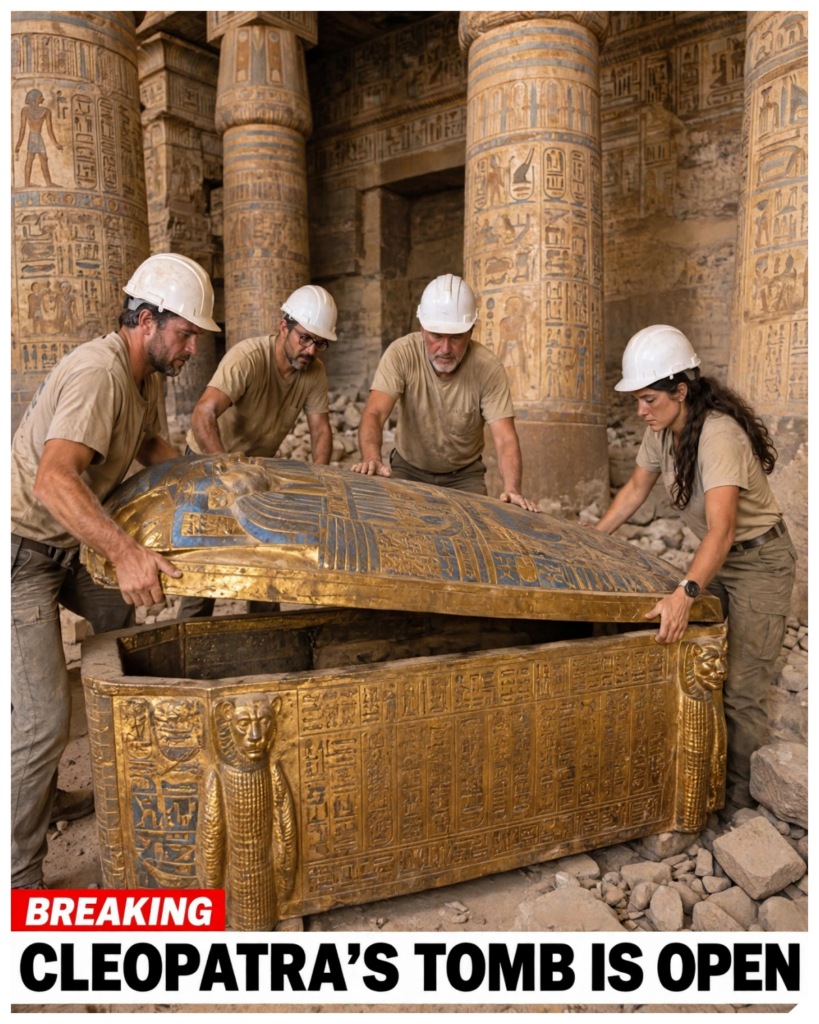
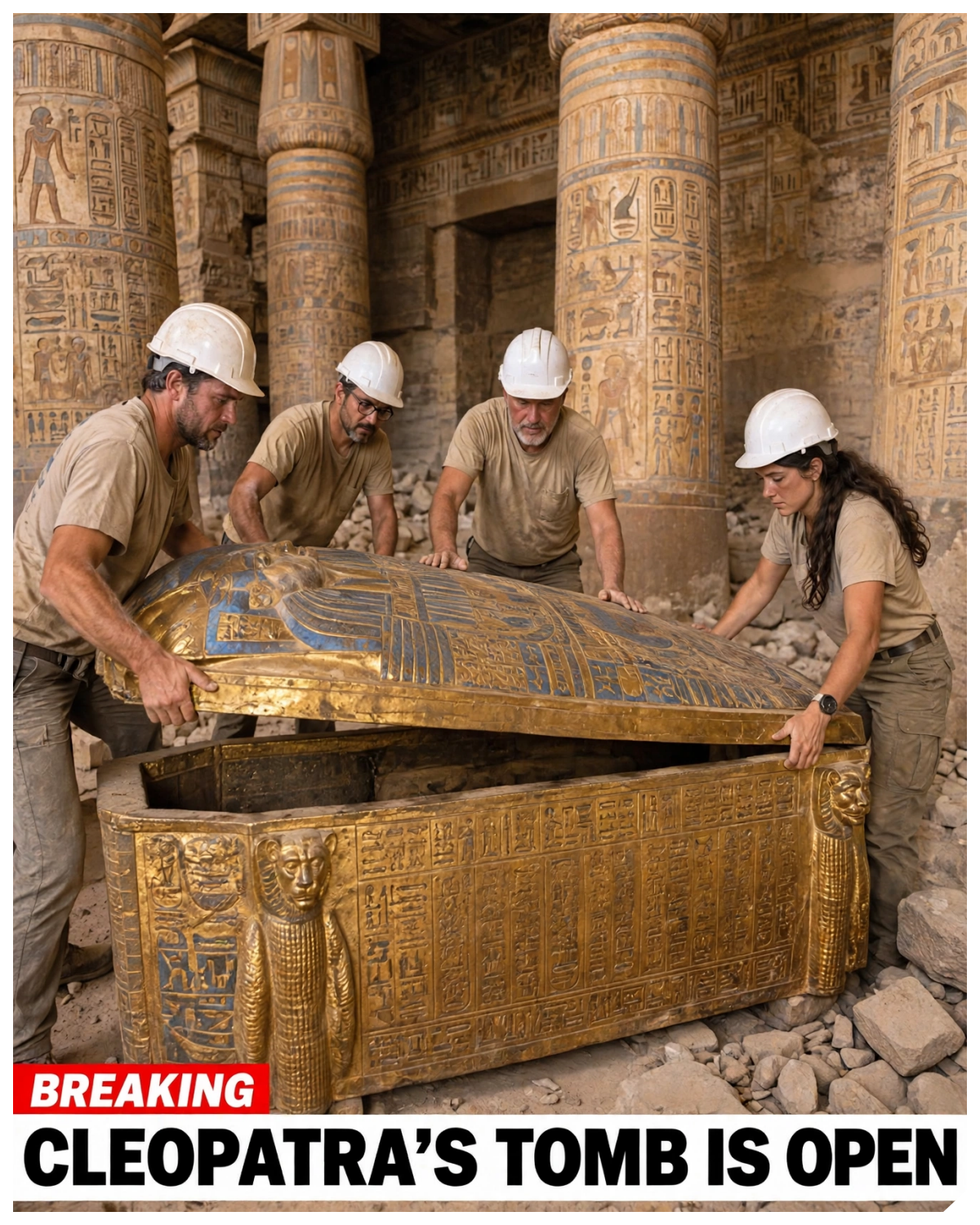
At the center of the chamber stood the sarcophagus, and it was unlike anything anyone had seen before.
Carved from a single block of black granite, it shimmerred under the flood lights with an oily reflection.
The lid alone weighed several tons, and its edges were sealed with a hardened mixture of resin and lead.
Every movement of the crane echoed through the hall as the team prepared to lift it.
When the lid finally shifted, a rush of warm air poured out.
It was several degrees hotter inside the sarcophagus than in the surrounding room.
Martinez noticed the difference at once and called for a scan.
The heat was coming from within.
Everyone had expected the remains to be cold and brittle.
What they found was far more unsettling.
Two figures lay side by side, wrapped in thick linen threaded with gold.
The wrappings were fused together, and theerary masks had melted into the fabric, their outlines barely visible.
Between the two bodies was a bronze cylinder positioned perfectly between their arms, like a shared possession.
Every few moments, it emitted a faint vibration that could be felt through the granite itself.
The rhythm matched the same 42 second pulse recorded across the entire site.
As the lights were adjusted, the teen began their examination with the male body.
It was partially decomposed, but the damage did not look natural.
His chest cavity had been opened intentionally.
The ribs bent outward.
The heart cavity filled with solidified resin stre with mercury.
This was not preservation.
It was ritual.
According to reports, some believed it was a form of sealing, a way to contain whatever force the body once carried.
The female body was better preserved, though time had still taken its toll.
Her wrappings were thick and stiff, hardened into a shell that held the shape of what once lay inside.
Under the lights, the surface glowed with a dull bronze hue, uneven and cracked with age.
Through the folds, small glints of gold and silver appeared, a brooch near the upper chest, a clasp lower along the torso, and a pendant pressed flat against the linen where the heart would have been.
It was shaped like a woman with outstretched wings.
Martinez leaned closer and recognized it immediately.
It was the figure of Isis, the goddess Cleopatra claimed as her divine reflection.
Then they noticed one more thing.
Around the woman’s wrist was a bracelet molded into the form of a cobra, its fangs bared and its head raised.
The metal was blackened, yet the shape was unmistakable.
For the Egyptians, the cobra was both protector and bringer of death.
The same creature said to have ended Cleopatra’s life.
The chamber fell silent.
According to reports, Martinez whispered only two words when she saw it.
It’s her.
Tests conducted later confirmed that both mummies belong to individuals of high status.
DNA sequencing revealed markers consistent with the tomic bloodline, supporting the claim that they were royal.
By the time the team sealed the chamber for safety, the air had grown heavy and metallic.
The floor beneath the sarcophagus gave off low heat and faint tremors ran through the walls.
One researcher described the feeling as standing near an active engine.
Another refused to re-enter the room, saying the air felt alive.
The excavation that had begun with excitement now felt like trespass.
According to reports, Martinez herself stood in silence before the open sarcophagus, her face pale under the work lights.
We wanted answers, she said quietly.
But this feels like punishment.
The discovery confirmed everything they had hoped for and everything they feared.
The tomb of Cleopatra had finally been found.
But what rested inside did not feel at peace.
The sarcophagus had given them answers and birthed a new terror.
And yet the true horror was not what lay inside it.
It was what surrounded it.
The passage beyond the sarcophagus narrowed and curved to the right.
The team moved slowly, light steady, masks tight.
The corridor opened into a round chamber with walls cut into shallow aloves.
In each al cove sat a single skull upright on a stone ledge facing the center of the room.
No bodies, no coffins, only skulls.
They counted 36.
12 that appeared to be male, 12 that appeared to be female, and 12 that were clearly children.
The sight froze the room.
Dust hung in the beams of light, and no one spoke.
The sockets of each skull were dusted with a thin gold powder that caught the light like grit.
Swabs from the bone later showed traces of blue lotus resin, the same compound identified in the inbalming area.
According to several field notes, the effect was simple and awful.
The skulls looked prepared, not abandoned.
All of them faced a small stone platform at the center of the floor, carved with the symbol of the ankh, the Egyptian sign of life.
On top of it were two small bronze cups that had melted together from heat.
One of them held a layer of dried black material that later tested positive for human blood.
A line of text ran above the aloves in both Greek and Egyptian.
It read, “They guard the passage and keep the balance.”
Some of the archaeologists said it was a prayer to Isis, protector of the underworld.
Others believed it was something far colder, a warning that the dead here were not resting, but restraining something below.
The pattern of the remains was deliberate.
Each skull was missing its lower jaw.
Forensic staff who reviewed the photographs called it an intentional method of decapitation, one that prevented reassembly.
The message was not subtle.
Whatever this circle was built to hold in place, it was meant to stay there.
Sensors placed around the room registered low electromagnetic spikes.
The spikes rose and fell every 42 seconds, the same rhythm that had followed the team since the first day in the desert.
The crew felt it as a pressure behind the eyes and a buzz on the tongue.
Martinez stepped onto the threshold and stopped.
She tasted metal.
She ordered the chamber sealed.
Her last recorded words before the signal cut were, “This is not a tomb.
It is a mechanism made of death.”
News of the chamber moved through universities and ministries within hours.
Photographs leaked to private forums before the site went into lockdown, and the reaction was immediate and split.
Some called for the rooms to be sealed forever.
Others demanded full publication of the finds.
A few voices asked a harder question.
If the circle was a working system and the skulls were placed to hold a balance, then what had the team changed by opening the way?
The implications reached far beyond the site.
If the 36 were guardians, then Cleopatra’s burial was not only a royal right, it was an engineered defense.
The inscriptions tied the circle to the idea of balance.
The pulse matched the number tied to judgment in Egyptian belief.
Nothing here looked random.
According to several researchers, the layout suggested that someone had planned this as a living system, one that would keep functioning long after the mourers were gone.
That raised a final possibility that unsettled even those who dismissed the rituals.
Perhaps Cleopatra was not only the figure written by Rome.
Perhaps she was a strategist who built her afterlife as a device, not a shrine.
Some believe she designed a burial that could not be plundered without a cost.
Others go further and say she built a warning that would still answer when disturbed.
So, here is the question that has no answer yet.
If Cleopatra designed her tomb as a weapon instead of a monument, what was she protecting?
Her legacy or something far greater?
Whichever side you land on, I would like to hear the reasoning because the most convincing explanations usually show up in the comments.
And if this story stayed with you, a like and a subscribe is the easiest way to make sure the next one reaches you.
Thanks for watching.