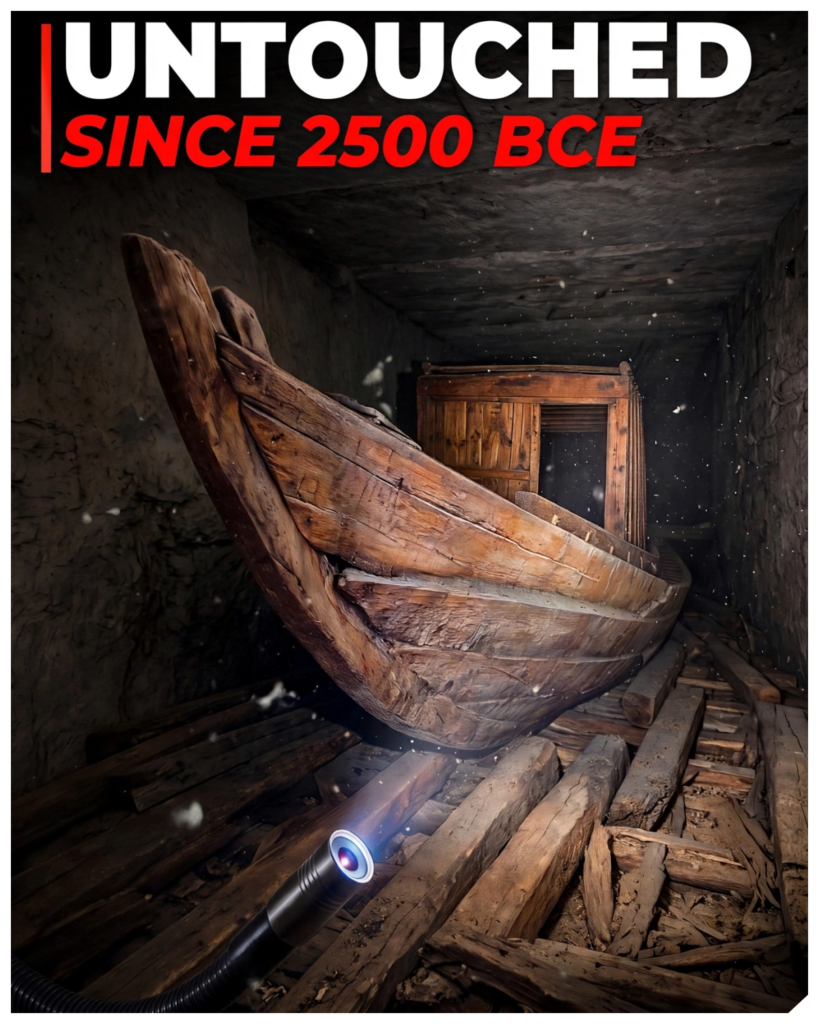
In 1987, a camera was lowered through a hole just 3.5 in wide beside the Great Pyramid.
Before it went in, scientists drew air from the darkness below.
They hoped the chamber still held a sample of the ancient world.
The pictures would confirm what lay inside.
The air would tell [music] a very different story.
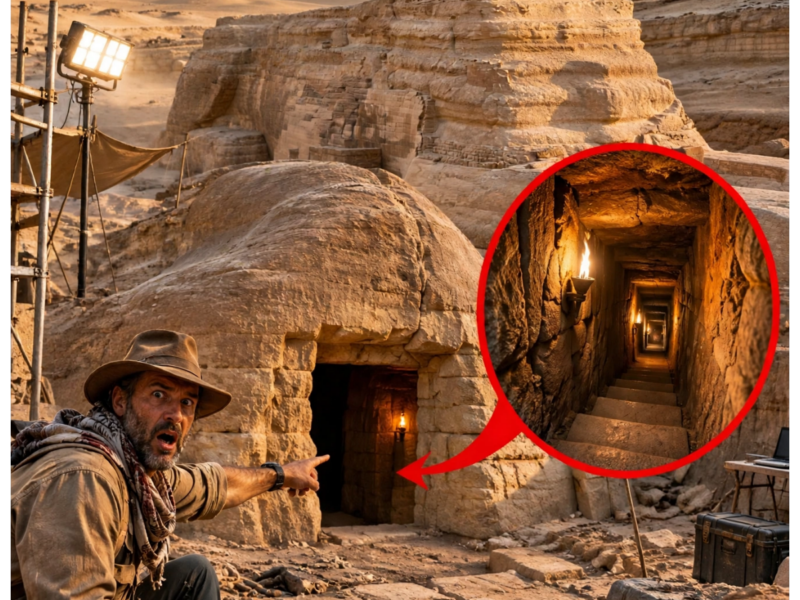
In 1954, Egyptian excavators identified two boat pits south of and outside Kufu’s Great Pyramid.
Rows of limestone blocks covered long, narrow cavities cut into the bedrock.
These were separate burial spaces beside the monument, each with its own stone roof.
The eastern pit held the dismantled remains of a wooden vessel.
Its discovery gave archaeologists thousands of years of shipb building history to recover [music] piece by piece.
The western pit remained covered.
Known as the second boat pit, it presented a different task.
Understanding what lay beneath its heavy roof while leaving the chamber and its contents as undisturbed as possible.
Conservators spent years stabilizing and reassembling the eastern boat’s timbers, eventually restoring a vessel more than 40 m long, but reconstruction left an ongoing task, protecting ancient wood from changes in temperature and humidity.
Timber can shrink, warp, [music] and crack as its moisture content changes.
That experience helped shape the archaeological team’s approach to the neighboring chamber.
Lifting its roof would expose the contents before conservators understood their condition or surroundings.
A limited inspection offered a way to gather that information first.
The practical requirement was narrow.
Get instruments through the stone while keeping disturbance to the chamber to a minimum.
Geologist Farooq Elbaz led the joint Egyptian Antiquities Organization and National Geographic Project.
NASA provided technical support while expedition leadership remained with Elbaz and the archaeological partnership.
Black & Decker engineer Bob Moors designed the mechanical rotary air lock, a sealed rotating mechanism that allowed instruments to pass through the access hole.
Its [music] job was to limit contact between the chamber’s air and the outside atmosphere as equipment moved in and out.
Rotation brought an instrument into position over the boar while maintaining a seal around the access.
The team could exchange tools without leaving an open passage through the roof.
That passage measured about 3 1/2 in across or 9 cm.
It extended through 63 in of limestone, roughly 1.6 m.
Each instrument had to fit through this narrow shaft.
Three separate devices served different purposes.
A video camera used low heat fiber optic lighting to record the interior while limiting heat near the timber.
A 35mm still camera took photographs.
An air sampling tube collected air for laboratory testing.
The cameras would document what lay beneath the roof.
The tube would provide a sample of the environment surrounding it.
Drilling began on October 17th, 1987.
[music] Over the next 2 days, the bit advanced through the limestone roof.
On October 19th, it broke through into the chamber below.
The opening gave the team a vertical route into the pit.
Instruments could now descend through the roof while the covering stones remained in place.
Pressure monitoring provided an early clue about the chamber’s surroundings.
The readings suggested that the air beneath the stone might not be isolated from the atmosphere outside.
Pressure alone could not establish when air had passed into the pit or how much exchange had occurred.
On the morning of October 20th, the video camera transmitted its first images from inside the chamber.
The team now had a direct view beneath the roof, obtained through the narrow bore rather than by lifting the limestone covers.
The inspection had reached the timber without requiring a full excavation.
Stacked wooden planks filled the camera’s view.
The second boat lay beneath the roof in separate pieces, packed into the narrow chamber rather than assembled into a hull.
Broad panels rested among the timbers.
Recognizable cabin components and ores helped establish what the pit contained.
The dismantled parts of a vessel that had survived for roughly 45 centuries.
The arrangement preserved individual shapes.
Plank edges could be followed across the stack, while overlapping pieces concealed much of the wood beneath them.
The camera could record exposed surfaces, but it could not inspect every [music] face or joint.
In the darker spaces, some fragments remain difficult to identify.
Assigning each one a place in the boat would have required information the brief inspection could not provide.
The recognizable components answered whether a boat remained under the stones.
They left its [music] physical condition unresolved.
A timber could retain its outline while losing strength within its fibers.
Its appearance alone could not establish whether it could withstand lifting, [music] treatment, or the stresses of reconstruction.
The recordings therefore documented survival without establishing readiness for removal.
They preserved the positions of visible pieces while leaving the buried layers undisturbed.
The team had reached the limits of a camera inspection.
Their assignment allowed documentation and sampling with the timber [music] left in place.
Ending the inspection meant keeping that boundary.
The boat would remain beneath its covers rather than become an excavation.
On October 25th, 1987, the team resealed the boar, leaving a monitoring device inside the chamber.
With images recorded and air samples collected, installing that device completed the planned fieldwork.
Closing the opening followed the mission’s original limits rather than a decision based on later laboratory findings.
The monitor could track conditions around the boat.
It could not strengthen weakened fibers or prepare a plank for lifting.
Recovering fragile timber required a separate conservation operation with support for individual pieces and [music] protection during handling.
For now, the instruments remained beneath the limestone while the wood stayed [music] where it had been packed.
Pressure inside the pit matched the surrounding atmospheric pressure within the reported measurement range.
The instruments registered no measurable pressure separation between the chamber and the air outside.
Laboratory analysis then identified CFC11 and CFC12 in the collected samples.
These chlorofluorocarbons are modern industrial gases in the Freon family, familiar from refrigeration.
They were absent from the atmosphere when Kufu’s boat was buried.
Their presence established that outside air had reached the chamber.
The limestone roof covered the vessel, but the measurements did not support treating that covering as an airtight seal.
Untouched ancient air had been a hope of the investigation.
The samples instead contained chemical traces of the modern world.
That finding had limits.
Detecting these gases did not establish a complete history of air movement or reveal how conditions around the timber had changed across 45 centuries.
It also did not explain why so much wood remained.
Cedar itself offers one possible part of that explanation.
Its natural compounds can help resist fungal decay and insect attack.
That resistance could have contributed to the survival of the boat’s components alongside conditions [music] within the pit.
But a property of cedar cannot by itself account for the condition of every plank.
Nor does it settle why the two neighboring boats were preserved differently.
The air analysis answered a narrower question.
Modern atmosphere had reached the covered chamber.
How the timber survived and which conditions mattered most remained unresolved.
The gas measurements could establish contact with outside air.
They could not measure its cumulative effect on the wood.
In 2011, more than two decades later, the Egyptian Japanese conservation team raised the limestone covers over the second boat pit.
Working beneath a protective enclosure, they opened the chamber for full archaeological access.
Removing the roof began a much slower task.
The team had to document the timber’s arrangement as they worked downward, preserving a record of where each piece had rested before lifting it away.
Photographs and catalog entries linked individual fragments to their layer, position, and condition.
Three-dimensional mapping helped record relationships that removal would otherwise erase.
Each recovered piece became both an object to conserve and part of a larger archaeological record.
On July 6th, 2021, the Japan International Cooperation Agency, known as JICA, announced that extraction was complete.
The Egyptian Japanese effort had recovered nearly 1,700 wooden pieces from 13 layers.
10 years separated the raising of the covers from that announcement.
The chamber had yielded its timber, but the vessel still existed as separate components.
Conservation and reconstruction remained unfinished.
The team still had to treat fragile wood, study how the parts fitted together, and prepare them for assembly.
A recorded crack helps conservators decide where a timber needs support.
A piece’s orientation and neighboring parts give ship building specialists clues to test when matching joints and rebuilding the hull.
Keeping those observations linked allows later decisions to be checked against the boat’s condition before treatment.
The purpose of the vessels requires a different kind of evidence.
Scholars consider whether they carried Kufu’s body orary goods or were intended for the king’s voyage after death, perhaps alongside the sun god Rah.
Their placement beside the pyramid supports a royal burial connection.
The surviving wood and its arrangement do not establish which role either boat was meant to serve.
In December 2025, the Egyptian Japanese team installed the second boat’s first restored plank inside the Grand Egyptian Museum.
The timber [music] was placed on a purpose-built metal support, beginning its assembly in the dedicated boat gallery.
Visitors could watch the reconstruction take shape as conservators fitted treated wood into position.
The support structure carried the ancient components while the team worked through the assembly.
On October 4th, 2026, Egypt’s state information service reported that [music] 16 floor components had been restored and installed.
These pieces formed part of the vessel’s base [music] with the rest of the reconstruction still unfinished.
16 was the count reported on that date rather than a running total or an announcement that the boat was complete.
The Egyptian Japanese project continued treating and fitting the remaining components with conservation and reconstruction still in progress.
The boat’s future now rests with the [music] people conserving it.
Every careful repair must protect fragile evidence that future researchers may interpret differently.
That makes conservation a responsibility extending beyond any museum opening.
What survives tomorrow depends on the care we give it today.
Subscribe to Impossible Archives for more.