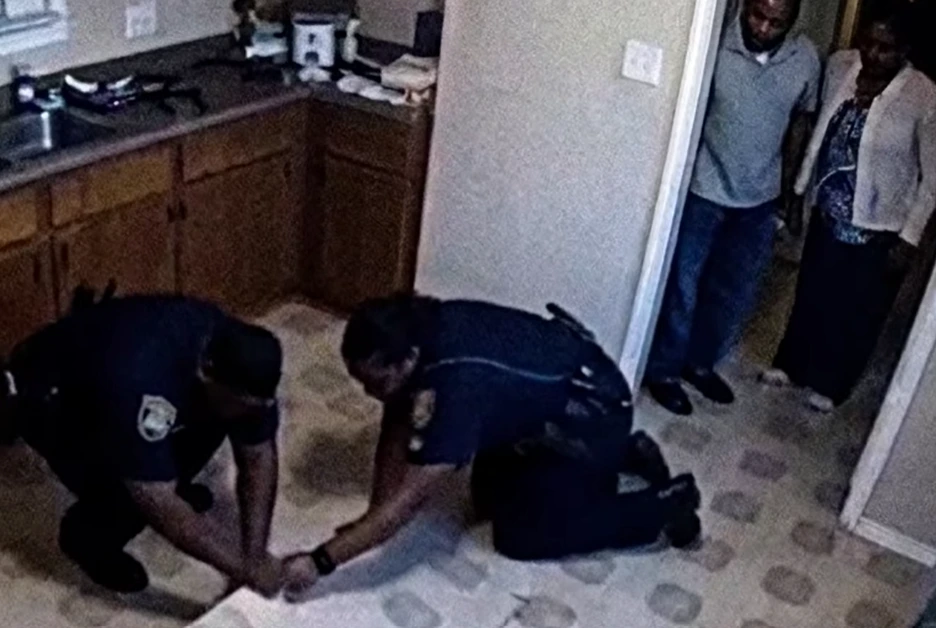
Not the Pruitts, not the officers, who had been tr…
Not the Pruitts, not the officers, who had been trained to allow exactly this kind of silence to play out rather than fill it, on the theory that an unprompted reaction, or the deliberate absence of one, often tells investigators more than any immediate denial would.
Officers present that day would later note, in their own written statements, that the silence itself became a kind of evidence in the minds of everyone standing in that hallway.
Not because silence alone proves guilt, but because the specific quality of it, the complete absence of any of the confusion or protest an innocent homeowner would typically display upon finding something like this beneath their own kitchen, was difficult for anyone present to interpret any other way.
It was Detective Reinhardt who eventually broke the silence, asking directly whether either of them wished to explain what officers had found.
Mitchell Pruitt’s only response, according to the official transcript, was a single sentence.
I think we’d like to speak to a lawyer.
Renata said nothing at all, and according to the officer standing nearest to her, did not so much as glance toward her husband when he spoke, keeping her eyes fixed instead on the open trapdoor for several seconds longer, as though completing some final private accounting of exactly what those next few years were now going to cost her.
Now we need to go back and explain the detail that turned this from an unusual discovery into one of the most discussed true crime cases of that year.
The identification of the two bodies.
Dental records and forensic analysis completed over the following 3 weeks confirmed what investigators had begun to suspect almost as soon as they pulled the Ashcombs original rental file.
The two individuals recovered from beneath the Pruitts’ kitchen were Harold and Delia Ashcomb, the very tenants whose relocation had made the house available for the Pruitts to rent in the first place.
The Pruitts had not stumbled into a house with a dark secret already buried beneath it, the theory nearly every early news report initially assumed.
They had created that secret themselves, specifically and deliberately, in order to obtain a house they had, according to evidence investigators would later piece together, targeted for reasons connected to their broader fraud scheme.
The Ashcombs’ identities, financial accounts, and personal records providing exactly the kind of foundation Mitchell and Renata needed to expand the identity theft operation that would eventually be what brought detectives to their door in the first place.
For 23 months, the Pruitts had lived an entirely ordinary suburban life directly above the two people whose deaths had made that life possible, hosting a small housewarming gathering for neighbors within their first month in the house, maintaining the kitchen renovation as an unremarkable home improvement project when asked about it by a curious neighbor, and continuing throughout that entire period to draw on the Ashcombs’ financial identities as the seed for an expanding fraud operation targeting other elderly residents across the region.
The Ashcombs’ daughter, upon learning the truth, gave a single public statement describing 2 years of growing distance from her parents that she now understands was never distance at all.
That every unanswered call, every uncharacteristically brief text, every excuse for why a planned visit kept getting postponed had been manufactured by the people who killed them specifically to buy the 23 months of silence that ultimately allowed the fraud scheme to operate unimpeded.
At trial, prosecutors built their case around the physical evidence recovered from the crawlspace, financial records connecting the Ashcombs’ compromised identities directly to the fraud scheme under separate investigation, and digital forensics establishing that messages sent from Delia Ashcombs’ phone in the weeks after her death originated from a device recovered during the search of the Pruitt residence.
The defense argued that physical presence in the house did not on its own establish who had caused the Ashcombs’ deaths.
The jury did not find that argument persuasive once presented with the full timeline connecting the contracting job, the falsified lease break notice, and the rapid aggressive push to secure the rental that followed within weeks.
Both Mitchell and Renata Pruitt were convicted on all counts, including two counts of murder after 11 hours of deliberation.
The trial itself drew extensive coverage in part because of how thoroughly it inverted the assumptions most people bring to a case like this.
Legal commentators following the proceedings noted that jurors appeared visibly affected not by any single piece of evidence, but by the cumulative realization of just how long and how ordinarily the Pruitts had lived directly above their victims.
Attending a neighborhood barbecue 11 months into the concealment, hosting Renata’s extended family for a holiday gathering the following year.
All while the crawl space beneath their kitchen remained exactly as it had been since the first weeks after they moved in.
One juror, speaking anonymously to a local reporter after the verdict, said the detail that stayed with her longest was not the discovery itself, but learning that the Pruitts had specifically chosen tile, rather than carpet or wood flooring for the kitchen renovation.
A material investigators noted was easier to keep spotless and odor-free, suggesting a level of forward planning that went well beyond simply covering a hole in the floor.
Both defendants received sentences of life imprisonment without the possibility of parole, with the sentencing judge specifically noting in his remarks that the case represented a degree of premeditated cruelty compounded by patience that he had rarely encountered in his years on the bench.
Not a single act of violence followed by panic, but a sustained, nearly two-year performance of ordinary domestic life built with full knowledge of what remained unmoved beneath every dinner served in that kitchen.
Detective Reinhardt, in a statement given after the verdict, said the case had fundamentally changed how his department approaches property-related fraud investigations, specifically around verifying independently that a reported relocation or lease termination actually corresponds to contact with the tenant in question, rather than relying solely on documentation submitted through a portal that requires no live verification at all.
“We built an entire system around trusting paperwork,” Reinhardt said.
“This case is the reason we no longer do that without a phone call first”.
Carol Whitmire, the property manager who processed the original lease break notice, has said publicly that she has replayed that single email exchange more times than she can count and that nothing in it, even now, reviewing it with the full knowledge of what it was actually covering for, reads as anything other than a routine, unremarkable notice.
“That’s what I can’t get past,” she said.
“It wasn’t clumsy.
It wasn’t a red flag I missed.
It was built specifically to look like nothing at all, and it worked exactly the way it was designed to”.
In the aftermath of the trial, the property management company that had handled the original lease implemented new verification procedures for early lease terminations, requiring a live phone or video confirmation from the departing tenant before any notice submitted through the digital portal can be processed.
A policy change Whitmire has said she pushed for personally, and one she has described, without much satisfaction, as the kind of fix that only exists because it was already too late for the people it should have protected.
The Ashcom family, through a spokesperson, has said they support ongoing efforts to reform tenant verification practices nationally, framing their parents’ case as an illustration of how thoroughly a well-executed deception can exploit systems designed for convenience rather than security.
The house itself was eventually sold by its out-of-state owner to a buyer aware of its full history, who chose, according to public permit records, to have the entire kitchen and subfloor demolished and rebuilt from the foundation up before any new occupant moved in.
If this story affected you, or if you’re concerned about an aging parent or family member who has become increasingly difficult to reach, please know that support and resources exist for families navigating that kind of uncertainty.
In the United States, you can reach the Eldercare Locator, a public service of the US Administration on Aging at 1-800-677-1116 for guidance on checking in on a loved one’s well-being and the 988 Suicide and Crisis Lifeline by calling or texting 988 for any mental health crisis or emotional distress.