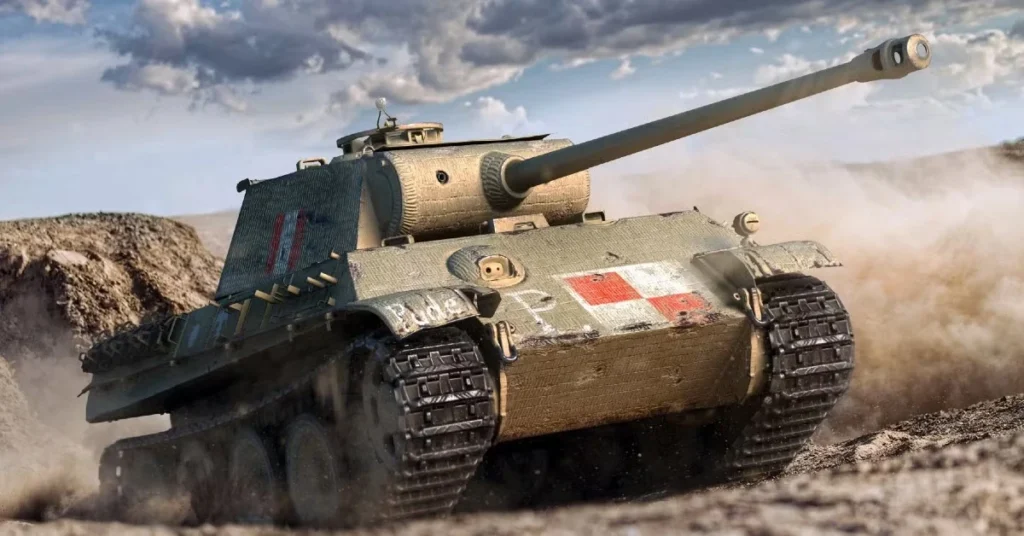
Their job was critical, to protect the tanks vulne…
Their job was critical, to protect the tanks vulnerable flanks and rear from enemy infantry, to clear out pockets of resistance the tanks bypassed, and to hold the ground the Panzers had just taken.
A tank alone is a blind, clumsy beast.
With its grenaders, it became part of a lethal hunter killer team.
But even that was only the beginning.
The Wedge was a self-contained spearhead.
It had its own mobile artillery, guns mounted on tank chassis that could move and fire in direct support.
It had its own eyes and ears, reconnaissance units on motorcycles, and in light armored cars scouting ahead.
It had its own nervous system, command vehicles bristling with antennas from which officers directed the flow of battle in real time.
And most importantly, it had its own lifeblood.
A thundering, churning tale of softskinned supply trucks.
Trucks carrying the thousands of gallons of fuel a Panzer division consumed every few hours.
Trucks carrying the hundreds of shells for the tank guns and artillery.
Mobile workshops for emergency repairs.
ambulances, field kitchens.
Without this tail, the armored fist would clench, swing once, and then fall limp.
The entire German doctrine of high tempmpo mechanized warfare depended utterly on this fragile, unarmored logistical chain, keeping up with the front line.
The tank was the tooth, but the long, vulnerable column behind it was the body.
For the British 8th Army in the North African desert, this system was a recurring nightmare.
They would see the dust cloud on the horizon first, a brown wall growing against the blue sky.
Then the dark shapes of the panzers would resolve out of the haze.
But it was the sheer scale of the formation that was demoralizing.
A seemingly endless column of vehicles stretching back for miles, moving with a coordinated purpose that felt unstoppable.
To counter this, the British had a primary weapon, the Ordinance QF2 pounder.
It was a small 40mm anti-tank gun that had served them well in the early years of the war, but by 1942, it was dangerously close to obsolete.
German tank design had not stood still.
Newer models of the Panzer 3 and 4 were rolling off the production lines with thicker frontal armor plates.
A two-pounder crew watching a Panzer 3 bearing down on them knew their gun fired a small solid steel shot.
and they were learning through bitter experience that their shells were now more likely to ricochet off the enemy’s frontal armor than to penetrate it.
Firing the two-pounder at an approaching panzer was becoming an act of suicidal defiance.
The tool designed specifically for this job was failing.
The British army was not without other guns, however.
In fact, they had thousands of another far more powerful 40mm weapon, the Swedish-esigned Bowfors gun.
It was a masterpiece of mechanical engineering.
With an automatic loader, a well- drilled crew could fire two shells every second.
Its powerful charge sent a high explosive projectile screaming into the sky at nearly 3,000 ft per second.
It was by any measure a formidable weapon, but it was an anti-aircraft gun.
Its entire existence was oriented toward the sky.
Its crews were part of the Royal Artillery’s air defense regiments, not the anti-tank units.
They were trained to track the flight paths of Germanuka dive bombers and Messersmidt fighters to lead a moving target and to fill a patch of sky with bursting shells.
Its ammunition was designed to detonate with a timed fuse, creating a cloud of deadly shrapnel to shred the thin aluminum skin of an airplane.
Its very design enforced this role.
The complex sighting system was a mechanical computer for calculating deflection against aerial targets.
And crucially, the gun’s traverse and elevation mechanism was physically constrained.
Engineers had installed small but robust steel blocks.
The elevation stops that prevented the barrel from being depressed more than a few degrees below the horizontal.
This was a safety feature to stop crews from accidentally firing into the ground or friendly positions.
It was a physical declaration forged in steel that this gun was for shooting at the sky.
Period.
This was the British dilemma in the summer of 1942.
They faced a perfectly integrated German combined arms machine, an ecosystem of armor, infantry, and support advancing across a desert that offered nowhere to hide.
Their dedicated anti-tank weapon was becoming a peashooter.
And their most numerous and powerful light cannon was built, trained, and doctrally locked into a role that was useless against the immediate threat.
The panzers were on the horizon.
The two-pounder couldn’t stop them, and the buffers couldn’t even aim at them.
With their backs against the wall, trapped between an obsolete tool and an unusable one, how could they possibly hope to break the German spearhead? And then they were there.
The rumble became a physical presence, shaking the dry desert ground.
Through the gunner’s sights, the vague shapes in the dust sharpened into the low, menacing silhouettes of Panzer 3es and fours.
They advanced in staggered formation, their long gun barrels level, searching for targets.
This was the moment of truth for any anti-tank gunner.
The moment to hold your nerve, aim for a weak spot, and pray your shot counted.
But the Buffer’s crew did not fire.
The gunner let the lead panzer drift through his crosshairs.
Then the second, then the third.
To any observer, it would have looked like paralysis, a crew frozen by fear, but it was discipline.
His commander, eyes pressed to his binoculars, was looking past the tanks.
He was watching the space between the tanks.
And as the armored spearhead passed, the fragile system that gave it life revealed itself.
A churning, chaotic procession of halftracks packed with infantry, command cars with whip antennas, motorcycles kicking up dust, and most vital of all, lumbering, thin skinned opal blitz supply trucks.
Target truck on the right.
The order was quiet, almost conversational against the growing den.
The gunner traversed the barrel, the mechanism whining softly.
He laid the sights not on a tank, but on the canvas cover of a truck carrying fuel drums.
He pressed the foot pedal.
There was no ringing clang of a failed anti-tank shot.
The first shell left the barrel with a sharp, violent crack.
A fraction of a second later, the truck didn’t just explode, it detonated.
A ball of orange flame and greasy black smoke punched into the sky.
The 40mm high explosive round designed to rip through the wing of an airplane had turned the vehicle and its volatile cargo into a funeral p.
The gunner didn’t pause to admire his work.
The automatic loader slammed another shell into the brereech.
Thump.
He shifted his aim.
An SDK 251 halftrack.
Its passengers, the panzer grenaders, exposed in the open topped compartment.
Thump.
Thump.
thump.
A stream of 40mm shells, two per second, walked across the vehicle.
The sound was of a giant tearing sheet metal.
The thin armor offered no protection.
The high explosive rounds shredded the compartment, sweeping the infantry from the vehicle in a storm of steel fragments.
The German column, a moment before a picture of coordinated power, was thrown into chaos.
Another Buffer’s crew, seeing the effect, followed suit.
A second stream of fire rad across a communications vehicle which sued sideways and stopped, its radio antenna bent and broken.
The nervous system of the attack was being severed.
Drivers of other trucks panicked, swerving to avoid the wreckage and the incoming fire, creating a traffic jam in the middle of an armored assault.
From the Koopa of his Panzer, the German tank commander at the front was untouched.
He was still advancing, still ready to fight.
But a glance over his shoulder revealed a catastrophe.
His vital support was being systematically dismantled.
His infantry screen was gone.
His fuel and ammunition were burning behind him.
The perfectly synchronized ballet of combined arms had just been interrupted by a screaming high velocity stream of metal coming from a gun that wasn’t supposed to be able to hurt him.
The panzers were unharmed, but they were suddenly, terrifyingly alone.
For the British gun crew, staring at the carnage they had wrought, a stunning realization began to dawn.
They had ignored the monster’s teeth, and by sheer accident and desperation, had found a way to attack its heart.
This wasn’t a lucky shot.
It was a revelation born from a new understanding of physics on the battlefield.
The reason the Bofers was so devastatingly effective in this new role had everything to do with its original design.
An anti-aircraft gun needs to get its shell to a high altitude fast.
To do that, it requires an extremely high muzzle velocity.
The buffers fired its 40mm projectile at over 870 m/s, more than twice the speed of sound.
On the ground, this velocity had a profound side effect.
It created an incredibly flat trajectory.
For a gunner aiming at a target a thousand meters away, there was almost no need to calculate for shell drop.
The crosshairs could be placed directly on the target.
Unlike a conventional artillery piece, which lobbed its shells in a high arc, the bofers fired like a massive sniper rifle.
It was simple, direct, and brutally fast.
Aiming didn’t require complex calculations.
It required only a clear line of sight.
And in the wide open spaces of the North African desert, line of sight was everywhere.
But the true power of this improvised weapon wasn’t in a single accurate shot.
It was in the relentless rhythm of its fire.
A well- drilled Bowfor’s crew could sustain a rate of 120 rounds per minute.
They didn’t fire single shells.
They fired in bursts from four round clips.
the automatic loader slamming a new shell into the brereech every half second.
Crews quickly learned to exploit this.
Instead of aiming at a single vehicle, they would traverse the gun horizontally while firing, creating a wall of flack just a few feet off the ground.
A four round burst could sweep across 50 m of frontage in 2 seconds.
Anything caught in that storm of high explosive shells was shredded.
Infantry caught in the open were suppressed instantly, forced to ground or scattered.
The thin steel bodies of trucks and halftracks offered no resistance.
A single gun could engage multiple targets in a matter of seconds, saturating an entire area before the enemy even realized what was hitting them.
The psychological impact was immense.
This wasn’t the single sharp crack of an anti-tank gun.
It was a continuous roaring torrent of destruction that seemed to come from nowhere and hit everywhere at once.
This new tactic didn’t spread through official channels.
There were no revised training manuals or memos from high command.
It spread like a secret handshake through the battered but resilient units of the eighth army.
A veteran crew, having survived an attack using the method, would be redeployed next to a greener unit.
In the quiet moments between battles, the lesson would be passed on.
The older sergeant pointing to the elevation stops on the new crew’s gun.
You’ll want to get a wrench and take those off.
Let me show you why.
It became a piece of frontline folklore, an unauthorized modification that was a key to survival.
Units began hoarding Bowfor’s guns, trying to get them assigned to their sector, not for air defense, but for the next ground attack.
From the German perspective, it was deeply unsettling.
Imagine a Panzer commander buttoned up inside the turret of his Panzer 4.
He feels the familiar, reassuring thickness of the 50 mm steel plate in front of him.
He is the apex predator of this battlefield.
He has weathered the fire from the British two pounders, seeing their small shots spark harmlessly off his glacus plate.
He pushes forward, confident, focused on the enemy positions ahead.
Then his radio, which had been crackling with commands from his battalion leader, goes silent.
He tries to raise his platoon sergeant in the tank to his right.
Nothing.
He risks a look through his periscope to the rear.
The SDKFZ 251 halftrack that was carrying his infantry support, the soldiers who were supposed to protect his flanks, is a burning, twisted wreck.
Further back, a column of greasy black smoke rises into the sky.
That was the fuel truck, the one he was counting on to be at the next rally point.
He hasn’t been hit.
His tank is perfectly fine, but his eyes and ears are gone.
His support is gone.
His lifeline is severed.
He is suddenly alone, blind, and running on fumes in the middle of a hostile desert.
German afteraction reports from the period begin to mention this new threat with a tone of confused alarm, describing the unnerving accuracy and devastating morale effect of British anti-aircraft guns being fired in the ground role.
This experience taught the British crews a more profound lesson.
They began to refine their targeting.
The initial impulse was to shoot at whatever was most vulnerable.
But now they started thinking like assassins, not just brawlers.
The target was no longer a vehicle.
The target was cohesion.
They learned to identify and prioritize.
That Kubalvagen with the extra radio antennas, that’s a forward observation officer for the artillery.
Take him out and the German guns fall silent.
That halftrack with the large frame antenna, that’s a company command vehicle.
Destroy it and an entire unit is decapitated, left without orders in the heat of battle.
They learned to listen for the distinctive thump of German mortars and then scan the rear echelons for the crews, eliminating the enemy’s own fire support before it could do any damage.
They were no longer just firing a gun.
They were performing surgery, surgically dismantling the nervous system of the German armored fist.
This battlefield improvisation, born of desperation, was proving to be more effective than anyone could have imagined, but it remained a rogue tactic, a trick of the front lines.
The crews were still technically violating procedure, modifying their equipment and expending expensive anti-aircraft ammunition on targets it was never intended for.
The men on the ground knew they had discovered something revolutionary.
The question was, what would happen when the generals and the logisticians back at headquarters found out.
Would they see the genius in this brutal battlefield innovation? Or would they see a breach of discipline that needed to be stamped out? For the generals in Cairo, the evidence became impossible to ignore.
The whispers from the front line had grown into a roar that echoed in official reports.
Ammunition logs showed vast quantities of expensive anti-aircraft shells being fired at moments when the sky was empty.
At the same time, intelligence summaries described German armored attacks breaking down in confusion, their spearheads blunted, and their columns scattered, often without engaging Britain’s primary anti-tank guns.
To a bureaucratic mind, this was a discipline problem.
But to a few astute planners, these two streams of information told a single revolutionary story.
They realized the soldiers in the field had stumbled upon a profound truth.
The Bofers was not a makeshift anti-tank gun.
It was something entirely new, an anti-formation weapon.
Its purpose wasn’t to win a duel against a panzer.
It was to destroy the very ecosystem that allowed the panzer to fight.
The goal was redefined.
The buffers would be the tool used to isolate the armor to strip away its infantry, its eyes, and its supply lines.
Then the conventional anti-tank guns like the new and more powerful six pounder could engage the now helpless tanks one by one.
The change when it came was swift and pragmatic.
An order went out from Middle East command.
The unofficial practice was now official doctrine.
The improvisation of the soldier had become the institution of the army.
Engineers were tasked with creating new equipment for this role.
The complex clockwork-like predictor sites designed for calculating the trajectory of a moving aircraft were often stripped away.
In their place, crews were issued simple, rugged reflector sites designed for direct lineofight ground fire.
Training pamphlets were hastily rewritten and rushed to the front.
The forbidden act of removing the elevation stops became a standard procedure.
A new chapter appeared in the Royal Artillery’s manuals detailing the engagement of ground targets, prioritizing not the heaviest armor, but command vehicles, halftracks, and supply trucks.
The buffers had been transformed in thought and in practice from an air defense weapon into a formation breaker.
The desperate tactic of a few had become the calculated strategy of an entire army.
And now the British began to ask a new question.
If a single gun used by a desperate crew could seow chaos in a German column, what would happen when dozens of them were used together, not in a frantic defense, but as the core of a deliberate, perfectly engineered ambush? The moment for that test was not long in coming.
On a shimmering, heat-hazed morning, the familiar signs returned.
A low brown wall of dust on the horizon.
The deepthroatated rumble of hundreds of engines vibrating through the sand.
A major German offensive was rolling forward.
A confident armored fist aimed at the heart of the British lines.
From the turret of his Panzer 4, a German commander could see the desert stretching out before him, flat and open.
He was leading the charge, secure behind his 50 mm of frontal steel.
His formation was perfect.
His mission was clear.
Then, from the flanks, the desert erupted, not with the singular crack of an anti-tank gun, but with a sudden, deafening roar from a dozen positions at once.
This was not a panicked defense.
It was a symphony of destruction.
Concealed Buffers batteries, silent until this precise moment, opened fire in unison.
Their streams of high explosive shells were not aimed at the panzers.
They were a horizontal lattice of fire, a crisscrossing storm of steel that saturated the space behind the armored spearhead.
The effect was instantaneous and catastrophic.
The first salvos tore into the command echelon.
An SD KFZ 250 command halftrack.
its antennas whipping in the wind was shredded into a cage of burning metal.
The voice of the German battalion commander vanished from the radio net.
A split second later, the fire walked across the open topped troop carriers.
The Panzer grenaders, the vital infantry screen for the tanks were swept away before they could even dismount.
Mortar teams just beginning to unlim their weapons disappeared in blossoms of orange and black.
The German formation, a model of combined arms precision just moments before, dissolved into a leaderless, burning chaos.
Drivers of the softskinned supply trucks stomped on their brakes, swerving wildly to avoid the storm, only to become easier targets.
A fuel tanker detonated with a concussive wump that shook the ground for a mile.
Its black plume of smoke, a greasy tombstone, marking the assault’s logistical death.
In less than 60 seconds, a cohesive armored attack had been dismembered.
Its brain was destroyed, its muscles were paralyzed, and its lifeblood was burning away in the sand.
Inside his panzer, the German commander watched his forward momentum die.
The tanks ahead of him, untouched but suddenly hesitant, slowed to a halt.
He screamed orders into a dead radio.
A glance through his periscope revealed not an advancing column, but a junkyard.
His support was gone.
His flank protection had vanished.
His fuel was a pillar of smoke on the horizon.
His tank, the invincible predator, was now just a steel box.
Death blind and stranded in a kill zone of his enemy’s making.
The attack was over.
The panzers, their armor unscratched, sat motionless in a field of burning wreckage.
Perfectly still targets, waiting for the patient crack of the six pounders that were already zeroing in.
The story of the Buffer’s gun in the desert is a masterclass in the grammar of warfare.
It reveals that a weapon’s true value isn’t always measured in millimeters of armor penetration, but in the tactical problem it solves.
The British Eighth Army was losing a fight defined by German rules.
A duel between an anti-tank gun and a tank.
So they changed the rules.
They stopped trying to break the fist and instead learned how to sever the arm.
The triumph of the buffers was not technological but intellectual.
It was the realization that an armored division is a network and a panzer is just a heavily armored node within it.
By attacking the network, the fragile connections of fuel, ammunition, command, and infantry support, they could isolate the node and render its strength irrelevant.
The strongest armor in the world is just a useless steel box if it has no orders to follow, no infantry to screen it, and no fuel to move.
The crews who pried off those elevation stops didn’t just modify a gun.
They redefined the target.
This shift in perspective was the buffers’s true power.
It proved that the most effective weapon on the battlefield is not always the one that hits the hardest, but the one wielded with the deepest understanding of the enemy’s vulnerabilities.
The German army had perfected a system of combined arms attack, a symphony of destruction.
But the British soldiers, with a gun that wasn’t supposed to be in the orchestra, found a way to silence the conductor.
And in a stunning turn of historical irony, the very gun designed to defend the cities of Britain from the German blitz in the air had become the perfect tool to defeat the German blitz on the ground.
The British didn’t outgun the panzers.
They outthought the system that deployed them.
To stop the unstoppable German war machine, the British learned they didn’t have to break the tank.
They just had to break.


