…
They were trading multiple Shermans for every German heavy tank they managed to destroy.
By this grim arithmetic, the offensive should have stalled, but it didn’t.
On the other side of the ledger were the morning readiness reports, a different set of numbers compiled overnight that listed the total strength available for the next day’s operations.
And these numbers told an impossible story.
A division that reported losing 20 tanks in a day’s fighting might show a net loss of only five or six vehicles on its morning roster.
The second armored division, which took a savage beating, consistently fielded over 90% of its authorized tank strength throughout the Normandy campaign.
For the officers staring at these conflicting documents, it was a statistical ghost.
The tanks were being killed, yet they refused to stay dead.
A chasm had opened up between the tactical reality of a knocked out tank and the strategic reality of a permanently destroyed one.
The crew of a stricken Sherman bailing out under fire would report their tank lost.
To them, it was.
But to the army’s logisticians, that was only the beginning of a different story.
This discrepancy forced a fundamental shift in how the war was understood.
Victory was not just about the kill loss ratio in a given firefight.
A new, more powerful variable was at play.
One that the Germans with their focus on the perfect dueling machine had almost entirely overlooked.
The critical question was not simply how many of our tanks did they destroy today.
The more important question was becoming how many of our tanks will be ready to fight again tomorrow morning.
The initial assumption that the massive industrial output of the United States was simply replacing every loss with a brand new tank shipped from a factory was only part of the truth and not the most important part.
The real answer wasn’t coming from across the Atlantic.
It was much closer.
The source of this phantom army, this relentless regeneration of combat power was operating just a few miles behind the front lines.
The answer lay in the mud, grease, and organized chaos of a force whose name rarely appeared in the headlines.
The US Army Ordinance Corps.
They were waging a war of resurrection, and they were winning.
To understand how this phantom army was possible, we must follow a single tank through its journey from death to rebirth.
Imagine a Sherman M4, part of an armored company pushing through the fields south of St.
Low.
A hidden German anti-tank gun fires.
The shell doesn’t penetrate the main crew compartment, but it smashes into the engine bay, shredding coolant lines and seizing the radial engine.
A track is thrown.
The tank lurches to a halt, dead in the water.
The crew bails out, scrambling for the ditch as machine gun fire sweeps over their crippled vehicle.
The battle moves on, flowing around this new steel carcass.
For the crew, it’s over.
Their tank is gone, but it is not forgotten.
The company commander notes its position over the radio.
A clipped message goes back to battalion headquarters and from there to a unit few tankers ever saw in the heat of battle, an ordinance maintenance company.
A set of grid coordinates is passed to a recovery team.
A clock has just started ticking.
The abandoned Sherman is now a prize.
It must be retrieved before an enemy counterattack reclaims the ground or before a German artillery observer calls in a barrage to finish the job for good.
Every minute it sits there, the odds of its destruction increase.
Soon, another tracked vehicle approaches, but it looks wrong.
It has the familiar Sherman hull and suspension, but where the turret and main gun should be, there is a heavyduty crane, a massive winch, and a collection of toolboxes welded to its sides.
This is the M32 armored recovery vehicle, the unsung workhorse of the American armored divisions.
Its crew are not tankers.
They are mechanics armed with wrenches and tow cables.
And their job is one of the most dangerous on the battlefield.
Under the constant threat of mortar fire or snipers, the M32’s crew gets to work.
They are a blur of practiced motion.
Heavy steel toe bars are manhandled into position, connecting the M32 to the dead Sherman.
The recovery vehicle’s engine strains, its tracks digging into the mud as it takes the full 30 ton weight of its sibling.
The journey back is slow, agonizing.
They are a massive, sluggish target, towing an even bigger one.
Their destination is not a pristine workshop, but a forward collection point, often just a designated field or orchard a few miles behind the lines, littered with other wounded machines.
The Sherman has been saved from the battlefield.
Now its resurrection can begin.
Here in the mud and grease of the field workshop, the core of the American philosophy is laid bare.
A team of ordinance mechanics swarms the tank.
They don’t spend hours trying to diagnose the exact internal damage to the engine.
They don’t meticulously disassemble the power plant piece by piece.
They perform a heart transplant.
They unbolt the large armored doors at the Sherman’s rear.
The entire power pack, the right radial engine and the transmission, all mounted on a single steel subframe, is disconnected.
The M32’s crane hooks on and with a groan of stressed metal, lifts the entire 2 and 1/2 ton unit out of the hull and sets it aside.
A truck is already waiting, carrying a replacement.
Not just an engine, but a complete preassembled factory tested power pack.
The crane lowers the new unit into the empty engine bay.
The mechanics reconnect the drive shaft, the fuel lines, the electrical connections.
The whole process from arrival to having a running engine could take as little as 4 hours.
This principle of modular replacement extended to the entire vehicle.
If the transmission failed, a common combat and operational problem for all tanks, the solution was equally radical.
The Sherman’s front hull was not a single welded piece.
The entire transmission cover was a massive multi-tonon piece of cast armor held on by a series of heavy bolts.
A catastrophic failure meant unbolting that cover, sliding out the entire differential and gearbox assembly and sliding in a new one.
It was a design feature born from the expectation of failure.
The tank was built not just to fight, but to be taken apart and put back together quickly by ordinary soldiers in the field.
Now shift perspective.
A few miles away, a German maintenance crew faces a similar but critically different problem.
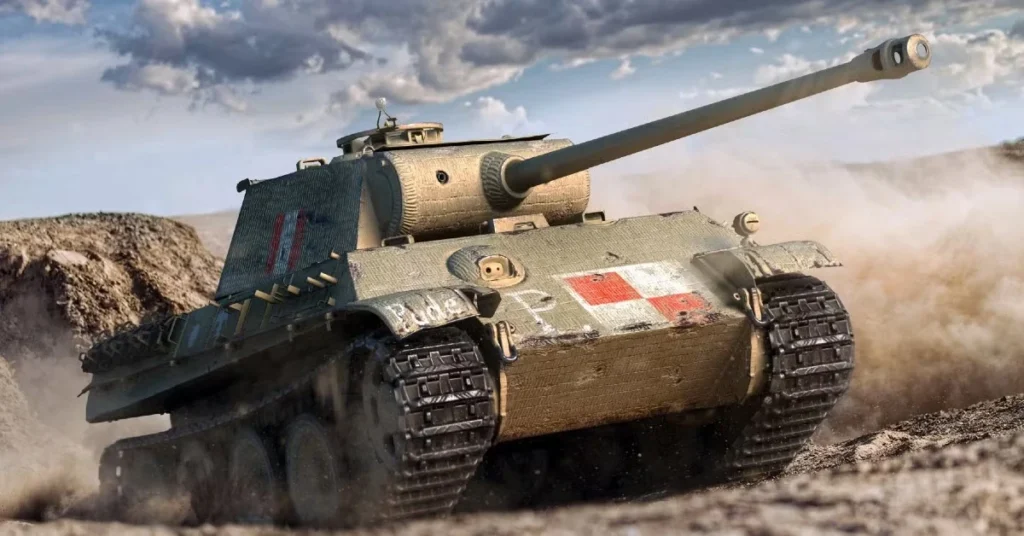
Their pride, a 45tonon Panther, has ground to a halt.
The diagnosis is a failed final drive.
The complex set of gears that delivers power to the tracks.
It was a notorious weakness, a component groaning under the immense weight and torque of the magnificent but overstressed machine.
For the German mechanics, this is the beginning of a logistical nightmare.
The Panther’s elegant but complex suspension uses interleved road wheels, an overlapping design that provided a smooth ride but made any track or suspension repair excruciatingly difficult.
To even access the final drive, they must first remove multiple half-tonon steel wheels.
This requires heavyduty jacks capable of lifting the entire side of the tank and specialized gear pullers, tools that were always in short supply.
Even in a perfect workshop, the job would take a team of expert mechanics several days of painstaking labor.
In a field with limited tools, under the threat of air attack, it was nearly impossible.
And if this breakdown happened during a retreat, the calculation became brutal.
There was no time.
The crew had only one option left.
They would place demolition charges inside the crew compartment and on the engine deck, set the timers, and walk away.
A minor mechanical failure had just resulted in the permanent loss of a machine worth a fortune in Reich’s marks and skilled labor.
This wasn’t an isolated tragedy.
It was a systemic collapse.
The German army simply could not retrieve its own wounded giants.
For every 10 Panther tanks produced, Germany built only one Berga Panther, the armored recovery version.
It took two of these powerful vehicles to safely tow one dead Tiger.
These vital recovery assets were rarer than the combat tanks themselves.
Compounding the problem was the everpresent fuel crisis.
A Berga Panther might be available, but there was often no gasoline to run it.
A spare final drive might exist somewhere in a depot hundreds of miles away, but with Allied air power savaging the rail lines, it might as well have been on the moon.
For German commanders like Hines Gdderion, the architect of the Blitzkrieg, this was a source of growing private despair.
Their most powerful weapons were becoming their greatest liabilities.
A single broken gear, a single snapped toe cable, a single empty fuel can immobilize a multi-million dollar asset, turning a technological marvel into an unmovable steel pill box waiting to be destroyed or abandoned.
Back at the American collection point, the story ends differently.
The Sherman with its new engine is refueled and rearmed.
A maintenance officer gives it a quick test run and signs it back into service.
The welded patch where the shell hit might get a quick splash of olive drab paint or it might not.
It doesn’t matter.
The tank runs.
It fights.
The vehicle that was a combat loss on Monday is combat ready on Wednesday, waiting in the motorpool for its original crew or a new one.
For the GIS, it was a symbol of incredible resilience.
For the Germans, it was the demoralizing sight of an enemy whose machines, like a mythical hydra, seemed to grow back as fast as they could be cut down.
This incredible process wasn’t just the result of a cleverly designed tank.
It was the visible output of a gargantuan, unseen industrial and logistical effort, an effort Germany could no longer hope to match.
That resurrection machine wasn’t born in the fields of France.
Its heart was beating 4,000 m away in the sprawling factories of Detroit, Flint, and Dearbornne.
While German industry was handcrafting technological marvels, American industry was churning out something far more revolutionary.
Standardized interchangeability on a global scale.
For every Sherman tank that rolled off the assembly line, the Ordinance Department commissioned a flood of spare parts.
Not just engines and transmissions, but every road wheel, every track pin, every periscope, every single bolt.
These components were cataloged with a fanatical devotion to standardization.
A transmission built by Chrysler in January would fit perfectly into a tank haul made by Ford in July.
This created a vast continental stockpile of mechanical life, ready to be transfused into the army a world away.
But having the parts in America was useless.
The genius of the system lay in its delivery.
After the breakout from Normandy, as the Allied armies raced across France, this system was put to its ultimate test.
It was called the Red Ball Express.
Beginning in late August 1944, it was a massive non-stop trucking operation designed to bypass the destroyed French rail network.
For 82 days, nearly 6,000 trucks ran a continuous loop of supply routes 24 hours a day, seven days a week.
Drivers, the majority of them African-American soldiers, were given 60 hours to make a round trip, often sleeping in their cabs.
They formed a relentless roaring river of steel, fuel, and spare parts flowing from the Normandy beaches directly to the forward maintenance depots.
A power pack pulled from a warehouse in Michigan could within weeks be sitting in a truck on the Red Ball Express heading toward a dead Sherman waiting in a muddy field near the German border.
This entire global assembly line from factory floor to front line was managed by an army within the army, the Ordinance Corps.
Tens of thousands of men whose sole purpose was not to fight, but to ensure the fighters could.
They weren’t just mechanics.
They were salvage experts, inventory managers, and logistics planners.
They operated on a single brutal principle.
A tank is not a weapon, but a weapons system.
And a system is only as strong as its ability to recover from failure.
The Sherman, therefore, was not merely a tank.
It was the physical endpoint of a continent spanning logistical network.
Its perceived weakness, its lack of overwhelming individual power, was irrelevant.
Its true strength was that it was a standardized, modular, and replaceable component in a system built to absorb and recover from damage on an industrial scale.
The Germans had designed a perfect sword.
The Americans had designed a self-reping shield.
But what happens when that shield is tested not by a thousand small cuts, but by one massive unexpected blow? What happens when the system itself comes under direct attack? In the bitter winter of 1944, these two opposing philosophies, the perfect weapon versus the perfect system, would collide in the forests of the Ardens.
December 16th, 1944.
Through the snow choked forests of the Ardens, the last great German offensive of the war erupts under a blanket of impenetrable fog that grounds Allied air power.
Elite Panzer divisions spearheaded by the monstrous 70tonon King Tiger smash into the thin American lines.
The shock is absolute.
For the surprise GIS, it’s a terrifying vision from the past.
The Blitz Creek reborn, this time with armor they have no hope of stopping headon.
The initial American losses are staggering.
Shermans are swatted aside by the high velocity 88 mm guns of the King Tigers.
Entire companies are shattered in hours.
The German spearhead confer Piper of the first SS Panzer Division races forward.
A seemingly unstoppable armored avalanche.
On paper, it is the ultimate validation of the German doctrine.
Superior technology overwhelming a numerically superior but qualitatively inferior foe.
But as the columns of panthers and king tigers push deeper into the winding icy roads of the Arden, the old familiar problems begin to fester.
Now magnified into a catastrophic crisis.
The advance is too fast.
The supply lines stretched thin and harassed by pockets of American resistance cannot keep up.
Above all, the tanks are thirsty.
A King Tiger burned through fuel at a rate of nearly 5 gall per mile on a good road.
In the mud and snow, its consumption was astronomical.
The advance begins to sputter, not from enemy action, but from empty fuel tanks.
Simultaneously, the bitter cold and the brutal pace of the offensive trigger a pandemic of mechanical failures.
The overloaded final drives on the Panthers, always their Achilles heel, begin to shear and fail in record numbers.
In the chaos of the advance, there are no workshops, no heavy lift cranes, and rarely enough fuel for the few recovery vehicles to even attempt a rescue.
The result is a scene of profound military irony.
A King Tiger, the most powerful and feared tank of the Second World War, is abandoned by its crew on the side of a road near the village of Leglaze.
Its armor is unscratched, its gun is fully functional, its ammunition racks are full, but its fuel gauge reads empty.
It has become nothing more than a 70tonon steel monument to a failed logistical system.
Further back along the route of the advance, a line of Panthers sits silent in the snow, immobilized by identical transmission failures, their crews forced to leave them behind as the offensive loses momentum.
While the German spearhead was bleeding out from self-inflicted wounds, the American system was demonstrating its own brutal, relentless logic.
Behind the chaotic front, ordinance maintenance battalions worked with a desperate fury.
In the freezing mud of forward collection points near towns like Stavalo and Malmadi, the resurrection machine went into overdrive.
M32 recovery vehicles, sometimes under artillery fire, ventured out to haul damaged Shermans back from the brink.
Mechanics worked in 20our shifts, their hands cracked and bleeding from the cold metal, performing mechanical triage.
They weren’t repairing.
They were replacing.
An engine shattered by a panzer foust.
Unbolt it, lift it out, and drop in a new one from the endless supply chain of the Red Ball Express.
A suspension wrecked by a mine.
Cannibalize the bogeies from a burned out hull that was beyond saving.
These patched up Frankenstein tanks were not pretty.
They were mismatched, scarred, and often still bore the scorch marks of their previous death.
But they ran and they fought.
They were given to ad hoc platoon made up of survivor crews from different units and sent immediately back into the line to hold a vital crossroads or plug a new gap in the defense.
The American line bent and in many places it broke, but it refused to shatter.
For every Sherman the Germans knocked out, another or sometimes the very same one seemed to rise from the snow to take its place.
By Christmas, the German offensive had ground to a halt.
Conf group of Piper was surrounded, cut off, and ultimately forced to abandon its vehicles and retreat on foot.
The Arden was a graveyard of German armor.
The fields and forests around Leglaze were littered with the abandoned titans of the Panzervafa, silent testaments to an army whose weapons had outrun their own supply lines.
The battle had been decided not just by the soldiers who fought it, but by the mechanics who kept them in the fight.
The silent frozen tanks left behind in the Arden were the final verdict in a war of competing philosophies.
Germany had staked its fate on the perfect weapon, believing a single superior machine could dominate the battlefield.
But the Americans had bet on something else entirely.
A perfect system.
A system designed not to prevent failure, but to conquer it.
This brings us back to our central question.
What is the true measure of a tank’s power? The battlefields of France and Belgium provided a brutal, unambiguous answer.
It was not measured in millimeters of armor or the caliber of a gun.
It was measured in hours of downtime.
The ultimate power of the Sherman was its mortality.
It was designed with the expectation that it would be hit, that it would break down, that it would fail.
And its genius was that it was also designed to be resurrected.
A tank that could be knocked out on Monday and be fighting again by Wednesday was infinitely more valuable than a superior tank that once disabled was lost to the war forever.
And so we returned to that Sherman crew in the summer of 1944, standing before their tank back from the dead.
The crudely welded patch on its hull was not a sign of weakness.
It was a badge of honor, a symbol of a doctrine that valued recovery as much as destruction.
Their personal miracle was not a fluke.
It was the strategy.
They were a single human scale example of a continental system that refused to let its army bleed out.
The endless debate over whether a panther could destroy a Sherman is the wrong conversation.
It asks the wrong question.
The real contest was never one tank against another.
It was Germany’s masterpiece of engineering against America’s masterpiece of logistics.
It was a war between an army that designed a tank to win an engagement and an army that designed an entire industrial ecosystem to win a war.
But that conclusion had another darker implication for every German armored attack.
If a tank was not just a tank, but the visible point of an entire system, then defeating it did not always require piercing its armor.
You could attack the system around it.
You could destroy its fuel, its infantry, its radios, its command vehicles, and its supply trucks.
You could leave the tank itself untouched and still make it useless.
The Americans proved that a weaker tank could survive by being part of a stronger machine.
But in the desert, the British discovered the reverse.
Even the strongest panzer could be stopped if you broke the team that allowed it to fight.
And they discovered it with a weapon that was never supposed to fight tanks at all.
North Africa 1942.
A British gun crew isn’t watching the sky.
They’re hunched over their 40mm bow for cannon.
Tools in hand.
With focused effort, they pry loose the elevation stops.
Small steel pins installed at the factory for one reason.
to prevent the barrel from ever pointing at the horizon.
But on that horizon, a cloud of dust is boiling.
A German armored column is coming.
The crew’s order is a direct contradiction of their training.
Ignore the planes.
With the stops removed, the gunner aims his weapon straight into the dust.
What could they possibly hope to achieve by firing an anti-aircraft gun at the ground? That simple unauthorized act of battlefield modification would unlock a devastating secret.
This is the story of how a common anti-aircraft gun became a nightmare for the German war machine.
Not by piercing the thick steel of its famous panzers, but by systematically dismantling the very system that made them so formidable.
The celebrated Blitzkrieg doctrine, the lightning war, was built on an illusion.
It projected an image of an invincible, unstoppable armored spearhead.
But in reality, a Panzer division was a complex, fragile ecosystem.
It was far more than just tanks.
And it was here in the spaces between the tanks that frontline soldiers discovered a critical vulnerability, a weakness hidden in plain sight.
The Bowfor’s gun was officially and correctly deemed almost useless against the frontal armor of a German medium tank.
And yet, this is the weapon that would begin to break the back of armored assaults in the desert.
How is this possible? How could a gun failing at its most obvious task succeed in stopping an army? To understand the answer, we must first look away from the British gun and toward the German machine it was about to face.
By 1942, the German army had refined its method of attack into a terrifying art form.
It wasn’t just a tactic.
It was a philosophy.
On paper, it was called gefect de verbundan vafan, the combined arms battle.
On the ground, it was a synchronized ballet of destruction.
At its heart was the panzer kyle, the armored wedge.
This was the instrument that had shattered Poland, humbled France, and pushed the British to the very edge of the Mediterranean.
It was designed to achieve a breakthrough, to rupture an enemy’s front line, not with brute force, but with focused, overwhelming pressure and speed.
Leading the charge were the Panzers.
The workhorse Panzer 3 designed to engage other tanks and the Panzer 4 with its larger 75mimeter gun tasked with destroying enemy machine gun nests and anti-tank positions.
Together they were the iron fist.
But a fist is useless without an arm.
And the arm of the Panzer Kyle was a complex living system that followed in its immediate wake.
Tucked in behind the tanks were the Panzer Grenaders, the mechanized infantry.
They rode in the iconic SDKFZ 251 halftrack, a vehicle that could keep pace with the Panzers over rough terrain.