By removing the requirement for the planes to retu…
By removing the requirement for the planes to return to the ship, Low’s concept instantly doubled the effective combat radius of the strike force.
The aircraft carrier wouldn’t have to wait in hostile waters to recover its aircraft, allowing it to flee at top speed the moment the last bomber was airborne.
It bypassed the limitations of naval aircraft by discarding them entirely and bypassed the runway requirements of army bombers by providing them with a moving start line.
The concept moved up the chain of command with shocking speed, finding immediate approval from Admiral King and General Henry Arnold, the head of the Army Air Forces.
On paper, it was a masterful stroke of asymmetric warfare.
It was a plan that circumvented every defensive expectation the Japanese possessed, simply because no military doctrine on Earth accounted for land-based medium bombers operating from the middle of the ocean.
But military history is littered with brilliant ideas that fall apart upon contact with physical reality.
Captain Low’s proposal hinged on one colossal unproven assumption.
An aircraft carrier flight deck was roughly 800 ft long.
A fully loaded medium bomber, packed with thousands of pounds of fuel and high explosives, required nearly three times that distance to reach takeoff speed on a stationary concrete runway.
The idea of using a carrier as a springboard for army bombers looked beautiful in a Pentagon briefing room, but nobody in the world had yet proven that an overloaded multi-engine land plane could actually fight gravity and safely tear itself away from a painfully short, violently pitching flight deck at sea.
To find out if a medium bomber could even survive a carrier launch, the military needed a very specific machine.
It couldn’t be just any bomber in the American inventory.
It had to possess a very narrow, unforgiving combination of wingspan, payload capacity, and low-speed lift characteristics.
The B-25 Mitchell was the only aircraft that fit the geometric and aerodynamic constraints.
In early February 1942, off the coast of Virginia, two lightly loaded B-25s were hoisted onto the USS Hornet and successfully flown off her deck.
The fundamental physics checked out, but a nearly empty test plane taking off near a friendly harbor is vastly different from a combat-loaded bomber preparing to cross an ocean.
To make the real mission work, the B-25 had to undergo a ruthless physical transformation.
The immediate enemy was not Japanese anti-aircraft fire.
The enemy was weight.
Every single pound left on the airframe was a fraction of a gallon of fuel they couldn’t carry.
Engineers began tearing the bombers apart, systematically stripping them of standard military equipment to convert them into highly specialized single-use weapons.
They ripped out the heavy liaison radios, reasoning the strike force would be maintaining strict radio silence anyway.
Most shockingly, they completely removed the highly classified, incredibly heavy Norden bomb sights.
The Norden was a marvel of American engineering designed for high-altitude precision, but the mission demanded a low-level approach where the complex optic was virtually useless.
Instead, a pilot designed a crude, makeshift aiming device out of a 20-cent piece of aluminum, which was simply bolted into the cockpit.
To compensate for the loss of defensive firepower in the rear, ground crews shoved painted wooden dowels into the tail cones, hoping to trick pursuing Japanese fighter pilots into thinking they were staring down the barrels of heavy machine guns.
The space cleared by this drastic weight reduction program was immediately filled with aviation gas.
Extra steel tanks were jammed into the bomb bays and massive collapsible rubber bladders were shoved into the crew crawlways.
The B-25s were transformed into flying fuel cans, carrying nearly twice their normal capacity, making them dangerously bloated and sluggish.
Now, they needed pilots who could actually force these overloaded machines into the air.
In March 1942, volunteer Army crews gathered in extreme secrecy at Eglin Field, Florida.
They were placed under the strict instruction of a Navy pilot, Lieutenant Henry Miller, whose sole job was to teach Army bomber crews the violent, unnatural art of carrier takeoffs.
>> On a concrete runway featuring a painted outline of the Hornet’s deck, the crews practiced a terrifying procedure.
They locked the brakes, throttled the twin engines to their absolute maximum manifold pressure, and let go.
As the heavy bombers lurched forward, the pilots hauled back on the control yokes at just 65 mph, a speed where a heavily laden B-25 should simply stall and drop out of the sky.
Day after day, they relentlessly dragged the heavy machines into the air, violently trading standard safety margins for those precious few feet of runway.
By the end of training, the crews had proven they could launch a fully fueled B-25 in less than 500 ft.
But, there was a fatal caveat to their success.
Hauling a bomber off a stationary, perfectly flat, marked concrete runway in the warm Florida sun was an impressive feat of aviation skill.
It was an entirely different reality from attempting that same mathematically fragile takeoff from the wet, heaving wooden deck of a real aircraft carrier operating deep inside hostile waters.
The physical reality of this theoretical plan crashed into existence on April 1st, 1942 at Naval Air Station Alameda in California.
The loading of the aircraft was a surreal, mechanically jarring spectacle that violated every established rule of naval aviation.
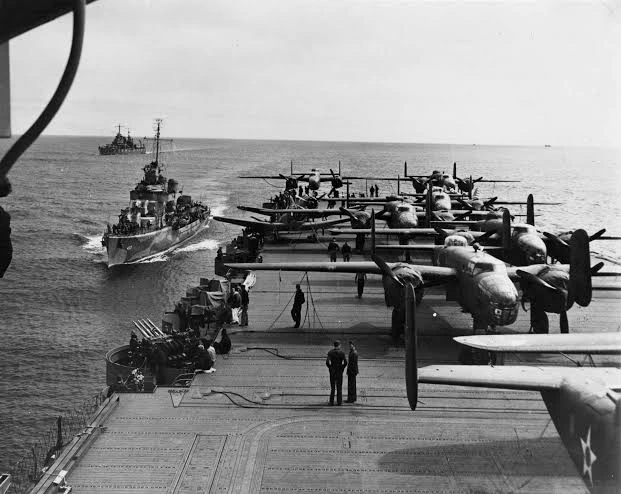
One by one, massive dockside cranes hoisted 16 North American B-25 Mitchell bombers out of the California air and gently lowered them onto the wooden flight deck of the USS Hornet.
The visual contrast was jarring.
The B-25 was an enormous piece of machinery boasting a wingspan of over 67 ft and a length of 53 ft.
The flight deck of the newly commissioned Hornet was less than 115 ft wide.
To fit 16 of these land-based leviathans onto the ship, Navy deck crews had to meticulously pack them together staggering their massive twin-engine wings and leaving their tail assemblies jutting precariously out over the open, churning waters of the Pacific Ocean.
But this bizarre parking arrangement carried a devastating tactical cost.
An aircraft carrier is a highly complex, living organism built entirely around the continuous movement of aircraft from its cavernous internal hangar deck up the elevators to the flight deck and back down again.
By securely tying down 16 immovable medium bombers across the rear and middle of the flight deck, the Navy had effectively paralyzed the Hornet.
The bombers were far too large to fit on the ship’s elevators, meaning they could not be struck below.
Consequently, the Hornet’s own organic air group, its squadrons of nimble Wildcats, devastating Dauntless dive bombers, and heavy torpedo planes were permanently trapped in the hangar deck below.
For the duration of the outward voyage, one of the United States Navy’s newest and most powerful fleet carriers was utterly stripped of its offensive and defensive capabilities.
It had been reduced from a lethal instrument of power projection to a multi-million-dollar floating cargo freighter.
Because the Hornet was rendered completely blind and defenseless by the very weapons it was carrying, Admiral William Bull Halsey was forced to attach a second fleet carrier to the mission.
Task Force 16 would center around the Hornet, but it would rely entirely on the USS Enterprise to provide the vital combat air patrol and forward scouting.
In the desperate, resource-starved environment of early 1942, this was a breathtaking strategic gamble.
The United States was committing two of its precious few Pacific Fleet carriers, representing a massive percentage of its total remaining naval strength, merely to act as a delivery mechanism for 16 bombers.
If Japanese intelligence discovered the task force, or if a submarine managed to slip through the destroyer screen, the American naval war effort could be fundamentally crippled in a single afternoon.
The sheer magnitude of this risk hung over the task force as it slipped under the Golden Gate Bridge and disappeared into the vast gray expanse of the Pacific.
The transit across the ocean was not a passive journey.
It was a grueling, continuous battle against the unforgiving maritime environment.
The North Pacific in April is a violent, freezing expanse characterized by deep low-pressure systems, gale-force winds, and massive, towering swells.
The B-25s, designed for the dry, controlled environments of inland airbases, were entirely unsuited for exposure to the open ocean.
Relentless waves crashed against the hull, sending corrosive sheets of salt spray violently over the flight deck, drenching the aluminum skins of the aircraft.
For the Army Air Force’s mechanics, accustomed to working in well-lit, stationary hangars, the voyage became a waking nightmare.
They were forced to live and work on the exposed, heaving deck, constantly fighting to protect the complex aviation machinery from the corrosive salt.
Every single day, crews had to meticulously wipe down the exposed metal, and most critically, manually rotate the heavy, three-bladed propellers of all 32 Wright Cyclone engines.
If they failed to do this, the heavy aviation oil would pool and congeal in the lower cylinders of the radial engines, virtually guaranteeing catastrophic engine failure the moment the pilots attempted to throttle up for takeoff.
Beneath the physical struggle to maintain the aircraft lay the crushing psychological weight of the mission’s central mathematical equation, the relentless, unforgiving countdown of fuel versus distance.
The entire operational plan was balanced on a razor’s edge of geographical proximity.
To have any realistic hope of surviving the mission, the bombers needed to be launched as close to the Japanese home islands as physically possible.
The optimum, meticulously calculated launch point was 400 mi from the coast of Japan.
At 400 mi, the heavily laden B-25s would possess just enough aviation gas to reach their targets, drop their high explosives, and continue westward across the vast expanse of the East China Sea to reach the designated friendly landing strips in nationalist held China before the fuel gauges hit zero.
500 miles was considered the absolute ragged edge of the mission survivability envelope.
Every single mile the naval task force could push westward before being detected was a literal mile of aviation gas the crews would have in their tanks on the far side of the bombing run.
The ships of Task Force 16 were buying the air crews eventual survival with their own increasing proximity to danger.
However, the Japanese High Command was neither blind nor naive.
They were fully aware that the United States deeply desired to strike back and pierce the psychological invulnerability of the home islands.
But Tokyo felt secure.
Their confidence rooted in a massive ingenious early warning system dictated by the known technological limits of standard naval aviation.
The Japanese defensive perimeter did not rely on advanced radar stations on the mainland.
Instead, they projected their awareness far out into the ocean using the Toku-setsu Kanchitai, a vast organized network of auxiliary picket boats.
These were not specialized heavily armored warships.
They were requisitioned commercial fishing trawlers and ordinary wooden vessels retrofitted with powerful long-range radios and light defensive weaponry.
Hundreds of these small ships were deployed in a massive sweeping arc that stretched across the Pacific maintaining a continuous invisible tripwire roughly 600 to 700 miles off the eastern coast of Japan.
The placement of this picket line at the 700-mile mark was a calculation based on pure military logic.
Japanese naval planners knew the exact operational limitations of standard American carrier-based aircraft.
An SBD Dauntless dive bomber or a TBD Devastator torpedo bomber taking off from an American carrier had a maximum practical combat radius of roughly 200 to 250 miles.
Therefore, for an American naval task force to launch a conventional strike against Tokyo, the ships would be forced to physically sail through the picket line, triggering the alarm.
Once detected, the American carriers would still have to spend 10 to 15 agonizing hours sailing another four or 500 miles closer to the coast just to reach their standard launch point.
This massive geographical gap was the Japanese kill zone.
Long before the American carriers could ever get close enough to launch their short-range naval planes, Tokyo would deploy waves of heavy land-based G3M and G4M bombers from the home islands to swarm the coordinates, annihilating the carriers and sending them to the bottom of the Pacific.
The picket line provided absolute geographic and tactical security.
The Japanese planners were not scanning the horizon for land-based medium bombers operating from the middle of the ocean because such a concept simply did not exist in the established doctrine of global naval warfare.
This intricate clash of opposing doctrines finally violently collided on the morning of April 18th, 1942.
The weather over the task force was atrocious.
A heavy churning storm system that whipped the ocean into a frenzy.
The ships were plunging violently through 30-ft swells, taking green water over their bows as gale-force winds howled across the flight decks.
It was just after dawn and the task force was roughly 650 miles from the Japanese coast, plowing directly into the heart of the invisible Japanese defensive web.
At 07:38 in the morning, the tension shattered.
Radar operators aboard the USS Enterprise detected a surface contact.
Minutes later, lookouts peering through the driving rain and heavy sea spray achieved visual confirmation.
Bobbing violently in the massive swells was the Nittou Maru number 23, a tiny 70-ton Japanese patrol boat.
It was practically insignificant in size, a mere speck of wood and steel against the towering gray waves, but it was arguably the most dangerous object in the Pacific Ocean because of the man sitting inside its cramped hull with his hand on a radio transmitter key.
The tactical crisis erupted instantly.
Admiral Halsey, standing on the flag bridge of the Enterprise, immediately ordered the light cruiser USS Nashville to break formation, intercept, and utterly obliterate the picket boat before it could broadcast its fatal warning.
But naval gunnery in the middle of a severe Pacific storm is not a simple equation of pointing and shooting.
The Nashville closed the distance and opened fire with its massive 6-in naval guns, but the horrific sea state turned the engagement into a desperate, frustrating struggle.
The 30-ft swells continuously threw the heavy cruiser wildly off balance, disrupting the sophisticated fire control solutions.
The tiny wooden Nittou Maru repeatedly disappeared deep into the massive troughs of the waves, causing the heavy American shells to whistle overhead or splash harmlessly into the churning sea.
The Nashville unleashed salvo after deafening salvo, ultimately expending more than 900 rounds of heavy ammunition, but the small Japanese vessel stubbornly refused to go down.
The engagement dragged on for roughly 30 agonizing minutes, and that critical delay proved fatal to the American operational plan.
Down in the radio room of the battered Nittō Maru, the Japanese radio operator coolly did exactly what he had been stationed in the middle of the ocean to do.
He tapped out a frantic, clear, and precise warning to his commanders in Tokyo.
“Two enemy aircraft carriers sighted, maintaining a westerly course”.
Aboard the Enterprise, American naval radio intelligence operators silently intercepted the transmission.
They translated the intercept, and the terrifying truth washed over the American command staff.
The element of surprise, the absolute prerequisite for the task force’s survival, had just evaporated.


