The archaeologist in charge said that standing over it felt like watching the destruction happen in front of her.
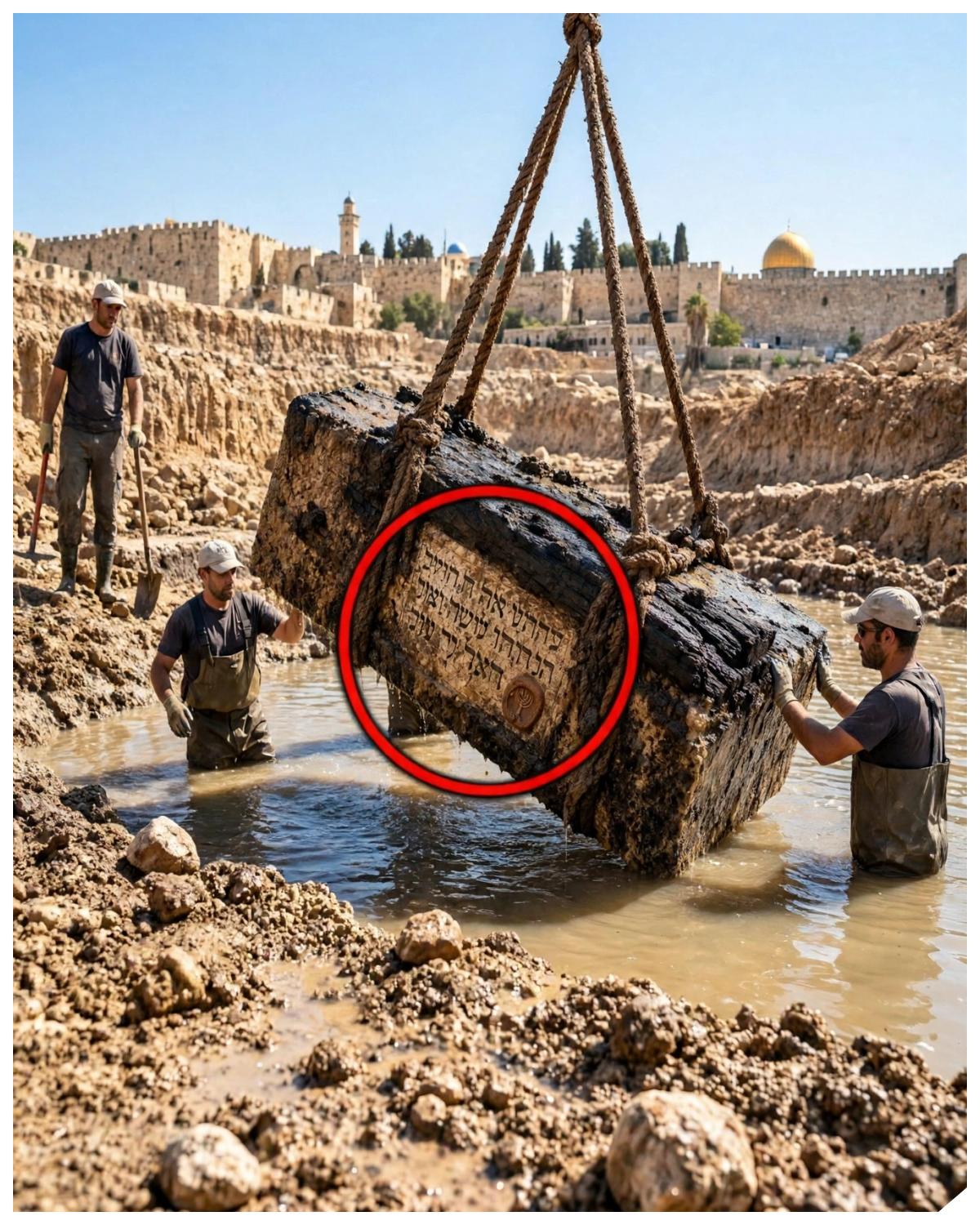
For roughly 2,600 years, a band of black ash had been lying under a parking lot in the city of David, and hardly anyone cared.
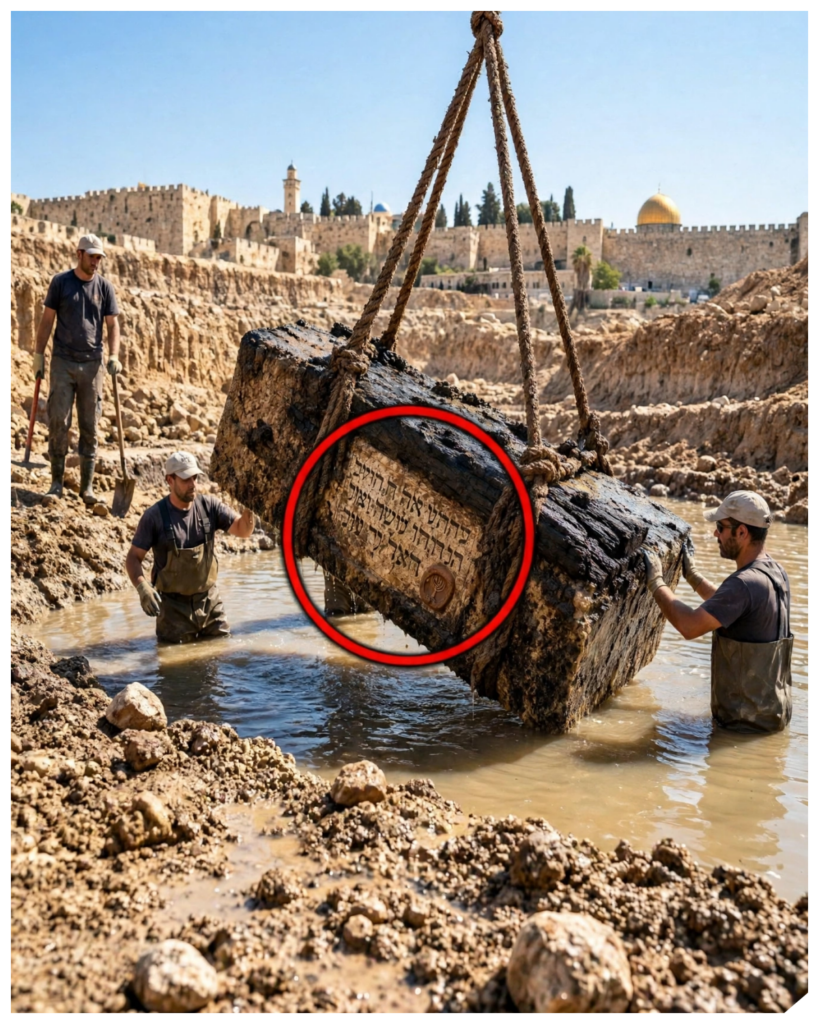
Then this July, days before Tishabove, the day Jews mourned the temple, Israel Antiquities Authority diggers lifted off a sheet of plaster.
The fire had melted and found massive roof beams burned to charcoal, lying exactly where they came down on a floor untouched since the night the building collapsed.
That’s a bigger deal than it sounds.
For the better part of a century, the only account of how Jerusalem fell in the sixth century before Christ was the Hebrew Bible, and skeptics called it theology, pretending to be history.
Now, there’s a second account.
It’s written in ash, in baked clay, and in the frozen magnetism inside a floor that crashed down from the upper story while it burned.
And when scientists measured that floor, the numbers pointed to one summer and one army.
I’m Ambrose Wild, and this is about a fire that one book kept describing for some 25 centuries before anybody built a machine that could find that same fire in the soil.
The soil mostly agrees with the book and the handful of spots where it disagrees end up being the best part of the story.
The spot itself has an irony to it.
One of the most argued over patches of ground anywhere spent years as somewhere to leave your car.
It’s the Givati parking lot at the northern tip of the city of David, the slim ridge south of the Temple Mount where Jerusalem started.
Directly uphill sits Silwan, a Palestinian neighborhood.
And this story will have to face that before it’s done.
Below the asphalt, crews have been working down for around 20 years.
And deep in that stack, there’s one band with no color in it at all.
It’s just black.
That July, the Antiquities Authority and Tel Aviv University revealed what that band was hiding.
Thick timbers turned to charcoal that had once held up the roof over an inner courtyard and had come crashing down onto its floor.
Ephra Boer, who directs the excavation, explained how the wood survived.
The heat melted the plaster coating on the walls, and that plaster slid down over the burnt timbers and sealed them like wax poured over the mouth of a jar.
The excavators say an earlier batch of beams from this same building turned out to be sycamore.
Dr.
Johanna Regv is now working on the new wood and she says timber with this many growth rings almost never turns up in Israel.
These rings could narrow the date to roughly 10 years.
Now hold that up against scripture.
2 Kings 25 describes Nebuchadnezzar, king of Babylon, marching on Jerusalem and camping around it.
Depending on the calendar, the siege lasted 18 months to two and a half years and the famine prevailed in the city.
The King James says, “And there was no bread for the people of the land.”
Then the defenses gave way.
King Zedekiah and his men escaped by night through the gate between the two walls.
And in the fifth month, a Babylonian commander called Nebuarodan rode in.
And he burnt the house of the Lord.
And the king’s house and all the houses of Jerusalem and every great man’s house burnt he with fire.
Here’s something that’s easy to miss.
Kings puts that burning on the seventh day of the fifth month.
Jeremiah telling the same event in chapter 52 says the 10th.
Jewish tradition reconciled the two by teaching that the fire was lit on the 9th and kept burning into the 10th which is why tishaba the 9th valve became the fast for the temple.
So those beams surfaced in the very week the Jewish calendar keeps for that fire.
That’s the test running under this whole story.
Lay the Bible’s account beside what’s really buried there and see how much survives.
The answer starts in the late 1970s with clay that had no business lasting.
In 1978, the Israeli archaeologist Yiggle Shiloh opened a dig on the east side of the ridge in a sector his team labeled Area G.
One house had collapsed in a blaze so fierce the team simply named it the burnt room.
Ash covered its floor and mixed into the ash were arrow heads of two kinds.
Some were the flat local Judeian type.
Others were bronze, threebladed with a socket, the kind archaeologists loosely call cyian, used by armies across the near east.
Two kinds of arrow in one room is about as close as archaeology gets to a photograph of a fight.
Beneath the ash lay blackened furniture, its carved palm leaf design still visible.
Four years on, in 1982, just below a house the team called the house of Ail, the diggers came across something stranger.
51 small lumps of clay.
Each was a buller, a dab of clay, a scribe pressed over the string tied around a rolled papyrus stamped with the owner’s seal.
Sundried clay usually crumbles.
These kept because the blaze that turned the papyrus to smoke fired the clay hard the way a kiln fires a pot.
Researchers still call that spot the house of the bully.
Most of the 51 carried Hebrew names and one said belonging to Jamaria, son of Chiffan.
Readers of Jeremiah know him.
In chapter 36, the prophet scribe Baruk reads his scroll of warnings to the crowd at the temple from the chamber of Jamaria, the son of Chapan, the scribe.
Later in that chapter comes a scene that makes this seal even stranger.
King Jehoakim sits in his winter house with a fire going on the hearth and each time three or four columns are read.
He slices them off with a pen knife and drops them into the flames until nothing is left.
The King James names three officials who pleaded with him to stop.
Elnathan, Delia, and Gariah.
Gemiah was in that room and he tried to stop it.
So here was a seal his or else a man’s with an identical name and an identical father fired hard by the very disaster that scroll had predicted.
One honest caution though, Jeemariah was active something like two decades before Jerusalem fell.
The buller shows a document under his seal ended up in that archive.
It can’t tell us he was there when it burned.
More names followed.
In 2005, Alot Mazar, working near the crest of the ridge, uncovered a buller naming Jehook, son of Shelomiah.
In 2008, just yards from the first, her team turned up a second, for Gdalia, son of Pashure.
Jeremiah 38:1 puts both men in one sentence, with Jehook under the short form Jukall.
They’re among the princes who press King Zedekiah to execute Jeremiah for urging the city to give up.
Then they let him down with cords into a system.
And the King James says, “In the dungeon there was no water but ma.”
So Jeremiah sunk in the mire.
And just one chapter before in 37:3, Zedekiah sends this very Jehook to Jeremiah with a request.
Pray now unto the Lord our God for us.
The man who asked the prophet to pray for the king.
Help drop him in a pit.
And notice who kept that unflattering detail on the record.
The people who lost the city did, and that choice is where this whole story ends up.
So by 2008, three officials named in Jeremiah had turned up as fired clay signatures.
Skeptics raised a fair objection.
A name isn’t a fire.
The seals proved the biblical writers knew genuine officials of the day.
They didn’t prove Babylon did what the Bible describes on the timeline the Bible gives.
That needed another kind of witness.
And the first one to come forward was sitting in London, a small clay tablet in a museum storoom that had gone unread for 87 years.
In 2007, the Austrian ununiform scholar Michael Jerser working through the British Museum’s collection came across one cataloged in 1920 that nobody had ever translated.
It was a receipt from 595 BC for roughly a pound and a half of gold donated to the main temple of Babylon by an official whose title was chief unuk.
His name was Nebo Sarsim.
Now turn to Jeremiah 39:3.
Jerusalem has fallen.
The princes of the king of Babylon take their seats in the middle gate and the verse names them.
In the King James, one man’s name is split across two entries.
Sam Ganibo and Sarskim.
And right behind it comes Rabsaris, which is that same title, Chief of the Unix.
The tablet rejoined the name, one man, one title, one king’s service, eight or nine years before he sat down in Jerusalem’s gate.
Jers said, “Bible figures who aren’t kings almost never turn up anywhere else.”
The Babylonian side has more.
One of the Babylonian chronicles published by Donald Wiseman in 1956 records that in Nebuchadnezzar’s seventh year, his troops besieged the city of Judah, captured it on the 2nd of Adar, took its king prisoner, and set up a ruler.
He picked himself.
That’s March 16th, 597 BC.
The first siege when Jehoakin surrendered.
Then there are the ration tablets dug up by Robert Coldy’s German team near the Ishtar Gate.
Sometime between 1899 and 1917, they log oil for Yaokinu, king of the land of Yahudu, with portions for five sons.
That’s Jehoakin, living on Babylonian rations, which is right where the closing verses of Second Kings leave him, eating at the Babylonian king’s table all the days of his life.
After that, though, Babylon falls silent.
What survives of the chronicle ends after 594 BC before the second siege and says nothing about any fire.
For that last destruction, the Bible is the only written account from the ancient world.
Anything more had to be dug up, which puts us back in the parking lot.
When Yuvil Gdote of Tel Aviv University and Yifa Chalev reached the Iron Age levels at Givati, they found the lower floor of a huge two-story building, three rooms in a row.
They named it building 100.
Part of its upstairs floor had been laid in a fine Terzo style plaster, the first floor like it found anywhere in Iron Age Israel.
Pay attention to what came out of the burnt layer in 2019 because it ties this building to a single verse.
It was a buller roughly a centimeter wide and it said belonging to Nathan Melik, servant of the king.
That name appears once in the whole Bible 2 Kings 23 11 where King Josiah removes the horses dedicated to the sun from the temple entrance by the chamber of Nathan Melik the Chamberlain.
Close by lay a bluish agate seal inscribed belonging to Ikar son of Natanyahu.
Dr.
Anat Mendel Gberovich who read the inscriptions was careful.
Nobody can prove the stamps owner is the man in kings she said though several details connect them.
In 2022 wet sifting of the burnt fill produced at least 1,500 splinters of carved ivory.
Conservators fitted them into about a dozen square plaques showing rosettes and lotus blossoms framing a stylized tree.
Lab tests confirmed elephant tusk.
Before this, plaques like these were known only from royal capitals like Samaria and Nimrod.
The Jerusalem set differs in one striking way.
Not one plaque shows an animal or a human or mythical figure, and the excavators think Jerusalem’s elite shows which foreign images to accept.
Amos had a phrase for people who lived like this.
They lie upon beds of ivory.
In a separate study, chemists found that eight jars from two buildings in the city of David, smashed in the collapse, had held wine spiced with vanilla, possibly carried from as far as India.
Whoever used these rooms was pouring vanilla wine among ivory furniture right up to the last days.
Still, none of it, not the seals, the ivory, or the wine, can say when the building burned or who lit it.
For decades, the date of that black band leaned on two props, pottery styles and the book itself.
So, a team led by Yo Vaknen asked the floor directly.
Floors and bricks contain tiny ironrich grains.
Heat them hot enough and let them cool.
And those grains freeze in line with the Earth’s magnetic field, its direction and its strength.
At that instant, like compass needles stuck in place, that field shifts from year to year, so a frozen reading can be checked against the known record, the way you’d check a fingerprint.
In a 2020 study, the team pulled 397 samples from 54 fragments of a carefully laid plaster floor in building 100.
Many fragments sat at odd tilts, and the magnetism explained it.
They belonged to the upstairs floor, dropped while the building burned and cooled exactly where they hit.
In most fragments, the original signal had been erased at about 300° C.
Three needed at least 600°.
Parts of that upper floor had been sitting in a furnace.
The field they captured was over twice the strength of today’s, and the team published it as one data point, the magnetic field above Jerusalem as it stood in August 586 BC.
In 2023, a team led by Nitsan Shalom went back into building 100 and read it the way a modern fire investigator reads a burned house using the magnetic signals frozen in broken pottery.
Their study found the heat peaked upstairs.
Patches of the lower floor never caught at all, probably because the second story fell in and choked the flames, and the fire had been lit in several spots.
A kitchen fire that gets out of hand doesn’t do that.
Somebody moved from room to room with a torch and whoever it was wanted the building completely gone.
It was set on purpose.
It burned hot and it spread fast, which is the fire the book describes.
A careful skeptic would push back here.
Vakn’s group pinned their reading to 586 because both the dig and the Bible pointed to that year.
The date was borrowed from the text.
A real test needs a clock that never opened the book.
In 2024, one arrived.
Elizabeth Beretto and Reggv of the Whitesman Institute together with Gdote Shalev Joe Yuzil and other colleagues released over 100 radiocarbon dates from the ridge in the proceedings of the National Academy of Sciences.
Radioarbon has a famous weak spot in exactly this era.
Scientists call it the Holstat Plateau, a stretch from roughly the 8th to the fifth century before Christ, where the calibration curve flattens.
So, a lone date smears across centuries.
The team beat it by sampling walls and floors in their true sequence, fitting that pattern to the curve, and anchoring it with 100 tree rings whose exact years were already known.
What came out was a city that pushed west in the 9th century before Christ, was hit by a major earthquake in the eighth, was rebuilt and walled, and kept growing until it stopped dead in 586 with the Babylonian destruction.
By their dates, building 100 had stood nearly 300 years before the fire, and one result moved a famous name.
Rebuilding after that earthquake had long been credited to Hezekiah.
The new dates point to Isaiah, his great-grandfather.
Scripture remembers that quake, too.
Amos dates his prophecy 2 years before the earthquake in the days of Uzziah and Zechariah centuries later still recalls how they fled from before the earthquake in the days of Uzziah.
2 Chronicles adds that Uzziah built towers in Jerusalem and fortified them.
So set the two witnesses side by side.
Scripture says, “Every great man’s house burned.”
The dig agrees.
Elite buildings in at least four areas carry the burn layer, and the best studied was torched on purpose.
Scripture describes a siege with fighting.
Again, the dig agrees with mixed arrowheads in the burnt room.
At the base of a tower in what’s now the Jewish quarter, and on Mount Zion, scripture says the walls came down.
On the eastern slope, the terrace homes slid downhill and nobody rebuilt them.
Scripture names Jamaria, Jahookal, Gdiliah, Nebo Sarsim, and Nathan Melik.
And between the ridge and that London storoom, all five have turned up.
Scripture also says that near the end, Laksh and Azeka were the last walled towns of Judah still standing.
Jeremiah 34:7.
For these defended cities remained of the cities of Judah.
In 1935, the British archaeologist James Leslie Starky pulled a set of letters from the ruins at Lakish, inked on broken pottery in those last months.
In one, a Judeian officer tells his commander he’s looking out for Lakish’s signal fires since Azac are no longer visible.
That letter came from the losing side, too.
Written by a soldier in the last weeks before Lakish fell.
If all you’ve heard is that archaeology proves the Bible, that’s half of it.
Scripture says all the houses of Jerusalem burned.
Shalom’s own 2023 work argues the damage was partial and targeted.
And a dig report from a different part of the city fits that.
Of three Iron Age buildings excavated there, just one room had the burn layer.
It looks as if the Babylonians aimed at palaces, government buildings, and rich men’s homes, and plenty of ordinary streets survived.
Scripture says the temple and the palace burned.
Excavating the temple mount is off limits and the palace has never been securely located.
So on those two points, the dig is silent.
Scripture describes a terrible famine and I haven’t been able to find a published scientific trace of it in the siege layers.
Scripture places the burning in Nebuchadnezzar’s 19th year, and scholars remain split nearly evenly between 586 and 587 since the chronicle tablet that would decide it hasn’t survived.
And scripture says the land laid desolate.
The digs show Jerusalem in ruins, but villages to the north and the government center at Ramat Rachel carried on under Babylon.
One leading estimate has Judah dropping from about 110,000 people to about 40,000.
A catastrophe with tens of thousands still living on the land.
One more disagreement is about the present.
Residents of Silwan and an Israeli archaeologists group called Mchave argue the excavation recasts their neighborhood as an ancient site instead of a place where families live.
The foundation that funds the work says the state’s own archaeologists dig to the highest standards.
Those two statements can both be true.
Which takes us back to those beams.
When BA looked down at that charred wood in July, she wasn’t looking at proof of the Bible.
She was looking at something smaller and harder to argue with a physical thing the book described, sitting where the book placed it, scarred by the fire the book says was set.
Reggiev is still working on the dates.
If the outer rings put the cutting of those trees within 10 years of the city’s fall, they’ll be among the most precisely dated relics of that night.
And there’s a detail here I keep coming back to.
When the exiles returned two generations later, they left the wreckage of building 100 where it lay and built on top of it.
Charv believes that was deliberate.
He calls it a landscape of memory.
Ruins kept in place on purpose.
A band of ash left under the new city so nobody would forget.
Now think about who wrote the book.
They were the losing side.
Their city was in ruins.
Their king had been blinded and carried off in chains.
And their temple was ash.
Lamentations opens on the city itself.
How do the city sit solitary that was full of people?
They wrote it down regardless naming the officials who wanted the prophet dead for calling it right.
That book was their own landscape of memory, kept on scrolls instead of in rubble, and for 26 centuries, it stood alone.
Now, magnetometers and a radiocarbon lab have checked their work.
And the two memorials, the ash under the parking lot and the pages of the book tell the same story about that summer.
What I’d like to know next is who owned building 100.
Gadot and Shalev have suggested it may have served as a chamber, the kind of official room scripture keeps mentioning near the temple and palace, like the chamber of Nathan Melik in Kings, or the chamber of the princes in Jeremiah 35, somewhere in that heap of fired clay seals.
Could be the owner of that ivory inlaid furniture whose vanilla wine was still in the jars when Babylon broke through.
If his seal is in there, someone has already read it.
Nobody has connected it to the room yet.
I’m Ambrose Wild and there are more stories like this on the way where a name from an old page of scripture turns up in the ground.
So stay with the channel for the next