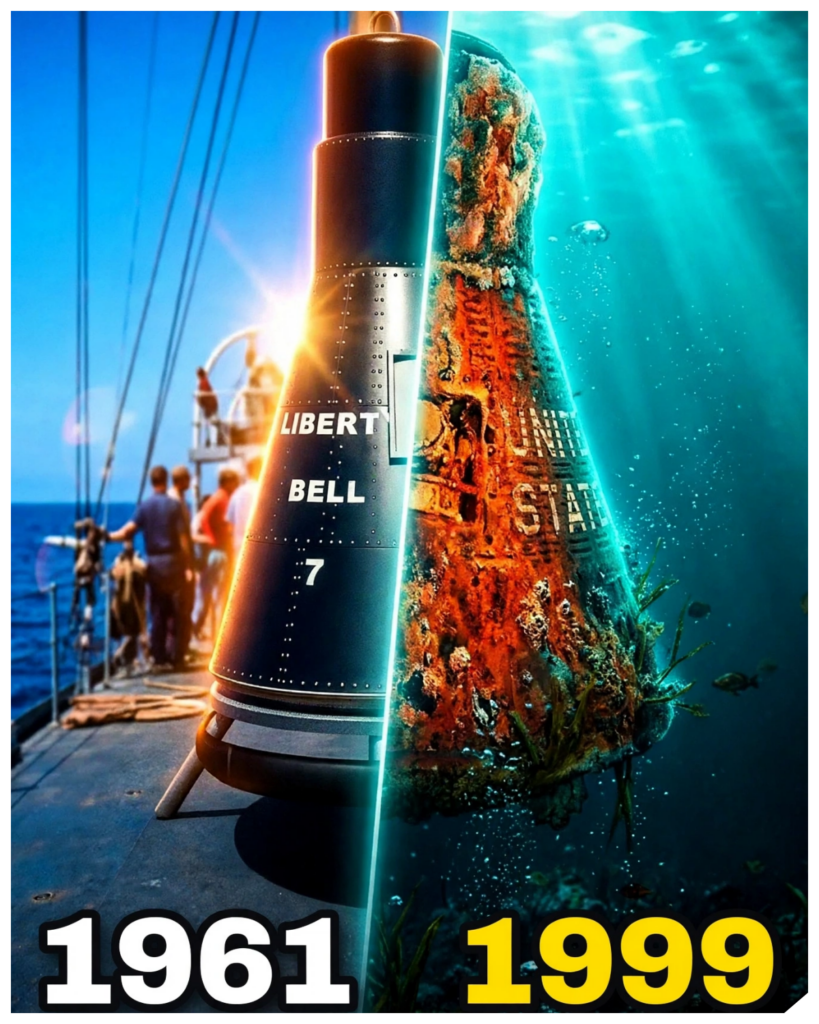
3 mi beneath the Atlantic, there is no daylight.
There never has been.
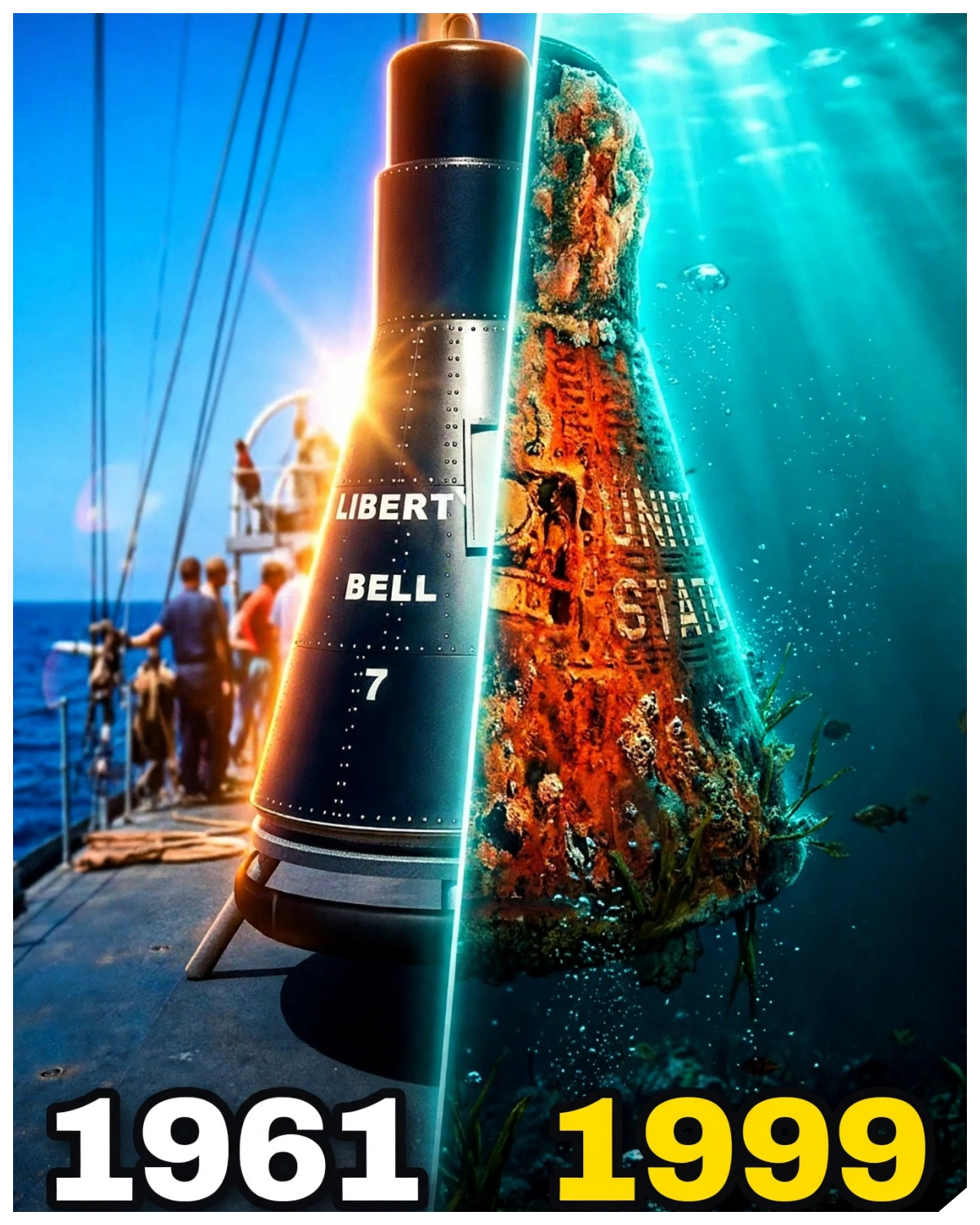
It is May 1999, and for the first time in 38 years, a light is moving across this part of the seafloor.
It belongs to a robot on the end of a long cable 90 mi northeast of the Bahamas.
On the pilot screen, something dark rises out of the mud, a cone about 7 ft tall.
At first, the team thinks it is a piece of a wrecked airplane.
Then the light reaches its side and they can read the words.
United States.
This is Liberty Bell 7, the second American spacecraft ever to carry a man into space and the only one NASA ever lost after a successful flight.
Inside [music] it, there might be the answer to a question that followed its pilot to his grave.
Did he blow the hatch?
In a few weeks, they would [music] pull it up and open it.
This is what they found inside and how it got down there.
July the 21st, 1961, Cape Canaveral, Florida.
Virgil Gryom, Gus to everyone who knew him, is a 35-year-old Air Force test pilot, one of the seven Mercury astronauts.
His spacecraft is capsule number 11.
[music] He named it Liberty Bell and had a crack painted down its side to match the bell in Philadelphia.
And it carries something new.
[music] An explosive hatch.
70 titanium bolts.
Each one drilled with a tiny hole and a cord of explosive running around the edge.
Fire that charge and every bolt snaps at once.
The hatch flies 25 ft in a second.
That morning, less than an hour before launch, a technician finds that one of the 70 bolts is out of line.
The engineers decide that 69 will be enough.
After 3 days of delays, the Redstone rocket finally lights.
15 minutes from now, Gus Gryom will be fighting to stay alive in the open ocean.
The flight itself goes almost perfectly.
The redstone throws him 118 m up.
For a few minutes, he is weightless and he cannot stop looking out of the window.
He can see the whole coast of Florida.
Later, he said it was hard to believe he was more than 150 mi away.
Then the fall.
The parachute opens and Liberty Bell 7 splashes down in the Atlantic, just 3 m from its target.
The helicopters are already on their way.
Gryom asks them to wait.
He wants 5 minutes to write down every reading on his instrument panel.
Then he pulls the safety pin out of the hatch detonator and lies back in his couch to wait.
[music] In his own words, he was lying there minding his own business when he heard a dull thud.
The hatch is gone, and the Atlantic is pouring in.
Gryom pulls off his helmet, grabs the instrument panel, and pushes himself out through the hole into the sea.
Above him, a marine helicopter hooks the sinking capsule with a pole and pulls the cable tight.
But a capsule full of seawater weighs more than 5,000 lb, 1,000 lb more than the helicopter can lift, and a warning light comes on.
Metal chips in the engine oil.
Gryom is sinking, too.
He has forgotten to close a valve on his spacuit, and the air that keeps him afloat is leaking out of it.
A second helicopter drops him a horsecollar sling.
He wraps himself in it backwards and is hauled out of the water.
The first pilot has to choose, his helicopter or the spacecraft.
He lets it go.
Liberty Bell 7 sinks into water 3 mi deep and a question begins to spread.
Did the astronaut panic and hit the plunger himself?
Gryom swore that he never touched it, but the only witness was now at the bottom of the ocean.
Gus Gryom kept flying.
In 1965, he commanded the first twoman Gemini mission.
[music] Then he was chosen to command the very first Apollo flight.
In January 1967, during a test on the launchpad, fire broke out inside that Apollo capsule.
Its hatch opened inward and the crew could not get it open in time.
Gus [music] Gryom, Ed White, and Roger Chaffy were killed.
The question of his first hatch was never settled while he lived.
Years later, an underwater engineer named Curt Newport decided [music] that somebody should go and look.
Newport flew deep sea robots for a living.
He had worked on the wreckage of the space shuttle Challenger and at the Titanic.
For 14 years, he studied NASA’s charts and photographs of the splashdown and narrowed the whole Atlantic down to one box on the map, 24 square miles.
[music] The seafloor there is more than half a mile deeper than the Titanic.
To reach it from the surface, you would need to stack 11 Empire State buildings.
In April 1999, with the Discovery Channel paying for it, his team put to sea.
Their sonar broke down at first.
[music] Once it was fixed, it found 88 possible targets on the seafloor.
They sent the robot down to look at the very first one.
It was Liberty Bell 7.
The camera followed a trail of broken heat shield up a hill, and there it stood upright, [music] its window still in place, its periscope still sticking out, and scorch marks where the hatch had blown away.
Then the sea turned rough.
The cable to the robot snapped [music] and the robot fell 3 m to the bottom.
Newport [music] called it triumph and tragedy.
A few hours apart, the capsule was found and now they had no way to bring it up.
So they built a new robot.
It was finished in a matter of weeks so the team could get back out before hurricane season.
This time two old men came along to watch.
Gwentter went, the pad leader who had closed Gryom inside that morning in 1961, and Jim Lewis, the helicopter pilot who had to let the capsule go.
Over several dives, the robot fitted custom tools and a lifting sling around the capsule and tied it to a line made of Kevlar.
But there was a problem waiting down there.
Liberty Bell 7 carried a small bomb, a sofar charge meant to explode if the capsule ever sank, so its position could be found.
In 1961, it never went off.
It was still on board.
Through [music] the night, the winch turned.
It took 8 hours to bring the capsule up through 3 mi of black water.
At a quarter 2 in the morning on the 20th of July 1999, Liberty Bell 7 broke the surface.
30 years to the [music] day since men first landed on the moon.
Newport said it was like a time portal.
On the bottom, it was still 1961.
[music] At the surface, all of a sudden, it was 1999.
On deck, experts took the old bomb out and got rid of it.
Then Newport climbed in to look.
The cabin smelled of sulfur.
In the muck at the bottom, he found coins, [music] seven silver dimes.
The next morning, the ship sailed into Port Canaveral.
It was the 21st of July, [music] 38 years to the day since the flight.
Gryom’s younger brother, Lel, was waiting on the dock.
This, he said, was the only craft that Gus didn’t bring home.
But the real search had not even started.
In Kansas, the capsule would be taken apart piece by piece, and NASA [music] wanted someone in the room.
September the 1st, 1999, Hutchinson, Kansas.
[music] For 6 weeks, it had sat in a steel tank of fresh water to keep the corrosion soft.
That morning at the Cosmosphere Museum, it was lifted out and a team from NASA watched it being opened up.
The outside was the first surprise.
The thin metal shingles of the hull had no corrosion at all.
Even the paint was still on, but the heat shield was gone.
It was made of burillium, and the sea had eaten it away completely.
Inside, the aluminium had been eaten through.
One instrument panel had almost vanished.
Its gauges lay on the seat, still hanging from their wires.
Many of the dials had imploded, their glass crushed by the pressure.
But plastic and fabric had survived.
The seat, the straps, a flashlight, and [music] then the things Gus Gryom had carried with him.
His flight notebook, a survival knife, [music] two cameras, though the film inside them was ruined, and more dimes, four that first afternoon.
35 more the next day, reportedly carried as souvenirs of the flight.
They even found the cover of the switch that fires the hatch, but not the hatch itself.
That was never found.
NASA’s report was short.
No items of scientific value.
So did Gus Gryom blow the hatch?
A year after his flight, [music] astronaut Wally Shira fired his own hatch on purpose.
The plunger kicked back and injured his hand.
Gryom’s hand had no such mark.
Gryom himself [music] later suggested that the release cord on the outside had come loose.
It was held in place by a single screw.
And in 2021, a new look at the recovery raised another idea.
Static electricity from the helicopter’s rotor.
The co-pilot remembered a spark when he touched the antenna at the moment the hatch blew.
None of it can be proved, but NASA kept giving him its most important missions.
[music] The people who knew him best believed him.
Today, Liberty [music] Bell 7 stands in a museum in Kansas, rebuilt from 25,000 parts.
The crack still painted down its side.
And the one piece that might have settled it all, [music] the hatch, is still out there somewhere on the floor of the Atlantic, 3 mi down.
