In the year the Bible gives for the fall of Jerusalem, a great house burned and the floor of an upper room crashed into the rubble below, freezing a record of the Earth’s magnetic field as it cooled.
That field, it turns out, was far stronger than it is over Jerusalem today.
The obvious scientific clock, radioarbon, should have timed that fire.
Instead, across this stretch of history, it all but stops.
In the ashes, clay seals baked hard by the flames still carry names, and two of them stand side by side in a single verse of Jeremiah.
The verse does not remember them kindly.
The Bible says, “Every house in Jerusalem burned.”
Where the ground can still be asked, that word is far from settled.
Scripture gives us the night.
Babylon’s own chronicle, which might have confirmed it, breaks off years too early.
So scientists went looking for clocks no scribe ever set.
By the end, you’ll see how close they’ve come, who stood inside the walls, and why the ash is still fought over today.
If you like your ancient history told with the evidence on the table, stay with us for more stories like this.
Every cold case starts with a file.
For the last night of Jerusalem, the file [clears throat] is surprisingly thick.
The book of Kings opens it like a police report.
The siege begins in the 10th month of King Zedekiah’s 9inth year and grinds on until the fourth month of his 11th.
Depending on how you count a king’s years, that is about 18 months or close to 2 and 1/2 years.
On the 9th day of that fourth month, the text says, there was no bread left for the people of the land.
Then the wall is breached.
Under cover of night, the king and all his soldiers slip out through a gate between two walls.
Zedekiah is blinded.
In the fifth month, a man named Nebuzared, captain of the guard, burns the house of the Lord, the king’s house, and every house in Jerusalem down to every great house.
The Babylonian army tears down the walls.
That’s one witness.
Now, we want a second, someone who wasn’t on Judah’s side.
Babylon kept records.
Its chronicle says that in Nebuchadnezzar’s 7th year, he marched west and besieged the city of Judah.
He took it on the second day of Adar, which is the 16th of March 597 B.CE.
The king fell into his hands, and in his place he set a ruler he had picked himself.
Jehoachin went out, and Zedekiah came in.
In Nebuchadnezzar’s palace archive, clay tablets list oil for Yahukin, King of Yehood, and his five sons.
Scholars take him to be Jehoachin himself, a captive king living on Babylonian rations.
For a while, the Babylonian clock ticks right in step with the Bible.
Then it stops.
The surviving chronicle runs to about Nebuchadnezzar’s 11th year, around 594 or 593 B.CE.
And breaks off.
No Babylonian text we have describes the final siege or the burning of the temple.
The page that should hold that night is gone.
That leaves the Bible to date it.
And the Bible doesn’t fully agree with itself.
Kings puts the destruction in Nebuchadnezzar’s 19th year.
Jeremiah gives his 18th year for the deportation.
Scribes counted royal years in different ways.
Some started the year in autumn and some in spring.
Some counted a king’s first partial year and some skipped it.
So scholars split.
Some argue for 587 B.CE and others argue for 586.
We have one night and two possible years.
The one witness that could settle it has gone silent.
To fix the date, we’ll need clocks that no scribe ever set.
The obvious clock is radiocarbon.
Every living thing takes in carbon, and once it dies, a rare form of that carbon begins to fade at a steady rate.
Measure what’s left in a charred seed or a burnt beam, and you can count backward to the moment it died.
It’s the clock that dates mammoths and mummies.
So, why not this fire?
Because here, the clock stalls.
Scientists turn radioarbon readings into calendar years using a calibration curve.
From roughly the 8th to the 5th centuries B.C.E.
That curve goes almost flat.
They call it the Holtat plateau.
Picture a stopwatch that freezes for three centuries.
A seed from long before the siege and a seed from the siege itself can read almost the same.
A single date gives a broad range, not a night.
So the burnt layer was dated the old way.
There was the biblical account of Nebuzard and burning Jerusalem in the fifth month of Nebuchadnezzar’s 19th year.
There was Iron Age 2C pottery along with seal impressions and jar handles stamped with a rosette.
Rosette seals vanish after the Babylonian destruction.
So finding them in the debris points to the final decades of the monarchy.
Decades, not a night.
Even a celebrated success shows the limit.
In 2003, Amos Frumpkin and colleagues dated the Salone tunnel using plant and wood fragments in its plaster and the stelactites growing inside.
They placed its construction around 700 B.CE.
But the plaster material alone spans roughly 800 to 510 B.CE.
That’s what dating usually gives us, windows, not nights.
To find one night, we need a clock that ticks faster.
That clock isn’t in the sky.
It’s underfoot.
In the city of David, Yuval Gadot of Tel Aviv University and Yifa Shalev of the Israel Antiquities Authority dug beneath a parking lot and found a large Iron Age building.
It once rose two stories and covered at least about 10×7 m.
Only the ground floor survives with a row of three rooms in its southern wing.
They called it building 100 and it was destroyed in 586 B.CE.
Hold that date loosely.
We’ll come back to it.
Here’s the trick.
Floors and bricks hold tiny grains of iron oxide, like microscopic compass needles.
Heat them, let them cool, and they freeze a record of where Earth’s magnetic field pointed and how strongly it pulled.
Compare that frozen snapshot with the known record of how the field has changed, and the floor starts talking.
A team led by Yo Vakn worked on a fine plaster floor in building 100.
They analyzed 54 segments and demagnetized 397 specimens.
42 segments passed their tests and 38 pointed in a tight cluster around the expected field direction.
But many segments weren’t lying flat.
They were tilted anywhere from about 6 to 80°.
The team’s explanation is that this was the floor of the room above.
It fell as the building burned, then cooled roughly where it landed.
A ceiling became a rubble pile, and the rubble pile became a recorder.
How hot did it get?
Most specimens lost their magnetism around 280 to 320° C, so the heat reached at least about 300.
Three segments held on until 600.
Then came the surprise.
The floor recorded a field of about 78 microtesla.
That is far stronger than global models predict, roughly 1.7 to 1.8 eight times today’s field in Jerusalem.
The team offered it as a data point for Jerusalem in August 586 B.CE.
3 years later, a second study added infrared spectroscopy to the magnetic work to gauge how hot the remains got.
It concluded the fire started upstairs.
In parts of the ground floor, it never fully developed, probably because the collapsing ceiling smothered it.
The authors read the evidence as deliberate burning ignited in several places.
Now, the honest part.
Several ignition points would fit a violent deliberate burning, but ash can’t reveal intent or a plan to erase a city.
That reading leans on the Bible’s account in Second Kings.
And the date, the floor didn’t supply it.
The team took 586 from historical and biblical chronology and anchored their result to it.
The floor didn’t confirm the Bible’s night.
It borrowed it.
Radioarbon can’t settle it either because 586 sits on a flat stretch of the calibration curve where single years blur together.
So if a single year blurs, what about a whole sequence of them?
Five separate excavation areas in the city of David yielded 103 radiocarbon dates published in April 2024 by a team that included Johanna Regvuadote and Joe Uziel.
Their trick was order.
Floors were laid on top of older floors and walls were built against older walls.
The team dated those layers in sequence and fitted the whole pattern to the calibration curve, like sliding a jagged key along a lock until every tooth catches.
That’s wiggle matching.
Then [clears throat] they tested their clock against trees.
They checked the 586 horizon against 100 single ring measurements, each from a ring dated to its exact year between 624 and 572 B.CE.
Along the way, they found that the carbon 14 in the air differed from region to region around 720 B.CE.
The Jerusalem that emerged was older than expected.
The city was already spreading west in the 9th century B.CE.
Earlier than the traditional view that credited that growth to Hezekiah in the late 8th century.
And one famous wall got a new builder.
The eastern slope wall, long credited to Hezekiah, went up after a great earthquake around 750 B.CE.
In the reign of Uzziah.
By the Bible’s own family tree, Uzziah was Hezekiah’s greatgrandfather.
And 2 Chronicles credits Uzziah with fortifying the wall.
Joe Uziel said the dating lets researchers pinpoint specific buildings and relate them to specific kings mentioned in the biblical text.
But the fire itself still sat on that flat stretch of the curve.
Then came July 2026.
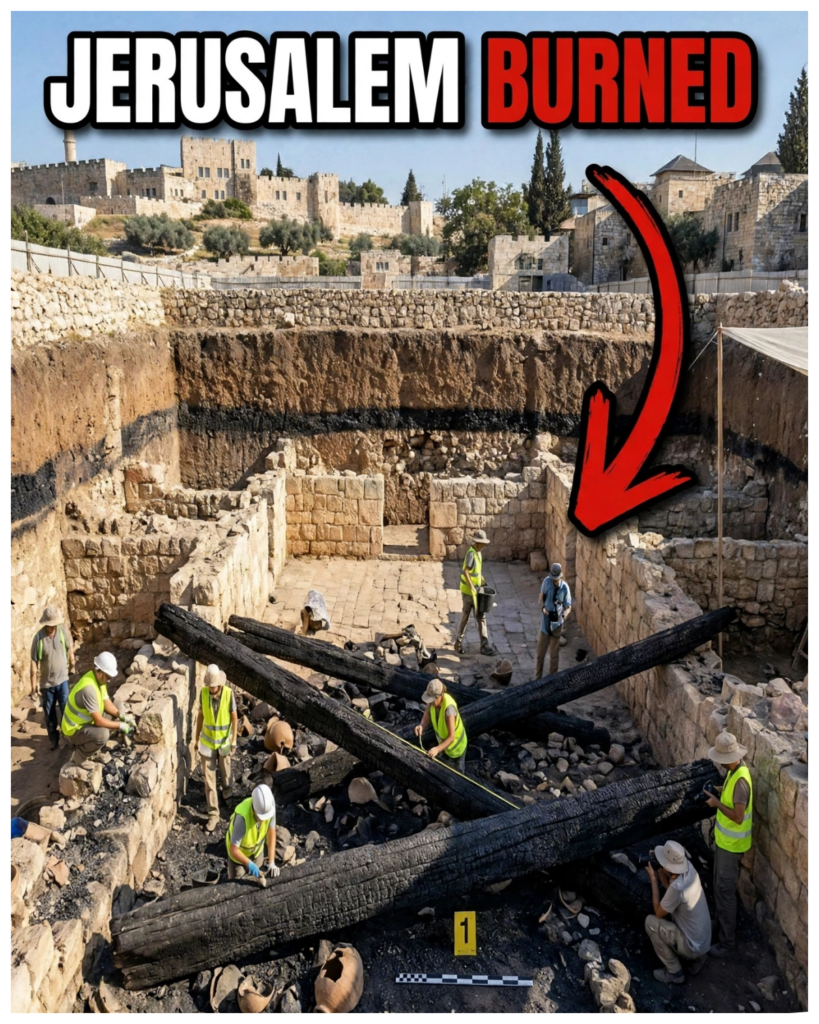
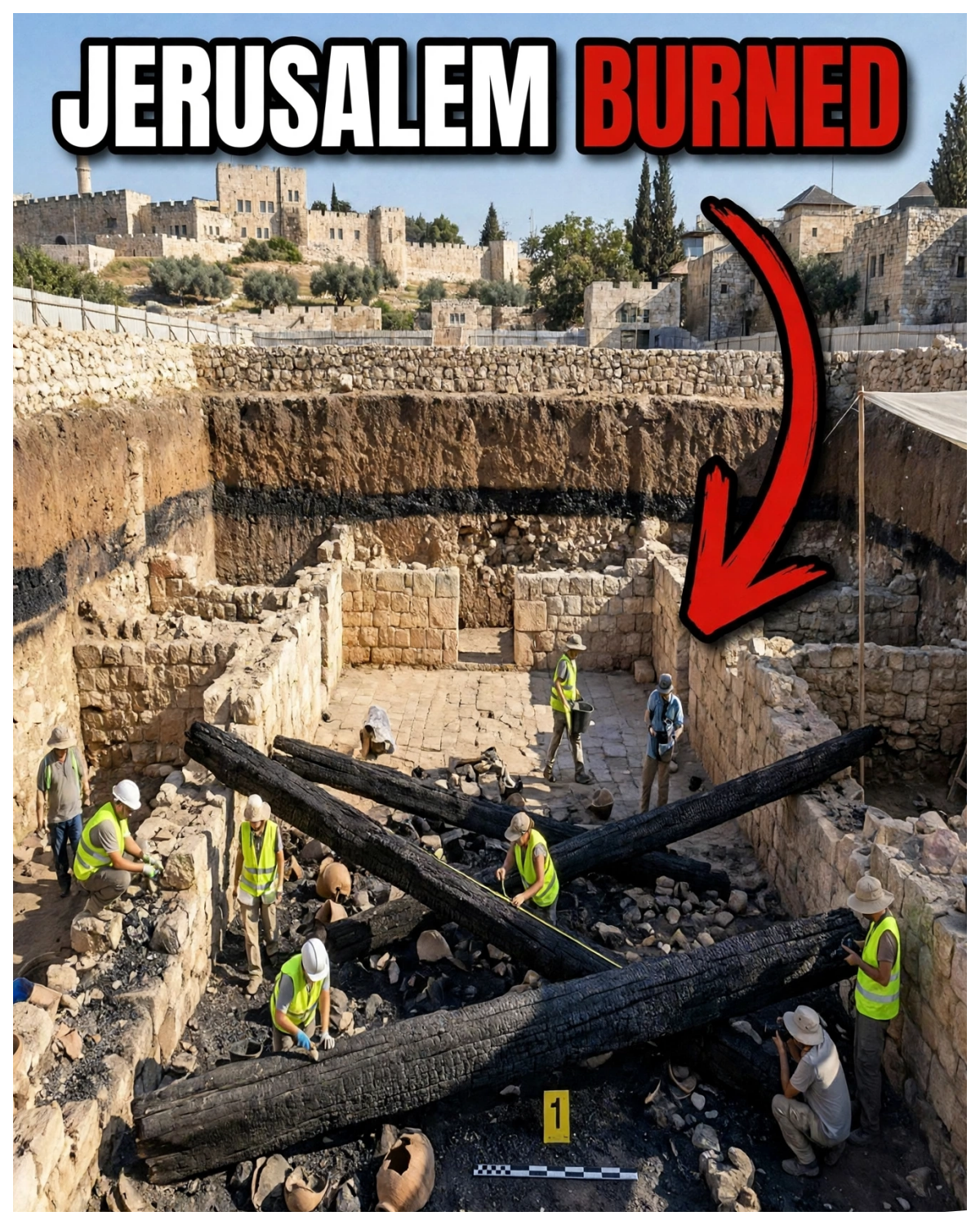
Then on the 20th, Tel Aviv University and the Israel Antiquities Authority revealed what lay under the Givati parking lot.
Enormous wooden beams blackened by fire.
The timbers had crashed down into what looks like the inner courtyard of a building from the first temple period.
It was the second set of beams found in that same building.
Johanna Rev is studying them, and what excites her is the rings.
She called it very rare in Israel to find wood with so many.
Combined with radioarbon, she says those rings could shrink a window of hundreds of years to about a decade.
Press reports add that she told Harets the building might go back as far as the 10th century BCE, possibly built with reused older materials.
Now, the fine print.
The university’s release gives no ring count, no beam dimensions, no species, and no peer-reviewed paper.
Even the wood is disputed.
One account says the first beams were sycamore, and the new ones came from an unnamed conifer.
Some outlets call these new beams sycamore.
The decade wide window is a promise for now, and it hasn’t been delivered.
If the beams turn out older than the fire, whose story are they telling, the builders or the burners?
So far, we’ve chased the when.
Now, the question turns to who was standing inside these walls when the clocks say the city burned.
In 1982, on a lower terrace of the city of David, Yigal Shilo’s team cleared a small house and found 51 lumps of clay.
Each one is a bulah, a blob of clay pressed over the string that tied a rolled papyrus document shut.
The papyrus is long gone, but the fire that swept the neighborhood baked the clay hard, and the seals survived.
Picture an envelope whose letter has turned to smoke, while the stamp on the flap still carries a name.
One of them reads, “Belonging to Gary Yahu, son of Chafan.”
Shilo linked it to a man in the book of Jeremiah.
There, Baroo reads Jeremiah’s scroll aloud from the chamber of son of Chaffan, the scribe.
Later, Gemiah and two other officials begged King Jehoakim not to burn that scroll.
The king burns it anyway.
Then the ground kept answering.
In 2005, Aot Mazar, digging near the summit of the ridge, found a Boulah of Yehukal, son of Shelomaya.
Roughly 3 years on, just a few yards away, her team revealed a second name, Gdalyahu, son of Pashur.
Open Jeremiah 38 and both men appear in the same verse among four officials who heard the prophet’s words.
Those officials asked the king to put Jeremiah to death and the prophet was lowered into a sistern.
Two names from a single verse turned up almost side by side in the dirt.
In 2019 came Nathan Melik, servant of the king, pulled from the burned layer of a large public building.
That name appears just once in the Bible as an official of King Josiah whose chamber stood near the temple.
Beside it lay an AGOT seal belonging to Ikar, son of Matanyahu.
One witness came from the enemy’s side.
In 2007, Michael [clears throat] Jersa recognized what a ununiform tablet in the British Museum actually said.
It had sat there unstudied for about 87 years.
It’s a receipt for gold belonging to Nabu Shahu Suukin, chief unic of Nebuchadnezzar II, sent to Marduk’s temple in Babylon in 595 B.CE.
Jersa linked him to Nebo Sarskim, the chief unic Jeremiah places among the Babylonian officers seated in the middle gate.
Irving called it a fantastic discovery, a worldclass find.
That makes four names from the ground and one from a museum drawer.
It’s hard not to feel a chill.
Now for the break.
Gemiah was active roughly 18 to 20 years before the fall.
His bulla shows only that a document sealed in his name was in that archive.
It doesn’t show that he died in the fire.
The scholar who deciphered the Nathan Melikbullah, Anat Mendel Gabberovich, cautioned that no one can be completely certain he’s the biblical man, even though the name, title, and period fit.
That pattern holds across all five.
The identifications are probable, not proven.
Skeptics push the point further.
Those seals tell us something striking.
The people who wrote these accounts were familiar with men who truly held office.
They don’t prove the Babylonians burned the city as and when the Bible says.
So, these were real people.
The fire still needs a witness of its own.
Before the fire finds its witness, look at the city that was still living its ordinary days.
At Givati, excavators wet sifted the burnt debris and recovered about 1,500 slivers of ivory.
Conservators Orna Cohen and Elan Naor fitted them back together into at least 12 square plaques, each about 5 cm across.
On them, insized rosettes frame a stylized tree, and some carry lotus or geometric designs.
They were probably furniture inlays, probably imported, possibly the work of Assyrian craftsmen.
Ivaries like these were known mainly from great royal and administrative centers such as Nimrod and Samaria.
They had never turned up in Jerusalem before.
Someone here was sitting on luxury.
They were drinking well, too.
In 2022, a study tested residues in 13 storage jars from the destruction layer, from Givati, and from a second site, reportedly Ramat Rael.
Some jars had held wine one season and olive oil the next.
Several wine jars carried chemical traces of vanilla, which the researchers read as wine flavored with vanilla.
And they were getting sick.
Sediment from two Iron Age latrines, one in the house of Aiel and one at Armon Hanativ, tested positive for Giardia, a parasite that causes dysentery.
The Armon Hanatie building was destroyed in 586 B.CE.
What about the people themselves?
The first DNA from the first temple period came from a family tomb at Abu Gosh, about 15 km west of Jerusalem.
It yielded only partial data from two individuals buried around 750 to 650 B.CEE judging by the pottery.
Their maternal lineages point to near eastern origins and one man has reportedly been assigned to the paternal lineage J2 but that is two people outside the city possibly generations before the fire.
Larger studies have left Judah for future work.
So far, no published full genomes from Iron Age Judah or its exiles appear to exist.
Then there is the ash.
In the burnt room lay arrow heads, both local types and threebladed bronze ones of the Iranocythian kind.
More arrowheads came from a burnt layer on Mount Zion in 2019.
Though some caution that ash alone doesn’t prove Babylonian destruction.
The mix of arrowhead types fits an assault on the quarter.
It doesn’t prove anyone fought inside that room.
The Bible’s account leaves little room for doubt.
The Lord’s house, the royal palace, every house in Jerusalem, all of it went up in flames set by the Babylonians.
All is a large word, though, and the ground can be asked to confirm it.
Start 30 m away at Lakish.
According to the Penn Museum and David Usishkin, the city’s level two was destroyed by fire around 588 to 586 B.CE.
In 1935, excavators there found a broken piece of pottery covered in ink.
A Judeian writer, probably an officer, reported to Lakish that he was watching for its fire signals as ordered because he cannot see a Zecha.
Some have read that line as a city that had already gone dark.
Most scholars reject that reading.
He may have had no line of sight or the fires may have been hidden for some other reason.
A single sentence can mean either thing.
In Jerusalem, the most important building is out of reach.
The temple mount cannot be excavated, so the burning of the temple cannot be tested.
The royal palace has never been securely identified.
Elsewhere, the fire did leave evidence.
Burnt layers and charred beams have been reported from the city of David and the Givati parking lot.
What that evidence means is still argued.
Some read the burning as concentrated in elite and public buildings.
Mitsan Shalom, writing in 2023, makes the case for a different picture, a destruction that was selective and only partial.
Others od lipshits among them describe it as thorough and citywide.
Neither conclusion is settled.
Both are interpretations.
Outside the walls, life went on.
Villages north of Jerusalem, including Mispa, carried on under Babylonian rule, and so did the administrative center at Ramad Rael.
Lipshits argues that Benjamin was barely touched and became the heart of the new province.
He estimates that Judah fell from about 110,000 people to about 40,000.
Israelfinkelstein is reported to suggest that about 3/4 of the population stayed.
Generations later, Persian period Jerusalem covered only about 2 hectares and had no walls.
Its population may have been just a few hundred people.
The ash came back into the light at a pointed moment.
The Israel Antiquities Authority announced the find on Monday, July 20th, 2026, a few days before Tishaba, the fast that mourns this very destruction.
The fast began at sundown that Wednesday.
So, the beam surfaced ahead of the day of morning, not on it.
Excavation director Ephrat Boher said, “This discovery makes you feel that you are witnessing the very moment of destruction.”
Heritage Minister Amikhai Eli Yahu went further.
He called the beams a silent yet powerful testimony to the presence of the Jewish people in Jerusalem.
But the ground they came from is not quiet.
The dig sits in the city of David area, often described as part of Silwan in East Jerusalem.
Though where Silwan begins depends on how the lines are drawn, the wider excavations are politically contested.
Silwan residents and the Israeli archaeology group MX Chaveet say these digs help reframe Silwan as an ancient Jewish site rather than a living Palestinian community.
For the minister, the fine spoke of Jewish presence in Jerusalem.
The same charcoal tells two stories.
Maybe that tension is older than we think.
Researchers believe the remains were deliberately left in place when Jerusalem was rebuilt.
Yifa Shalev put it simply.
Preserving memory is a human need, seeking to preserve what once existed.
[snorts] Someone long ago chose not to sweep the ruin away.
Thank you for following this cold case with us.
If it moved you, like the video and subscribe for the next story.
And so the question stays open.
Inside those blackened beams, the rings are still waiting.
Will they give us the first date for that night that was not borrowed from the Bible?